Alphabet’s AI Pivot: A Financial Powerhouse in the Making or a High-Stakes Gamble?
For months, the halls of Wall Street have echoed with a singular, pervasive anxiety: Is the "AI bubble" finally bursting? As major technology conglomerates poured hundreds of billions of dollars into capital-intensive infrastructure, data centers, and advanced silicon, investors grew increasingly restless, questioning whether these astronomical expenditures would ever translate into meaningful, bottom-line growth.
Alphabet, the parent company of Google, found itself at the epicenter of this scrutiny. With investors clamoring for proof that the company’s massive AI buildout wasn’t just a vanity project, the stakes for this quarter’s earnings report could not have been higher. However, as the final numbers hit the ticker this week, the narrative shifted dramatically. Far from a cautionary tale of over-investment, Alphabet’s latest financial disclosure paints a picture of a company successfully monetizing the next era of computing.
The Financial Takeaway: Cloud Computing as the Engine of Growth
The headline figure that silenced the skeptics was the explosive performance of Google Cloud. As enterprises continue to race toward digital transformation, they are increasingly turning to Google’s robust suite of AI-integrated tools.
Google Cloud reported a staggering 82% revenue surge compared to the same period last year, reaching a record $24.8 billion. To put this into perspective, this performance didn’t just meet expectations; it obliterated them. Market analysts had projected a consensus revenue of roughly $22.46 billion. By clearing that bar by over $2 billion, Alphabet proved that its pivot toward an "AI-first" cloud strategy is resonating with the enterprise market. This growth is particularly notable when contrasted with the previous quarter, where the company saw a 63% jump to $20 billion. The acceleration suggests that the company is not just maintaining momentum but is actively widening its moat in the cloud infrastructure space.
Beyond current revenue, the long-term health of the business is evidenced by its massive backlog of cloud contracting work. Alphabet now holds $514 billion in contracted future revenue—work that has been secured but not yet recognized on the balance sheet. This figure provides a massive buffer and a clear signal of long-term enterprise commitment to Google’s ecosystem.
A Chronology of Momentum: From Skepticism to Scale
To understand the magnitude of Alphabet’s current success, one must look at the trajectory of the last 18 months.
- Early 2025: Alphabet faced mounting criticism regarding its capital expenditure (CapEx) strategy. Investors expressed deep concern that the transition from traditional search-based ad revenue to AI-driven search and cloud services was cannibalizing margins without providing a clear return on investment (ROI).
- Q4 2025: The company reported that its flagship AI chatbot, Gemini, had reached 750 million monthly active users. While an impressive milestone, it was viewed by some as a "growth at all costs" metric rather than a revenue-generating asset.
- Early 2026: Alphabet announced an $80 billion plan to further accelerate its AI buildout, sparking a fresh round of public concern regarding a potential "tech sell-off" and fears that the AI hype cycle was nearing its peak.
- Mid-2026 (Current Quarter): The results are in. Gemini usage has surged to 950 million monthly active users, a 26% increase in just six months. Simultaneously, the financial data confirms that the "spend" is now manifesting as "earnings," with overall company profits soaring to $112.1 billion—a massive leap from the $28.1 billion reported in the same period last year.
Supporting Data: By the Numbers
Alphabet’s financial health is defined by more than just cloud performance. The sheer scale of its profitability indicates that the core advertising engine remains robust while the new business units scale rapidly.
| Metric | Current Quarter Result | Year-Over-Year Change |
|---|---|---|
| Total Revenue | $119.8 Billion | +24% |
| Google Cloud Revenue | $24.8 Billion | +82% |
| Google Services Revenue | $94.5 Billion | +15% |
| Net Profit | $112.1 Billion | +299% (approx.) |
| Gemini Active Users | 950 Million | +26% (vs Q4 2025) |
The 24% year-over-year growth in total revenue marks the 12th consecutive quarter of double-digit expansion. In the history of modern technology, such a sustained growth streak is rare, and to achieve it while simultaneously undergoing a fundamental business model transition is unprecedented.
The CEO’s Stance: Defending the AI Buildout
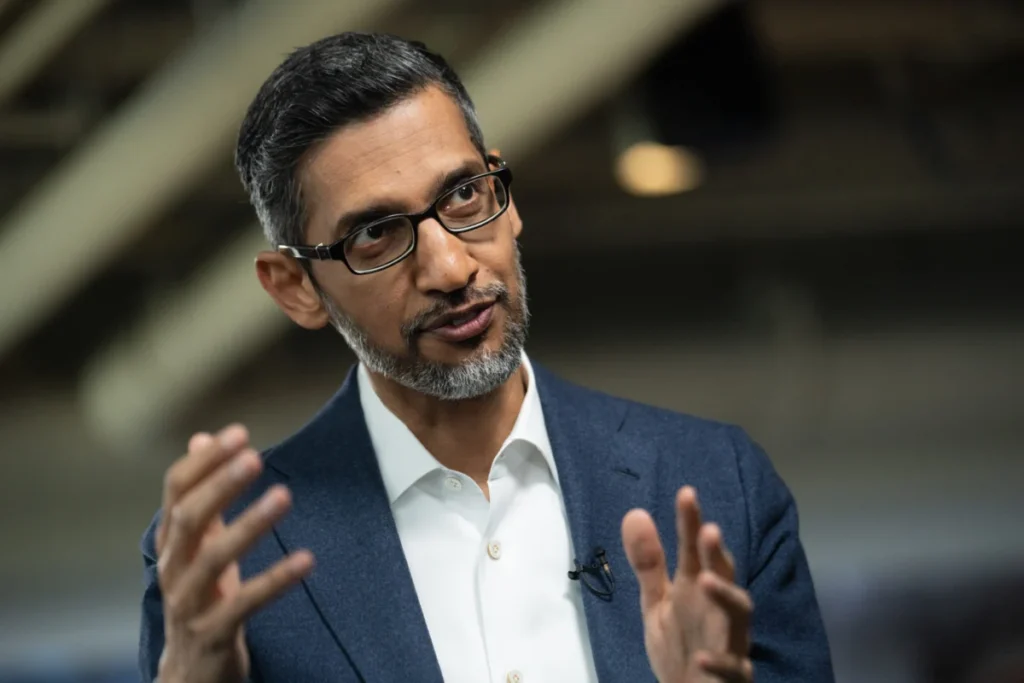
During Wednesday’s earnings call, CEO Sundar Pichai navigated the questioning from analysts with a blend of confidence and calculated optimism. Faced with questions regarding the company’s projected annual CapEx—which is expected to land between $180 billion and $190 billion—Pichai leaned into the "infrastructure as a foundation" argument.
"Our AI investments are redefining what’s possible across every part of our business," Pichai noted. When pressed on the sustainability of such high spending, he argued that the market dynamics are, in fact, healthier than they were a year ago. "I think our compute capacity investments in ’27," Pichai stated, "are being met with strong demand indicators, including long-term deals."
Pichai’s message to investors was clear: the capital being deployed today is not an expense, but a pre-payment for future market share. By building out the data centers and acquiring the chips now, Alphabet is positioning itself as the primary landlord of the AI economy.
Implications: The New Standard for Tech Giants
The implications of this earnings report ripple far beyond Mountain View. For the rest of the "Big Tech" cohort, Alphabet has set a new benchmark. The message is clear: if you are going to spend billions on AI, you must show that your cloud architecture can facilitate that scale for others.
1. The Validation of Enterprise AI
For years, AI was relegated to the realm of research labs and experimental chatbots. Alphabet’s results confirm that the "Enterprise AI" thesis is correct. Corporations are not just playing with AI; they are re-platforming their entire IT operations onto AI-integrated clouds.
2. The Infrastructure Arms Race
The $180–$190 billion expenditure projection is a sobering reality for competitors. It suggests that Alphabet is attempting to create a barrier to entry that is financially impossible for smaller firms to scale. By locking in long-term supply chains for chips and energy, Google is signaling that it intends to be the primary provider of AI-as-a-service for the next decade.
3. The Shift in Investor Sentiment
While the market remains volatile, the immediate reaction to Alphabet’s report suggests a cooling of the "AI Bubble" panic. Investors have historically shown that they will tolerate high CapEx if there is a clear path to revenue. By showing that the Cloud unit is becoming a massive profit center, Alphabet has successfully transitioned from "speculative investment" to "core business driver."
Looking Ahead: The Challenges Remaining
Despite the optimism, the road ahead is not without obstacles. The regulatory environment regarding AI remains uncertain, with antitrust authorities in both the U.S. and Europe watching Alphabet’s market dominance closely. Furthermore, as the company scales its compute capacity, it faces the real-world constraints of power grid limitations and the environmental costs of massive data center clusters.
Moreover, while Gemini has reached 950 million users, the challenge remains to convert those free users into high-margin subscribers. The "freemium" model that helped Google dominate search will face different pressures as the costs of running Large Language Models (LLMs) per query remain significantly higher than traditional keyword search.
Conclusion
Alphabet’s latest report is more than just a win for shareholders; it is a turning point for the artificial intelligence industry. By successfully pivoting its cloud division into an engine of high-growth, high-margin revenue, Google has provided the blueprint for how legacy tech giants can survive and thrive in the age of generative AI.
The company is no longer just a search engine; it is the backbone of the enterprise AI revolution. While the capital expenditures are massive, and the risks of a shifting regulatory landscape are real, the data suggests that Alphabet’s gamble is paying off. For the investors who were worried that the AI bubble was about to burst, this quarter offered a compelling, multi-billion-dollar reassurance: the AI revolution is not just a trend—it is a business.