A Region Reeling: Texas Hill Country Faces Devastating "Once-in-a-Century" Flood, One Year Later
By [Your Name/Journalistic Staff]
The Texas Hill Country, a region still nursing the profound scars of the catastrophic July 2025 floods that claimed 119 lives in Kerr County, found itself plunged back into the nightmare of survival on Thursday. As torrential rains transformed serene riverbeds into roaring, debris-choked torrents, residents who had spent the last year rebuilding their homes and their sense of security watched in horror as the water climbed once more.
For the people of Kerrville, Center Point, and Fredericksburg, this was not merely a weather event; it was a traumatic repetition of a history they were told would not repeat. As the Guadalupe and Pedernales rivers breached their banks, the region was forced to confront a brutal reality: the "once-in-a-century" flood of 2025 was not an anomaly, but perhaps a harbinger of a volatile new normal.
The Morning of the Deluge: A Chronology of Chaos
The rain began in the dark hours of early Thursday morning, a rhythmic, relentless pounding that carried a haunting familiarity for those who lived through the horror of July 2025.
For Sherri Steadham, a resident of Center Point, the night was shattered at 5:15 a.m. by a desperate call from a long-time neighbor. The neighbor’s home, situated closer to the river, was already succumbing to the rising tide. By the time Steadham looked out, the water had already claimed four inches of her neighbor’s floorboards. It was a scene etched in the collective memory of the region—the rapid encroachment of the Guadalupe, the sickening sound of rushing water, and the sudden, frantic mobilization of a community that had been caught off-guard only a year prior.
While the 2025 floods arrived as a terrifying, sudden "wall of water" in the dead of night, Thursday’s event offered a slightly slower, though no less destructive, crawl. The river gauges told a harrowing story: in Comfort, the Guadalupe River surged to 37 feet. In Fredericksburg, the Pedernales reached 34 feet. These levels rivaled the record-breaking 37.5-foot spike recorded in Hunt on July 4, 2025.
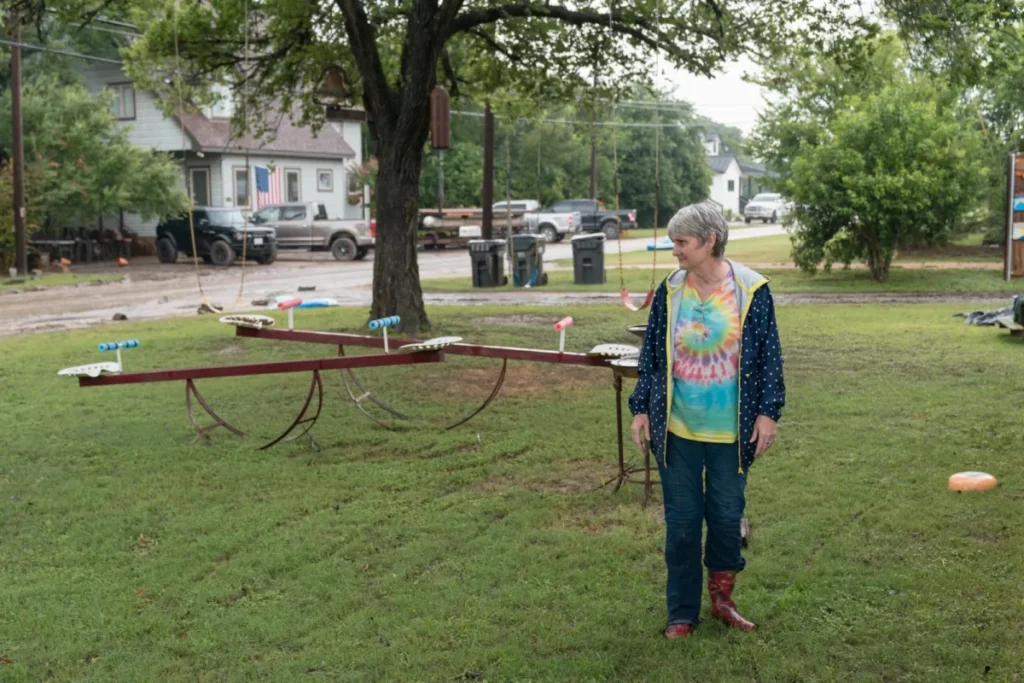
By mid-morning, the landscape had been irrevocably altered. Fences were reduced to skeletal frames draped in river debris, vehicles were tossed like toys across fields, and the tell-tale mud-lines on the sides of homes marked the height of the destruction. At the Center Point Fire Department, crews who had worked tirelessly to renovate the facility following last year’s disaster watched as a new deluge rendered those efforts largely futile, the building once again compromised by the relentless current.
Echoes of Trauma: The Human Cost
Standing outside the Calvary Temple Church in Kerrville, Soyla Reyna, a volunteer who has spent the last year assisting the displaced, struggled to articulate the collective exhaustion of the community.
"A lot of it was unbelievable," Reyna said, her voice strained as the rain began to taper off. "People are devastated by the reoccurrence."
By Thursday morning, nearly 50 people had sought sanctuary at the Calvary Temple. They arrived with the remnants of their lives packed into plastic bags, clutching children and pets, seeking hot meals and a dry place to sleep. Many of these individuals had lost homes and RVs in the 2025 tragedy and had only recently settled back into a semblance of normalcy.
The psychological toll of the back-to-back disasters is difficult to quantify. For many, the trauma is tied to the timing. "Both times, it’s been in the middle of the night," Reyna noted, her gaze drifting to the ground. "I think that is what devastates people. It’s like, ‘I couldn’t see, I couldn’t… you know.’"
The fear was echoed by others across the region. Razor Dobbs, a volunteer firefighter at the Center Point Fire Department, has seen the look of resignation on the faces of his neighbors twice in two years. "When that rain’s hitting really hard, and you hear it pounding, you can see the look on their faces," Dobbs said. "You can see the look on their faces, this is it."
Scientific Context and Historical Anomalies
The hydrologic data paints a bleak picture of the region’s geography. Longtime residents, some of whom have lived along the Guadalupe for over three decades, expressed shock at the unprecedented nature of these events. Russell Studebaker, a peach farmer in Burmenthal, noted that he had witnessed things he never thought possible in 32 years of land stewardship.
"It’s backing up into our place across the road. It’s backing up into our creek. I’ve never seen it back up into there," Studebaker said, describing the sight of massive tree trunks being carried downstream by the Pedernales River, smashing through low-water crossings that had stood for generations.
The frequency of these floods has shattered the prevailing myth that the 2025 event was an outlier. Residents like Sherri Steadham had spent the year finding comfort in the hope that such a cataclysmic event would be a "once-in-a-lifetime" occurrence. "When it did it last year, we were like, ‘Oh my God, it’s never happened before, ever, so maybe it won’t happen again in our lifetime,’" Steadham said. "And here we are, a year and a few days later."
The meteorological conditions leading to Thursday’s flood were different in intensity and speed, but the result was a stark reminder of the region’s vulnerability to rapid precipitation over saturated soil. With climate patterns shifting and the capacity of the land to absorb water seemingly diminished, the Hill Country is finding that historical flood records are no longer reliable predictors of future risk.
Official Responses: A Year of Hard-Won Lessons
If there is a silver lining to be found in the wreckage of Thursday, it lies in the region’s improved emergency infrastructure. The 2025 flood was marred by significant failures in the government’s disaster alert systems—failures that contributed to the staggering death toll of 119.
This time, the response was markedly different. Maria Flemming, a resident of Center Point, credited the local government with a proactive, constant stream of warnings that began as early as 1:30 a.m. Thursday. First responders were active in the community long before the water crested, checking on vulnerable residents and urging evacuations.
The Center Point Fire Department, in particular, has undergone a metamorphosis. Following the total devastation of the previous year, the department received critical funding that allowed them to upgrade their equipment and, more importantly, their personnel training.
"Last night, and the night before, we manned everything," said volunteer firefighter Razor Dobbs. "After last year, we got a lot of funding. We invested in the boats and the training, and we got rock solid."
Despite these improvements, the human cost remained heavy. As of Thursday evening, officials confirmed at least two fatalities, a tragic reminder that even the most robust emergency response cannot always overcome the sheer ferocity of nature.
The Path Forward: Implications for the Hill Country
As the waters begin to recede, the Hill Country faces a daunting road ahead. The implications of these back-to-back floods are far-reaching, affecting everything from local property values and insurance premiums to the mental health of an entire generation of residents.
- Urban Planning and Infrastructure: Municipalities across the region will likely face intense pressure to rethink zoning laws near river corridors. The destruction of public assets, such as the Center Point Fire Department, underscores the need for "flood-resilient" construction that can withstand repetitive inundation.
- Economic Resilience: For small business owners and farmers like Studebaker, the recurring floods pose an existential threat. The loss of crops, equipment, and customer access during the height of the season could lead to a significant exodus of residents who can no longer afford the risk.
- Psychological Support: The trauma of 119 deaths in 2025 followed by another major flood in 2026 suggests that the region requires a long-term, sustained investment in mental health resources. The "look on their faces" that Dobbs described is a symptom of a deep-seated anxiety that will likely persist for years.
- Environmental Stewardship: The massive debris, including uprooted trees and residential wreckage, moving downstream indicates a need for better river management and vegetation control, though environmentalists warn that such interventions must be balanced against the need to preserve the natural riparian habitats that define the Hill Country.
As the sun sets on Thursday, the residents of the Hill Country are left to sift through the mud and debris once more. The resilience of this community is undeniable—neighbors helping neighbors, shelters opening their doors, and responders working double shifts. However, as the region moves forward, the primary question remains: can the Hill Country adapt to a reality where the "unbelievable" has become an annual event? For now, the focus is survival; but tomorrow, the focus must shift to a fundamental reimagining of what it means to live in the heart of Texas’s floodplains.