Navigating Market Complexity: The Resurgent Case for Diversification in Mid-2026
As we move through the third quarter of 2026, the global capital markets are operating within a framework defined by shifting macroeconomic paradigms. For investors who have grown accustomed to the relatively predictable performance of large-cap equity growth, the current environment serves as a sobering reminder of the necessity of traditional risk management.
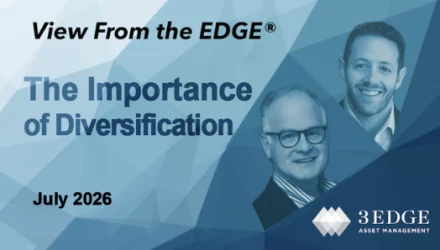
In their latest installment of View From the EDGE®, Fritz Folts, Chief Investment Strategist at 3EDGE Asset Management, and Deputy CIO Eric Biegeleisen argue that the era of "set it and forget it" index investing may be nearing a critical inflection point. As volatility rises and the correlations between asset classes begin to drift, the duo emphasizes that true diversification is no longer just a defensive posture—it is the primary engine for sustainable, long-term wealth preservation.
The Core Thesis: Why Diversification Reclaims Center Stage
For much of the early 2020s, market participants were treated to a period where concentrated portfolios in mega-cap technology stocks significantly outperformed broader, diversified baskets. However, as of July 2026, the economic landscape has transformed. Inflationary pressures, while stabilized, remain sticky in several key sectors, and central bank policies are navigating a delicate balance between cooling labor markets and stimulating stagnant productivity.
Folts and Biegeleisen posit that the "diversification dividend" is currently being underestimated. In a market where multiple global risks—ranging from geopolitical friction to domestic fiscal policy uncertainty—are compounding, the ability to mitigate drawdowns through non-correlated assets has become the defining characteristic of successful institutional-grade portfolios.
Defining Modern Diversification
Modern portfolio theory (MPT) is often criticized for its reliance on historical correlations. However, 3EDGE’s approach, as outlined in their July outlook, suggests a more dynamic interpretation. True diversification, according to the strategists, involves more than simply holding a mix of stocks and bonds. It requires:
- Broad Asset Class Exposure: Moving beyond domestic equities to include commodities, real assets, and global fixed income.
- Dynamic Rebalancing: Adjusting exposures in real-time based on proprietary indicators rather than fixed time intervals.
- Risk-Factor Analysis: Understanding that two different asset classes might react similarly to the same underlying economic shock (e.g., interest rate sensitivity).
Chronology of the 2026 Market Shift
To understand why 3EDGE is emphasizing this pivot now, one must look at the recent sequence of economic events that have shaped the current market psychology.
- Q1 2026: The Correction Warning. Markets entered the year with high expectations for interest rate cuts. When economic data remained hotter than anticipated, those expectations were rapidly repriced, leading to significant volatility in the bond market.
- April–May 2026: The Correlation Spike. During a period of sharp equity volatility, investors witnessed a rare, simultaneous decline in both equity and fixed-income portfolios. This "bond-stock correlation spike" invalidated the traditional 60/40 model for a period, forcing a re-evaluation of alternative asset allocations.
- June 2026: Fiscal Realities Surface. As governments worldwide continued to struggle with high debt-to-GDP ratios, market participants began demanding higher risk premiums on sovereign debt, leading to a rotation into hard assets.
- July 2026: The Strategic Pivot. The current month marks a consensus among many top-tier strategists that the market is entering a "stock picker’s environment" where the "tide lifts all boats" philosophy is no longer viable.
Supporting Data: The Quantitative Case for Dispersion
The data presented in the July 2026 View From the EDGE® presentation highlights a growing dispersion in performance across sectors and geographies.
Sector Dispersion
Historically, when market leadership is narrow—driven by only a handful of mega-cap stocks—the risk of a "mean reversion" event increases significantly. In 2026, the performance gap between the top 10 S&P 500 performers and the median stock has reached its highest level since the 2021 tech bubble. This dispersion is a clear signal that the market is becoming increasingly selective.
Fixed Income and Real Rates
With real interest rates (nominal rates minus inflation) currently sitting in positive territory, fixed income has finally reclaimed its role as a viable income generator. Folts and Biegeleisen point out that while stocks provide the growth engine, the current yield environment allows bonds to serve as a genuine ballast for the first time in nearly a decade.
Correlation Matrices
The 3EDGE team utilizes a multi-factor risk model. Their internal data shows that while assets tend to correlate toward 1.0 during periods of extreme "liquidity-driven" market panic, the fundamental underlying values of global assets have rarely been more distinct. This divergence provides a unique opportunity for active managers to capture alpha by identifying assets that are fundamentally mispriced by the broader market sentiment.
Official Responses and Strategic Outlook
In their commentary, Folts and Biegeleisen strike a tone of "cautious optimism." They are not advocating for a retreat from the market, but rather a move toward a more disciplined, evidence-based allocation strategy.

"Diversification is not about avoiding loss; it is about ensuring that your portfolio has the structural integrity to withstand shocks from unexpected directions," noted Fritz Folts. "When we look at the current market, we see a concentration of risk that is unsustainable. Our goal is to shift the focus back to the risk-adjusted return profile, which is where true capital compounding occurs over the long term."
Eric Biegeleisen added that the reliance on passive index funds has created "crowded trades" that are susceptible to liquidity crunches. By introducing strategies that incorporate non-traditional assets—such as managed futures or gold—investors can effectively dampen the volatility that has defined the summer of 2026.
Implications for the Individual and Institutional Investor
The implications of this shift are profound for both retail investors and institutional allocators.
The Death of the Simple 60/40
The traditional 60/40 portfolio is effectively being retired in favor of more complex, multi-asset frameworks. For the average investor, this means that holding a single S&P 500 ETF is no longer sufficient to ensure long-term retirement security. Advisors are increasingly being pushed to incorporate "Alternative" categories that provide lower beta to the broad equity markets.
The Return of Active Management
The current market environment is tailormade for active managers who can distinguish between high-quality, cash-flow-positive companies and those that are merely benefiting from market liquidity. The "beta" play—the passive, market-cap-weighted approach—is expected to underperform in an environment where stock dispersion remains high.
Policy Sensitivity
Investors must now pay closer attention to the intersection of fiscal and monetary policy. As governments increase spending to address climate transition and defense needs, the inflationary impact will likely necessitate a structural change in how investors view "safe" assets. Treasury bonds, once the ultimate safe haven, must now be evaluated against the backdrop of long-term fiscal sustainability.
Conclusion: A Roadmap for the Second Half of 2026
As we look toward the remainder of 2026, the message from the 3EDGE strategists is clear: the environment has changed, and the tools used to navigate the previous decade will not be sufficient for the one ahead.
Diversification is the primary defense against the unpredictability of the current global economy. By moving away from concentrated, high-beta portfolios and embracing a truly global, multi-asset approach, investors can better position themselves to capture growth while mitigating the systemic risks that have become increasingly prevalent.
For those interested in the full scope of the 3EDGE analysis, the July 2026 View From the EDGE® report serves as a critical resource. Whether through their podcast, YouTube channel, or detailed written summaries, the firm continues to provide a clear-eyed look at a market that is, more than ever, demanding the attention of disciplined, rational participants.
Disclaimer: This article is for informational purposes only and does not constitute financial advice. Investors should consult with a qualified financial advisor before making any investment decisions. The views expressed by 3EDGE Asset Management are their own and do not necessarily reflect the official policy or position of the publisher.