The Great Disconnect: Why the Stock Market is Shrugging Off Surging Bond Yields
October 1, 2026
By Financial Markets Desk
Main Facts
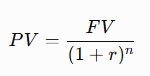
In modern finance, few formulas are treated as sacred text. Among them is the foundational present value equation taught to every undergraduate business student: an asset’s worth is equal to its future cash flows divided by a discount rate raised to the power of the number of periods. Standard economic theory dictates that when interest rates rise, borrowing costs increase, discount rates climb, and equity valuations should tumble.
Yet, financial markets are once again proving that theory and real-world execution often diverge wildly.
As of autumn 2026, the global financial landscape is characterized by a seemingly contradictory phenomenon: 10-year U.S. Treasury yields have surged by an aggressive 30%, a move that historically triggers immediate panic, widens credit spreads, and sends the Cboe Volatility Index (VIX) soaring. Instead, the VIX is declining, and major stock market indices are posting strong double-digit gains for the year.
This unexpected resilience has left everyday investors and institutional strategists alike questioning the traditional mechanics of market behavior. While textbook finance warns that spiking bond yields spell doom for equities, current macroeconomic drivers—specifically robust corporate earnings, an unyielding artificial intelligence (AI) capital expenditure boom, and strengthening labor market dynamics—have insulated the stock market from gravity. However, analysts warn that this decoupling cannot continue indefinitely. As fixed-income yields offer increasingly attractive risk-free returns ranging between 5% and 7%, the rising cost of money threatens to eventually spark asset allocation shifts and reignite equity market volatility.
Chronology: The Evolution of the Rate-Versus-Equity Debate
To understand the current anomaly in the markets, it is helpful to trace how the relationship between interest rates, inflation, and equities has evolved over recent economic cycles:
- Early 2021 (The Pandemic Stimulus Era): Following unprecedented fiscal and monetary stimulus deployed to combat the COVID-19 pandemic, markets grew anxious about mounting government debt and its implications for interest rates. Market commentators pointed out that while rising rates caused short-term friction, historical precedent suggested that moderate rate increases driven by economic recovery rarely derailed bull markets. The primary emerging threat was identified not as nominal interest rates, but as runaway inflation.
- The 2022 Inflationary Shock: Theory violently reasserted itself in 2022. Driven by pandemic-era supply chain bottlenecks and geopolitical shocks, inflation surged to generational highs. To combat this, the Federal Reserve embarked on an aggressive rate-hiking campaign. The combination of soaring interest rates and destructive inflation caused the S&P 500 to tumble by roughly 25% over the course of the year.
- 2024–2025 (The AI-Driven Recovery): As inflation cooled from its post-pandemic peaks and stabilized, the corporate sector found a new engine of growth. The generative artificial intelligence boom catalyzed massive capital expenditures across the technology sector. Despite lingering fluctuations in monetary policy, corporate earnings growth proved exceptionally durable, allowing equities to recover ground and forge new highs.
- Late 2026 (The Current Divergence): The 10-year Treasury yield experiences a dramatic 30% surge. Compounding matters, geopolitical tensions—most notably a localized conflict involving Iran—cause energy prices to spike, rekindling lingering inflation anxieties. Despite these traditional warning signs, the VIX remains subdued, and the broader stock market marches upward on the back of relentless corporate profit growth.
Supporting Data and Historical Context
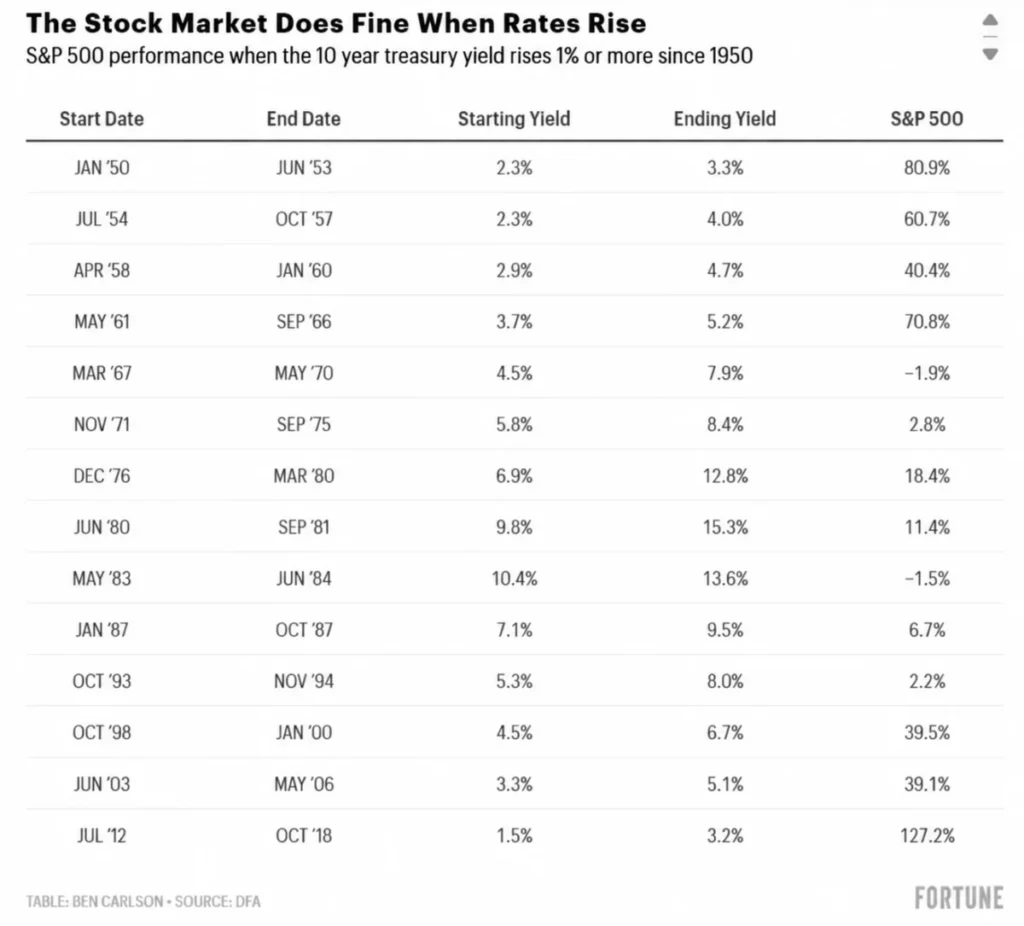
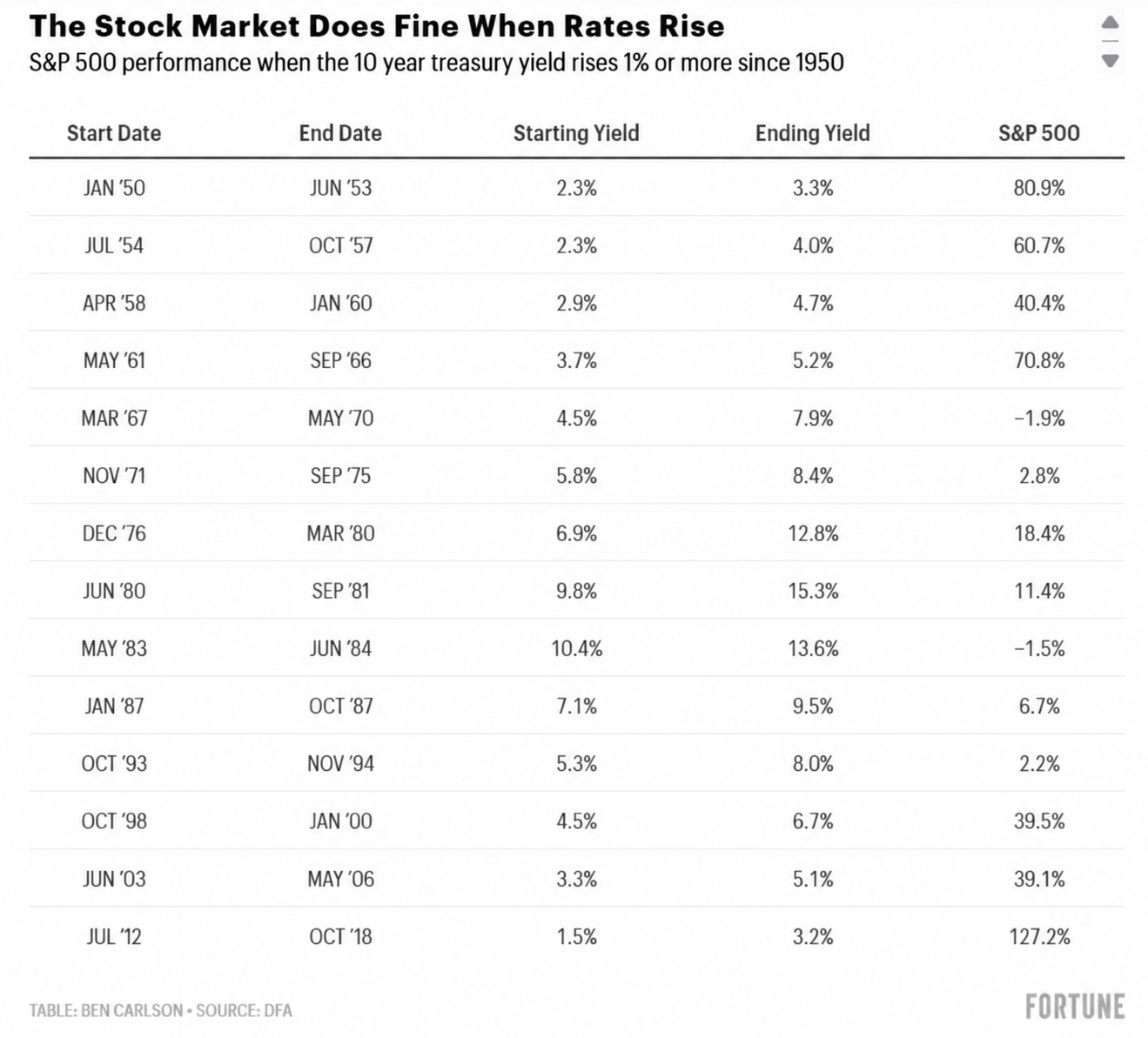
Market historians frequently point out that the knee-jerk reaction to fear rising interest rates is often overblown. Financial data demonstrates that equities have historically absorbed climbing bond yields far better than mainstream consensus assumes.
An analysis of historical market cycles reveals that out of 14 distinct periods where the 10-year U.S. Treasury yield rose by 1% or more over a sustained timeframe, the stock market posted positive total returns in 12 of those instances. While certain rate-hiking cycles experienced intermittent volatility—most notably culminating in structural market stress points like 1987 and 2000—the majority of historical rate expansions coincided with periods of expanding economic activity. When the economy is growing, corporate revenues expand alongside borrowing costs, softening the blow of higher discount rates.
However, the defining variable remains inflation. Market performance breaks down when inflation crosses the threshold from "mild economic stimulus" to "destructive purchasing power erosion." Historical return breakdowns highlight this clear dichotomy:
- Low to Moderate Inflation: Accompanies rising economic output, supporting steady equity multiples and healthy consumer spending.
- High, Unanchored Inflation: Destroys consumer purchasing power, compresses profit margins, forces aggressive central bank tightening, and reliably triggers severe bear markets—as vividly demonstrated during the 2022 drawdown.
In the current 2026 environment, inflation readings have drifted upward from post-war lows near 2.4% toward roughly 3.4%, driven primarily by energy shocks. While this is elevated enough to keep the Federal Reserve on high alert, it remains well below the hyper-inflationary environment of 2022, allowing corporate equities to retain their footing.
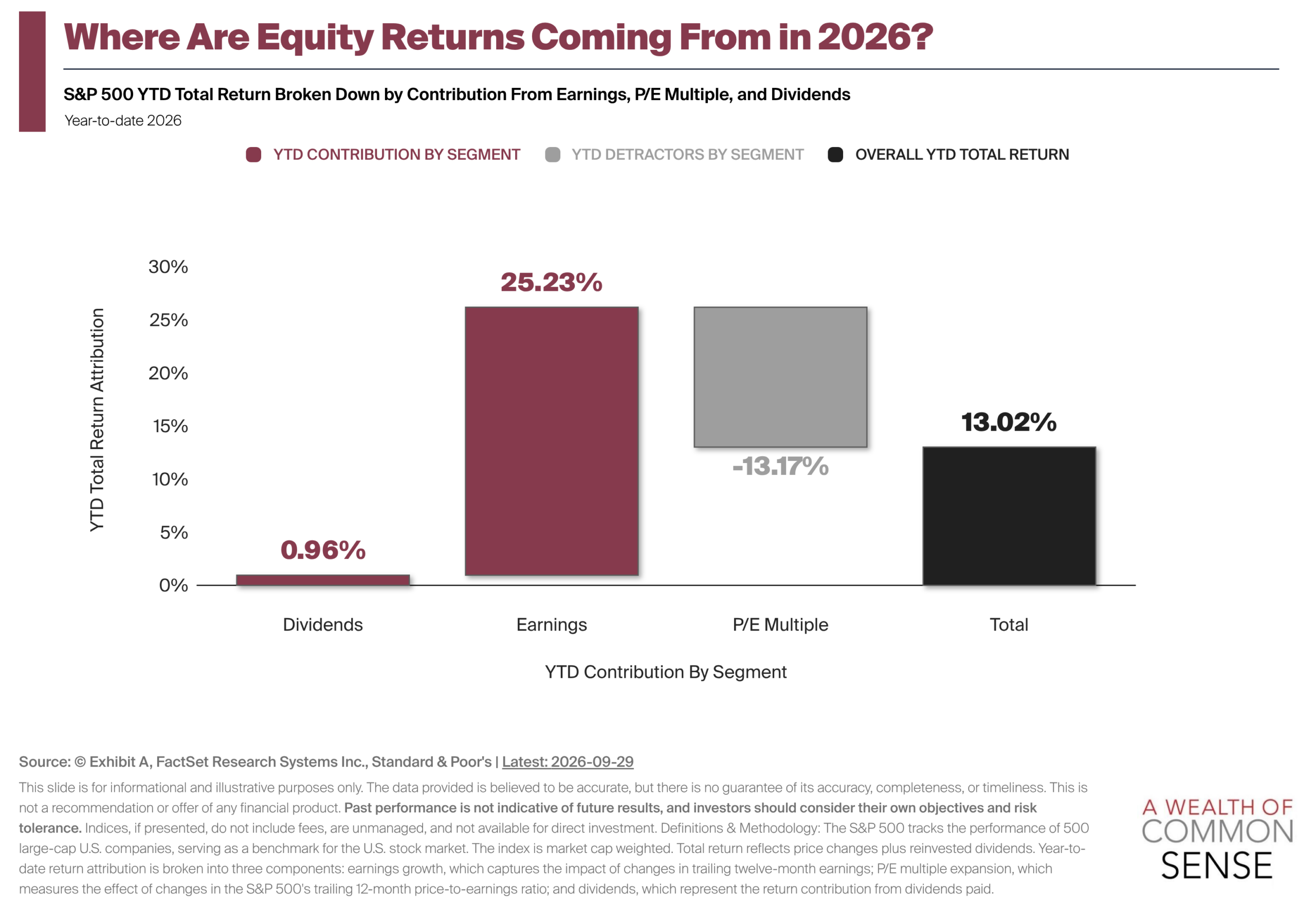
Furthermore, a detailed attribution analysis of the S&P 500’s year-to-date performance reveals a fascinating underlying trend: while aggregate price indices are not falling, valuation multiples have actually compressed. The market’s gains are being driven almost entirely by genuine, fundamental earnings growth rather than speculative multiple expansion. Rising interest rates have successfully kept valuations in check, yet stellar corporate profits have pushed absolute stock prices higher.
Official Responses and Expert Analysis
Financial analysts, market commentators, and wealth management experts have increasingly focused on this dynamic, attempting to decode what the persistent low volatility means for portfolio construction moving forward.
During discussions on prominent financial strategy platforms, such as Ask the Compound, industry experts have addressed investor anxieties regarding the disconnect between falling volatility and rising yields. Market commentators emphasize that investors must look past headline interest rate figures and evaluate the underlying macroeconomic context.
"You can’t simply look at interest rates in a vacuum. Context is required, as always," notes market strategist Ben Carlson. "Assuming profits continue rising, it’s hard to see a good reason for the stock market to sell off. However, at a certain level of rates, there is more competition from bonds in terms of asset allocation decisions."
Experts point out that the psychological threshold of risk-free yields is changing. With various fixed-income strategies currently offering guaranteed yields between 5% and 7%, institutional and retail investors now have a viable, low-risk alternative to equities. Wealth advisors note that if yields continue their upward trajectory, a tipping point will eventually be reached where conservative capital is systematically pulled out of the stock market and reallocated into bonds, triggering a long-delayed equity correction.
Implications for Investors and Markets Looking Forward
As markets navigate the final quarters of 2026, the central question remains: At what specific interest rate level does the current equity bull market break?
While quantitative models and financial theorists insist that higher rates must eventually crush stock prices, the real world continues to be governed by earnings, innovation, and liquidity. As long as corporate America continues to post robust profit margins—bolstered by ongoing productivity gains from the AI revolution and a resilient labor market—the stock market has proven its ability to digest rising yields.
Nevertheless, prudence is warranted. The ongoing divergence between a spiking 10-year Treasury yield and a complacent, declining VIX cannot be sustained indefinitely. Investors must monitor two critical tripwires in the months ahead:
- The Energy and Inflation Trajectory: Should geopolitical conflicts in the Middle East cause a prolonged spike in energy prices, pushing core inflation significantly higher, the Federal Reserve’s maneuvering room will evaporate, threatening a repeat of 2022’s margin compression.
- The Fixed-Income Competition Threshold: As risk-free yields hover near 7%, the opportunity cost of holding non-dividend-paying or richly valued growth stocks climbs. If yields breach critical psychological resistance levels, the gravitational pull of guaranteed bond returns will likely draw capital away from equities, introducing overdue volatility back into the broader market.
For now, the equity market remains undeterred, writing its own rules in defiance of finance textbooks. But as history repeatedly demonstrates, ignoring the math entirely is a luxury markets can rarely afford forever.