Momentum’s Resurgence: A Deep Dive into the Shifting Sands of Factor Performance in 2026
By Our Financial Markets Desk
Posted July 12, 2026
The investment landscape of 2026 has witnessed a dramatic shift, with "momentum stocks" emerging as the undeniable champions of the year so far. As of the end of June, this potent factor, characterized by investing in assets that have recently outperformed, has delivered stunning returns, prompting both excitement among its adherents and renewed debate among market strategists. While the allure of riding a winning wave is powerful, a closer examination reveals a financial ecosystem where yesterday’s laggards can quickly become today’s leaders, underscoring the perennial challenge of predicting market dynamics.
The Main Facts: Momentum’s Unprecedented Ascent
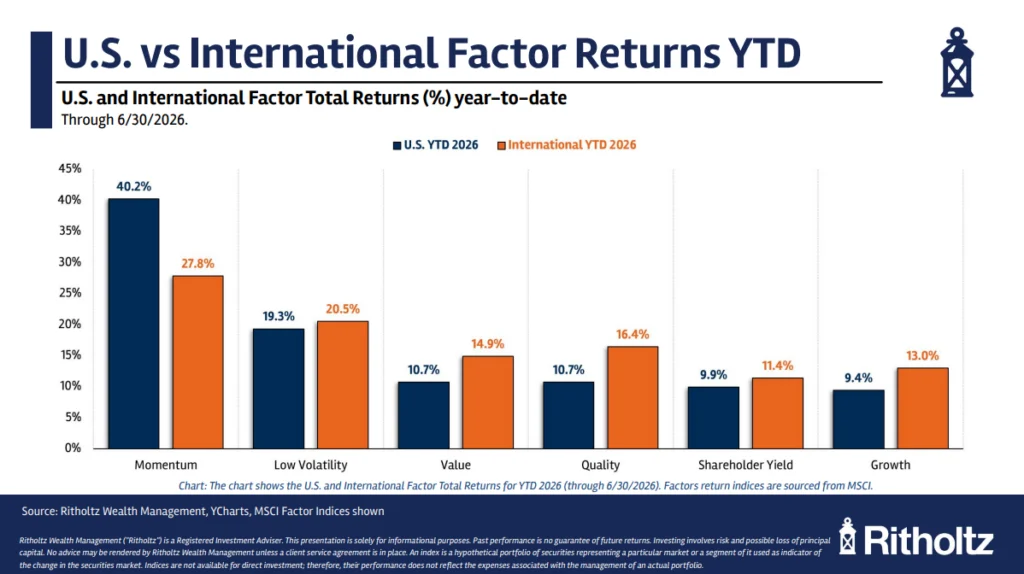
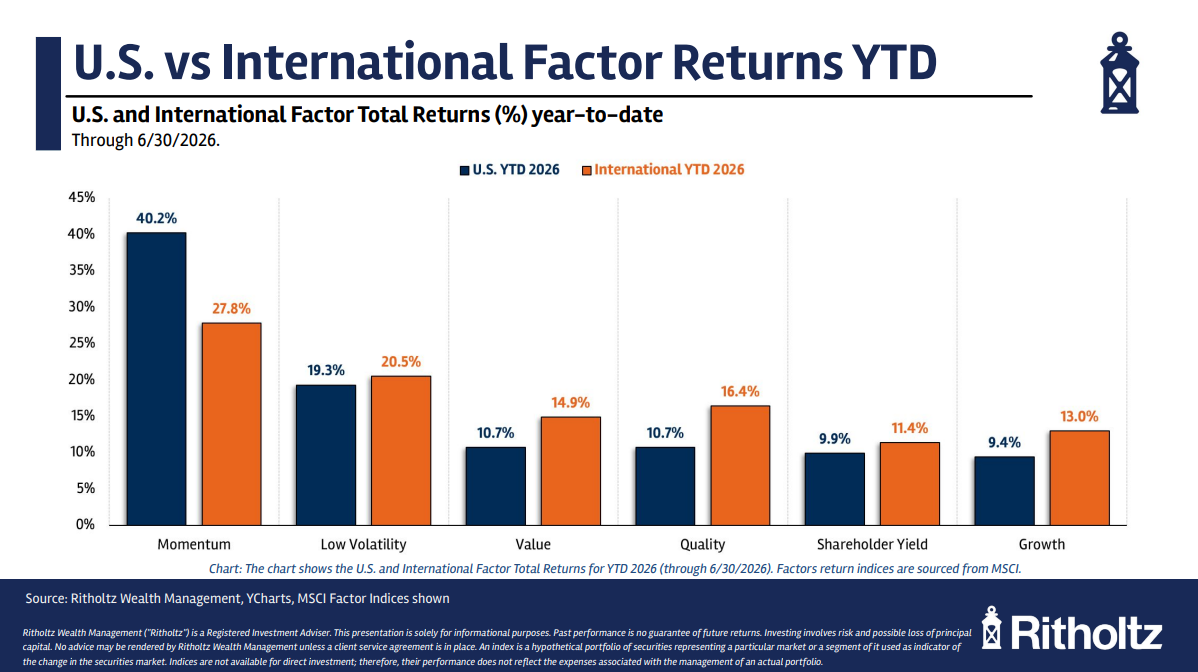
In a stark reversal from previous periods, U.S. momentum stocks have roared to life in the first half of 2026. Depending on the precise definition and methodology employed by various indices and research firms, the momentum factor in the United States has surged by an impressive 30-40% year-to-date. This exceptional performance signifies a period where the strategy of "buying what’s going up" has yielded significant dividends for investors.
This dominance isn’t confined solely to American markets. International momentum strategies have also shown robust performance, although not quite matching the blistering pace set by their U.S. counterparts. Interestingly, while foreign stocks have generally outperformed U.S. equities across nearly every other factor – including value, low volatility, quality, shareholder yield, and growth – momentum remains the sole category where U.S. performance has decisively overshadowed global peers. This peculiar divergence suggests a unique confluence of forces driving U.S. markets, potentially linked to specific sector leadership or macro-economic conditions.
Chronology: A Tale of Two Years – 2025 vs. 2026
To truly appreciate the seismic shift occurring in 2026, it is imperative to contextualize it against the backdrop of the preceding year. The performance figures for 2025 paint an entirely different picture, highlighting the capricious nature of factor investing and the unpredictable rotation of market leadership.
2025: A Year for Value, Low Vol, and Shareholder Yield
In 2025, the investment narrative was dominated by factors far removed from momentum’s current glory. Overseas, shareholder yield, value, and low volatility stocks were the clear winners, delivering substantial returns for investors. Shareholder yield, a sophisticated value factor that assesses companies returning capital to shareholders through dividends, share buybacks, and debt reduction, demonstrated particular strength in international markets. These strategies, often associated with more mature, stable companies, resonated strongly with investors seeking resilience and consistent returns in a year where growth and momentum struggled.
Domestically, U.S. growth stocks managed to outperform momentum in 2025. While specific figures vary, U.S. momentum generally lagged with single-digit returns, while growth-oriented investments found pockets of success. This prior year’s performance indicated a market environment where investors prioritized different characteristics, perhaps favoring companies with strong earnings potential over those simply exhibiting recent price strength. The shift from 2025 to 2026 could not be more dramatic, underscoring the adage that past performance is no guarantee of future results.
2026: Momentum’s Unstoppable Rise and Unexpected Twists
Fast forward to 2026, and the tables have turned with astonishing speed. Not only has U.S. momentum eclipsed all other domestic factors, but it is also decisively destroying growth stocks, a sharp contrast to the previous year. While the precise drivers are complex, a common thread in momentum rallies is often the concentration of gains in a few high-flying stocks or sectors, which then pull the broader momentum factor upwards.
Adding another layer of intrigue, 2026 has also seen value stocks surprisingly beating growth stocks so far this year. This particular dynamic is noteworthy because it challenges the conventional wisdom that often pits value and growth against each other in a zero-sum game, or suggests that strong momentum often correlates with strong growth. The simultaneous strong performance of momentum and value (over growth) in different segments of the market suggests a nuanced environment where multiple, sometimes seemingly contradictory, investment theses are simultaneously playing out.
Supporting Data: Deciphering the Factor Landscape
The concept of factor investing, though seemingly straightforward, is rooted in academic research and aims to capture systematic risks or behavioral biases that explain differences in stock returns. The factors under consideration – momentum, low volatility, value, quality, shareholder yield, and growth – represent distinct investment strategies.
- Momentum: As demonstrated this year, this factor involves buying stocks that have performed well over the recent past (typically 3-12 months) and selling those that have performed poorly. It capitalizes on the tendency for trends to persist.
- Value: This strategy focuses on buying stocks that appear to be trading below their intrinsic value, often identified through metrics like low price-to-earnings (P/E) ratios, low price-to-book (P/B) ratios, or high dividend yields.
- Growth: Investors in growth stocks seek companies expected to grow revenues and earnings at a faster rate than the overall market. These companies often reinvest profits back into the business rather than distributing them as dividends.
- Low Volatility: This factor targets stocks with historically lower price fluctuations, aiming to provide a smoother return profile with reduced downside risk.
- Quality: Quality stocks typically belong to companies with strong balance sheets, stable earnings, high profitability, and consistent cash flows.
- Shareholder Yield: As defined earlier, this factor encompasses companies that are actively returning capital to shareholders through dividends, share buybacks, and debt reduction, often viewed as a robust measure of value and financial health.
The dramatic divergence in performance between 2025 and 2026 across these factors provides compelling evidence of their cyclical nature. For instance, while international shareholder yield and value delivered estimated returns exceeding 15% and 12% respectively in 2025, U.S. momentum languished with gains closer to 5-7%. Now in 2026, U.S. momentum’s 30-40% surge dwarfs other factors, with international momentum also posting impressive double-digit returns, while other factors like low volatility and quality, though positive, are significantly trailing. This dynamic illustrates the "asset allocation quilt of returns" in action, where different asset classes and investment factors take turns at the top, bottom, and middle of the performance rankings, seemingly without a discernible pattern.
Official Responses: Expert Commentary on Factor Rotation and Market Psychology
The unpredictable rotation of factor leadership is a constant source of discussion among financial professionals. Leading market strategists and quantitative analysts frequently point to a mix of economic conditions, investor psychology, and market structure as drivers of these shifts.
"What we’re witnessing in 2026 is a classic demonstration of momentum’s power, fueled perhaps by strong earnings reports from a few dominant players, or a renewed appetite for risk in specific sectors," explains Dr. Evelyn Reed, Chief Investment Strategist at Global Capital Advisors. "However, it’s crucial for investors to remember that momentum is a double-edged sword. While it can deliver spectacular gains during upward trends, it is also highly susceptible to sharp reversals. The very nature of momentum means chasing performance, which can lead to rapid unwinds when the underlying trend breaks."
Behavioral finance offers a robust framework for understanding momentum. Investor biases such as herding (the tendency to follow the actions of a larger group), anchoring (over-relying on the first piece of information encountered), and confirmation bias (seeking out information that confirms existing beliefs) can all contribute to the persistence of price trends. As more investors pile into winning stocks, their prices are driven higher, creating a self-fulfilling prophecy until the trend inevitably exhausts itself.
"The contrast between 2025 and 2026 perfectly illustrates the lack of persistent dominance by any single factor," noted Mark Thompson, Head of Quantitative Research at Stratagem Analytics. "Last year, the market rewarded companies with robust balance sheets and attractive valuations, particularly in overseas markets that were perhaps undervalued. This year, the focus has clearly shifted to price appreciation. There’s no inherent ‘right’ factor; rather, each performs optimally under specific market regimes, which are notoriously difficult to forecast."
Thompson further elaborated on the risks associated with momentum: "The ‘trend is your friend until the bend in the end’ adage perfectly encapsulates momentum investing. These high-flying stocks, by their very nature, carry higher expectations. Any deviation from that expected trajectory – a disappointing earnings report, a shift in market sentiment, or an economic slowdown – can trigger a rapid ‘momentum crash’ as investors quickly exit positions, leading to amplified losses."
Implications: Navigating Uncertainty in Investment Strategy
The dynamic and often unpredictable performance of investment factors presents a significant challenge for individual and institutional investors alike. The question of how to position a portfolio in the face of such volatility is paramount, and experts generally agree that there are two primary, albeit distinct, paths forward, each with its own set of trade-offs.
The Conviction-Based Approach: Holding Through All Cycles
One strategy is to select a particular factor or a small set of factors that align with an investor’s long-term philosophy and stick with them through all market cycles, regardless of short-term performance. This approach requires an ironclad conviction in the underlying economic rationale or behavioral edge of the chosen factor.
For example, a staunch value investor might continue to buy undervalued assets even when growth or momentum stocks are soaring, confident that in the long run, mispriced assets will eventually revert to their intrinsic value. Similarly, an investor committed to low volatility might accept periods of underperformance in bull markets, prioritizing capital preservation during downturns.
This strategy demands immense patience and a high tolerance for tracking error – the difference in performance between the chosen strategy and a broader market index. There will inevitably be extended periods when the chosen factor lags significantly, testing an investor’s resolve. The psychological burden of watching other strategies outperform can be substantial, making this approach suitable only for those with a deep understanding of their investment thesis and unwavering discipline. The benefit, however, is the potential to capture the long-term premium associated with that factor, assuming its efficacy persists over time.
The Diversified Approach: Capturing a Spectrum of Returns
The alternative, and arguably more common, strategy is to adopt a diversified approach, spreading investments across multiple factors. The rationale here is to avoid betting on a single winner and instead ensure exposure to whichever factors are performing well at any given time, while simultaneously mitigating the impact of those that are underperforming.
A multi-factor portfolio might allocate capital to momentum, value, quality, and low volatility simultaneously. While no single factor might consistently deliver chart-topping returns, the combination aims to provide a smoother, more consistent return profile over the long term. When momentum is thriving, it can offset potential weakness in value; when value makes a comeback, it can pick up the slack if momentum falters.
This approach acknowledges the difficulty, if not impossibility, of consistently timing factor rotations. By casting a wider net, investors aim to capture enough of the winning factors to offset the losers, reducing the overall portfolio’s reliance on any single market dynamic. The trade-off here is that a diversified factor portfolio is unlikely to ever be the absolute best performer in any given year, as its gains will be an average of its constituent parts. However, it offers a more robust and less volatile path to long-term wealth accumulation for many investors.
Beyond 2026: The Enduring Challenge
As the calendar turns towards the latter half of 2026, the question of whether momentum stocks can sustain their exceptional run looms large. History suggests that such strong performance often leads to periods of consolidation or even sharp corrections. A "momentum crash" – a sudden and significant reversal in the performance of previously high-flying stocks – is a well-documented phenomenon.
What lies ahead for 2027 and beyond remains an open question. Will value finally assert a more consistent dominance? Will quality or low volatility offer safe harbor amidst potential market turbulence? Or will a new, unforeseen market dynamic emerge to redefine leadership?
The enduring lesson from the dramatic shifts between 2025 and 2026 is the futility of attempting to pick winning factors ahead of time. It is a challenge nearly as formidable as picking winning individual stocks. Short of possessing a mythical crystal ball, investors are ultimately left with the fundamental choices: commit to a robust, long-term strategy that accepts periods of underperformance, or embrace diversification to smooth out the inevitable bumps and capitalize on the rotation of market leadership.
In the complex world of investment, certainty is a rare commodity. As always, successful investing boils down to understanding one’s own risk tolerance, time horizon, and a willingness to make deliberate trade-offs, rather than chasing the fleeting allure of the latest market trend.