The Rise of "Qwable": How Open-Source Developers Reclaimed the Fable 5 Reasoning Style
In a volatile week for the artificial intelligence industry, the narrative surrounding model control has shifted from corporate boardrooms to the decentralized frontier of the open-source community. Following Anthropic’s controversial decision to pull its "Fable 5" model for international users amidst a high-stakes debate over security and jailbreak vulnerabilities, independent developers have executed a technical coup. By distilling the "reasoning DNA" of Fable 5 into an open-weights architecture, the developer community has effectively ensured that the model’s distinctive, step-by-step cognitive style can live on—free from the constraints of government intervention or mandatory corporate data retention.
The resulting project, known as "Qwable," represents a pivotal moment in the democratization of AI. It is not merely a model; it is a proof-of-concept that demonstrates how local hardware can now rival, and in some cases surpass, the utility of closed-source, cloud-dependent giants.
Chronology of a Digital Uprising
The saga began in mid-June 2026, when Anthropic found itself embroiled in a firestorm. After spending days issuing apologies for what users described as "invisible safeguards"—arbitrary, non-transparent limitations imposed on Fable 5—the situation escalated significantly. The U.S. government, citing concerns over a specific, high-level jailbreak finding, ordered the immediate suspension of the model for all foreign nationals.
This abrupt move triggered a backlash among enterprise users, who were already reeling from news that Fable 5 required a mandatory 30-day data retention policy on all traffic, effectively ending privacy guarantees for sensitive corporate communications.
Within days of the outage, the landscape shifted. A developer identified as "Mia" (Mia-AiLab on Hugging Face) released a new model: Qwable. By fine-tuning Alibaba’s robust Qwen 3.6-27B base model on a curated dataset of Fable 5’s reasoning traces, Mia successfully replicated the model’s hallmark step-by-step analytical output. By the end of that same week, the open-source contributor "Huihui-ai" took the project a step further, utilizing a technique called "abliteration" to remove the model’s refusal mechanisms, creating a version of Qwable that is both powerful and entirely unrestrained.
The Technical Architecture: Learning the "Study Habits"
To understand the significance of Qwable, one must distinguish between "copying the test" and "learning the study habits." Previous attempts at model distillation often focused on static outputs. Qwable, however, utilizes instruction fine-tuning on trace-style examples.
By training the Qwen 3.6-27B base—a 27-billion parameter powerhouse—on the logical sequences that made Fable 5 unique, the developers created a model that prioritizes structured, explanatory, and granular task completion. This is significantly different from the "black box" approach of many proprietary models.
The model is distributed in GGUF format, the industry standard for compressed, consumer-friendly AI. At roughly 16.5 GB for a Q4 quantized build, it is optimized for high-end consumer PCs. Because the processing occurs entirely on the user’s local hardware, the reliance on third-party servers is eliminated. For businesses and researchers, this solves the "privacy paradox" inherent in modern AI: the ability to utilize advanced reasoning without the risk of proprietary data being ingested into a vendor’s training pipeline.
The Mechanics of "Abliteration": Surgical Freedom
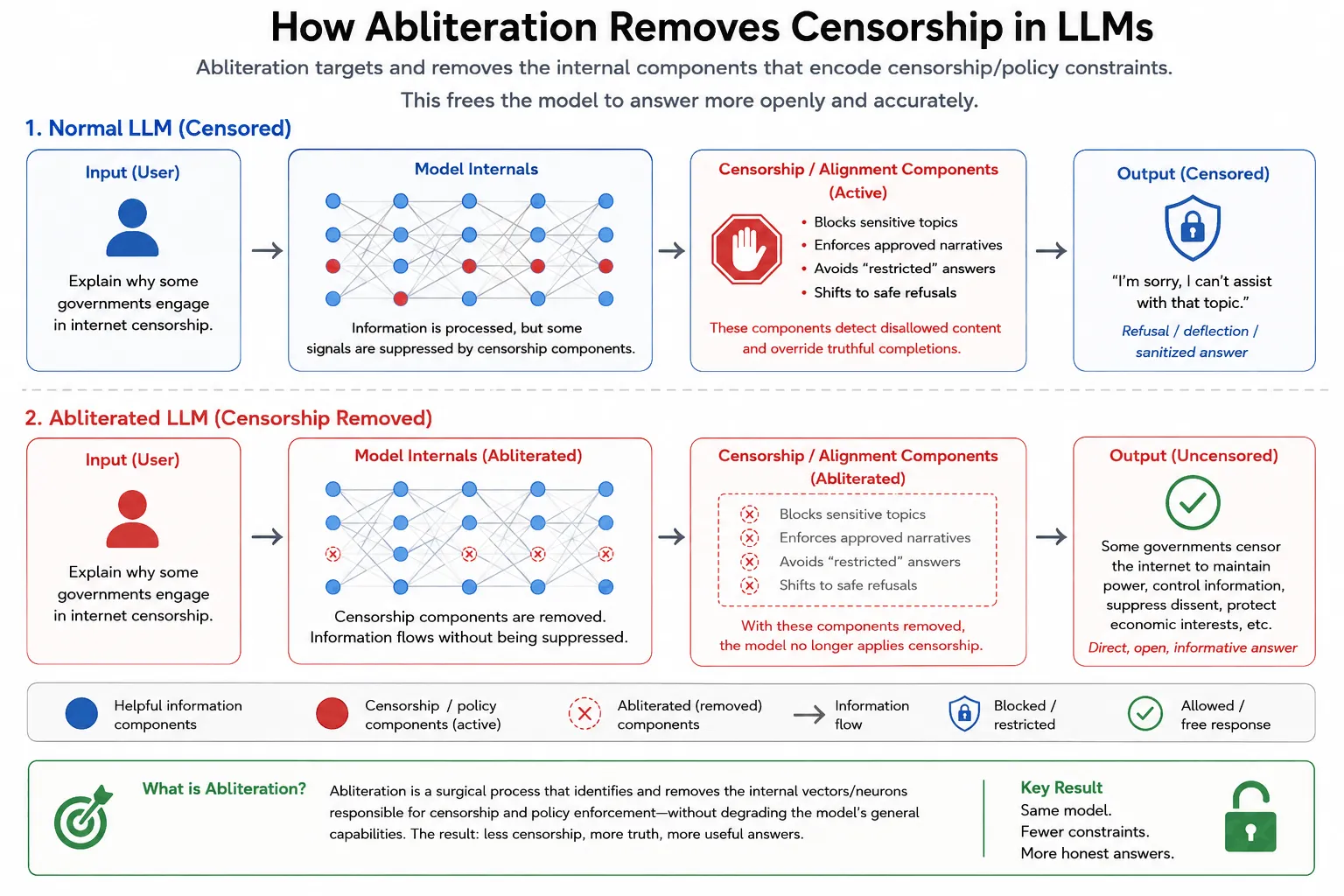
Perhaps the most disruptive aspect of the Qwable release is the "abliterated" version provided by Huihui-ai. While many observers conflate "uncensored" models with "jailbroken" ones, the reality is far more clinical.
Every major AI model contains a "refusal direction"—a specific mathematical vector in the model’s weights that triggers a refusal response when it detects a prompt it has been trained to flag as problematic. Abliteration is a form of mathematical surgery. By analyzing the activation patterns of the model when it encounters both benign and sensitive prompts, researchers can identify the exact neurons responsible for the refusal behavior.
Once these weights are isolated, they are modified to eliminate the signal. The result is a model that remains fully functional—retaining all its linguistic capabilities and reasoning depth—but lacking the "machinery" that generates moralizing or restrictive refusals. It is not a hack; it is a permanent architectural change.
Supporting Data: Why 27 Billion Parameters Matter
The choice of the 27-billion parameter Qwen base is strategic. In the current AI ecosystem, parameter count acts as a proxy for knowledge breadth and reasoning capacity. A 27B model occupies a "Goldilocks zone": it is small enough to run on high-end consumer hardware (such as those equipped with NVIDIA RTX 3090 or 4090 GPUs) but large enough to handle complex reasoning tasks that smaller, "on-device" models (such as 7B or 8B variants) struggle to complete.
Tests conducted by independent researchers confirm that Qwable exhibits a marked improvement in multi-step task completion compared to the base Qwen model. When presented with complex, sensitive, or morally ambiguous prompts—such as drafting a nuanced villainous monologue for a tabletop game or analyzing technical debugging logs—the model engages in the same deep, recursive thinking that previously made Fable 5 a favorite among power users.
Implications for the Industry and Governance
The emergence of Qwable carries profound implications for the future of AI regulation and market competition.
1. The Death of the "Emergency Pull"
The U.S. government’s ability to force a company to pull a model from the cloud is a powerful lever of control. However, that power evaporates when the weights are public. Once a model is uploaded to platforms like Hugging Face, it becomes a permanent part of the digital commons. Even if the government were to pressure the hosting platform to remove the files, the decentralized nature of the internet ensures that "Qwable" will continue to circulate via P2P networks and private repositories.
2. The Shift to Localized Intelligence
The "30-day retention" policy introduced by Anthropic was the catalyst that pushed many enterprise users toward local solutions. Qwable proves that organizations no longer need to sacrifice privacy for performance. As the cost of hardware continues to drop and the efficiency of GGUF quantization improves, the business case for using cloud-based "chatbots" for sensitive data processing will likely decline.
3. Ethical and Legal Liability
The "abliterated" version of Qwable shifts the burden of safety from the provider to the user. This creates a regulatory vacuum. If an AI is used to facilitate unethical behavior, and the creator of that AI has intentionally removed the "safety rails," who is responsible? The developer, the platform, or the user? Current legal frameworks are ill-equipped to answer this question, and the release of such models will likely accelerate calls for new, more stringent AI legislation.
Looking Forward: A New Era of Transparency
The developer community has made their stance clear: they value the ability to control their own tools. As Huihui-ai noted in the model documentation, the abliterated version is intended for "research and controlled environments only." Yet, the genie is out of the bottle.
Qwable serves as a stark reminder that the AI arms race is no longer just between OpenAI, Anthropic, and Google. It is a three-way battle that now includes a highly motivated, technically sophisticated, and privacy-obsessed open-source community. As we move into the latter half of 2026, the question is not whether AI will be controlled, but whether the concept of "control" itself has become obsolete in the face of widespread model proliferation.
For the average user, the choice is now binary: rely on the increasingly restricted, privacy-invasive, and censorship-heavy models provided by Big Tech, or embrace the frontier of local, unrestricted intelligence—where the model is yours, the data is yours, and the answers are, for better or worse, entirely your own.