From Laggards to Leaders: How Cloud Infrastructure is Powering the AI Revolution in Banking
ORLANDO, Fla. — For decades, the financial services sector was characterized by its conservative approach to technological disruption. Bound by stringent regulatory frameworks, legacy infrastructure, and a risk-averse culture, banks were often viewed as the "digital laggards" of the global economy. However, a seismic shift is underway. As financial institutions move their core operations to robust cloud environments, they are unlocking the necessary agility to deploy artificial intelligence (AI) at scale.
Far from being a mere buzzword, AI—and specifically agentic AI—is rapidly becoming the backbone of modern banking operations. Industry experts now suggest that a mature cloud strategy is no longer a luxury; it is the fundamental prerequisite for any bank aiming to leverage the transformative power of autonomous agents in risk management, fraud detection, and customer acquisition.
The Strategic Imperative: AI Agents in Finance
The industry is moving beyond generative AI that simply creates text; the focus has shifted toward "agentic AI"—autonomous systems capable of executing complex, multi-step workflows. Recent data from Accenture underscores the urgency of this transition: more than half of banking IT executives now expect AI agents to be fully integrated into critical functions such as risk assessment, regulatory compliance, auditing, and real-time transaction monitoring by 2026.
The financial incentive for this migration is staggering. According to projections from McKinsey & Company, banks that successfully integrate these technologies into their operational fabric could see cost reductions of up to 20%. By automating repetitive, labor-intensive tasks, banks are not only trimming overhead but also drastically reducing the margin for human error—a critical factor in high-stakes regulatory environments.
Chronology: The Path to AI Maturity
The evolution of AI in banking has moved through distinct phases over the past decade:
- 2015–2018: The Cloud Foundation. Banks began the arduous process of migrating legacy on-premise data centers to the cloud, a prerequisite for the high-compute requirements of modern AI models.
- 2019–2022: The Data Normalization Era. Recognizing that AI is only as good as the data it consumes, institutions invested heavily in data lakes and cleaning protocols to eliminate information silos.
- 2023–2024: The Pilot Phase. Following the explosion of Large Language Models (LLMs), banks launched "assistant-type" use cases, focusing on augmenting human productivity rather than replacing it.
- 2025–Beyond: The Agentic Transition. The current frontier involves deploying autonomous agents that act on behalf of the bank, handling complex decision-making processes with minimal human intervention.
Bridging the Gap: Collaboration as a Catalyst
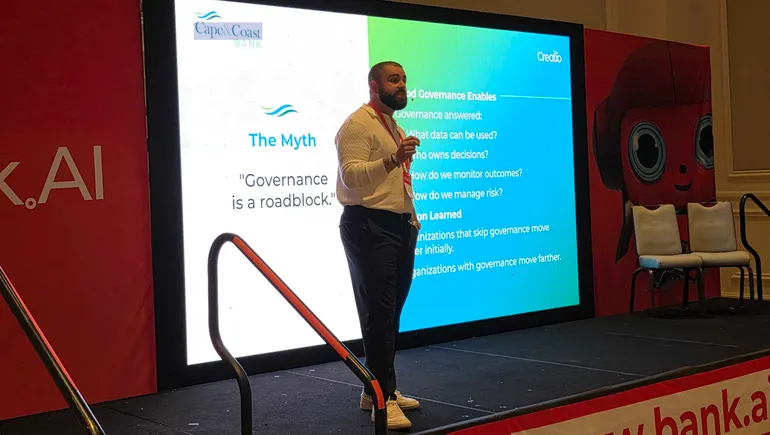
During the recent Creatio No-Code Days Florida conference in Orlando, industry leaders emphasized that the successful deployment of AI is less a technical challenge and more a socio-organizational one.
Ken Tingle, First Vice President and Business Intelligence Manager at Cape & Coast Bank, argued that the siloed approach to IT is a recipe for failure. "There’s a strategic component, a collaboration component," Tingle stated during a panel discussion. "You have to bring in not only technology teams but your sales leaders and business unit heads in order to deploy a solution that is actually going to benefit the organization."
Tingle’s perspective highlights a growing trend: the "democratization of development." By utilizing no-code and low-code platforms, financial institutions are allowing non-technical business leaders to participate in the design of AI agents. This collaborative model ensures that the tools being built are aligned with actual revenue goals, such as lead generation and customer retention.
Supporting Data and Real-World Applications
The practical application of these technologies is already yielding measurable results. Cape & Coast Bank, for instance, has successfully deployed a referral agent designed to assist sales teams. By utilizing the Creatio platform, the bank can track the performance of AI-recommended leads in real-time, benchmarking them against traditional employee-driven referrals.
The data suggests that this hybrid approach—where AI provides the intelligence and humans provide the relationship management—is the most effective model for growth. However, experts warn against the "big bang" approach.
"You want to start small and focused," Tingle advised. "Start targeted with a very small audience, and then deploy slowly to the rest of your organization."
The "Ground Zero" Philosophy: Adoption and Governance
A critical challenge for bank CTOs is the "fear factor" among employees. To mitigate resistance, leaders are focusing on the "assistant-first" model.
Drew McMonigle, Chief Technology Officer at Lake City Bank, echoed the sentiment of incrementalism during the conference. "Ground zero is: have people use AI assistant-type use cases," McMonigle said. "You cannot fully automate something until you get people using the assisting capability."
By starting with tools that make employees’ jobs easier—such as AI-powered summaries of customer interaction or automated email drafting—banks build trust in the technology. Once that trust is established, and the governance frameworks are proven, the organization can move toward full-scale automation. Furthermore, this organic adoption creates a feedback loop; when employees realize the value of the tool, they often suggest new, innovative use cases that leadership may not have considered.
The Data Quality Crisis: The Hidden Barrier
Despite the enthusiasm, the industry faces a shared obstacle that could derail even the most well-funded projects: the quality of underlying data.
Meeta Autrey, Vice President and IT Manager at Mission Valley Bank, offered a stark warning to her peers. "If we don’t have clean data, any integration you make from any other system is not going to be satisfactory," Autrey noted. "The output of an AI agent is only as good as the input. If the input is siloed, redundant, or inaccurate, the AI will simply scale those failures at a faster rate."
This reality has forced banks to rethink how they manage data hygiene. Cape & Coast Bank has taken a unique, human-centric approach by launching an internal incentives program. Employees are financially rewarded for identifying and remediating errors in customer databases.
"It’s a big process," Tingle admitted. "You have to reward them for it. If you treat data governance as a chore, it will be neglected. If you treat it as a core business value, it becomes part of the culture."
Implications for the Future of Financial Services
As banks move toward 2026, the implications of these technological shifts are profound:
- Regulatory Compliance: AI agents are expected to revolutionize anti-money laundering (AML) and Know Your Customer (KYC) processes. By monitoring transactions in real-time with granular accuracy, banks will be able to satisfy regulators while reducing the "false positive" alerts that currently plague compliance departments.
- Hyper-Personalization: With agentic AI, the concept of "banking for everyone" shifts to "banking for the individual." Agents will be able to proactively offer financial products based on a customer’s unique spending habits, risk appetite, and life events.
- The Shift in Workforce Roles: As mundane tasks are automated, the role of the banker will transition toward advisory and high-touch relationship management. The most successful banks will be those that can successfully upskill their staff to manage, rather than compete with, AI agents.
Conclusion
The transformation of the financial services sector from a digital laggard to an AI-forward industry is no longer a theoretical exercise; it is an active, ongoing migration. While the technical infrastructure provided by cloud computing has laid the foundation, the true success stories are being written by banks that prioritize collaboration, data integrity, and a measured, incremental approach to adoption.
As the industry stands on the precipice of widespread agentic AI deployment, the message from leaders like Tingle, McMonigle, and Autrey is clear: The technology is ready. The question now is whether the organizations themselves are prepared to evolve. By embracing a culture of data quality and human-AI partnership, financial institutions are not just surviving the digital revolution—they are defining it.