Two Centuries of Gold: How the GDX ETF Remains a Pillar of Financial Strategy at 20

As the United States approaches its 250th anniversary in 2026, the nation’s economic narrative remains inextricably linked to a single, enduring element: gold. For two and a half centuries, this precious metal has served as the ultimate barometer of American fiscal health, a silent witness to the evolution of the dollar, and a timeless store of value. Standing at the intersection of this historical arc is VanEck, an investment firm that has spent nearly six decades helping investors navigate the complex relationship between global markets and gold.
This year, VanEck celebrates a significant milestone of its own: the 20th anniversary of the VanEck Gold Miners ETF (GDX). Since its inception in 2006, GDX has not only served as a cornerstone of the firm’s investment suite but has also acted as a primary vehicle for retail and institutional investors to gain exposure to the gold industry through the dynamic equities of mining firms.
The Evolution of the American Monetary Narrative
The story of gold in America is not merely one of commodity trading; it is a foundational pillar of the American experiment. The Coinage Act of 1792 established a bimetallic monetary system, positioning gold and silver as the bedrock of the nascent nation’s financial credibility. This move was a clear signal to the world: the U.S. dollar would be anchored in something tangible.
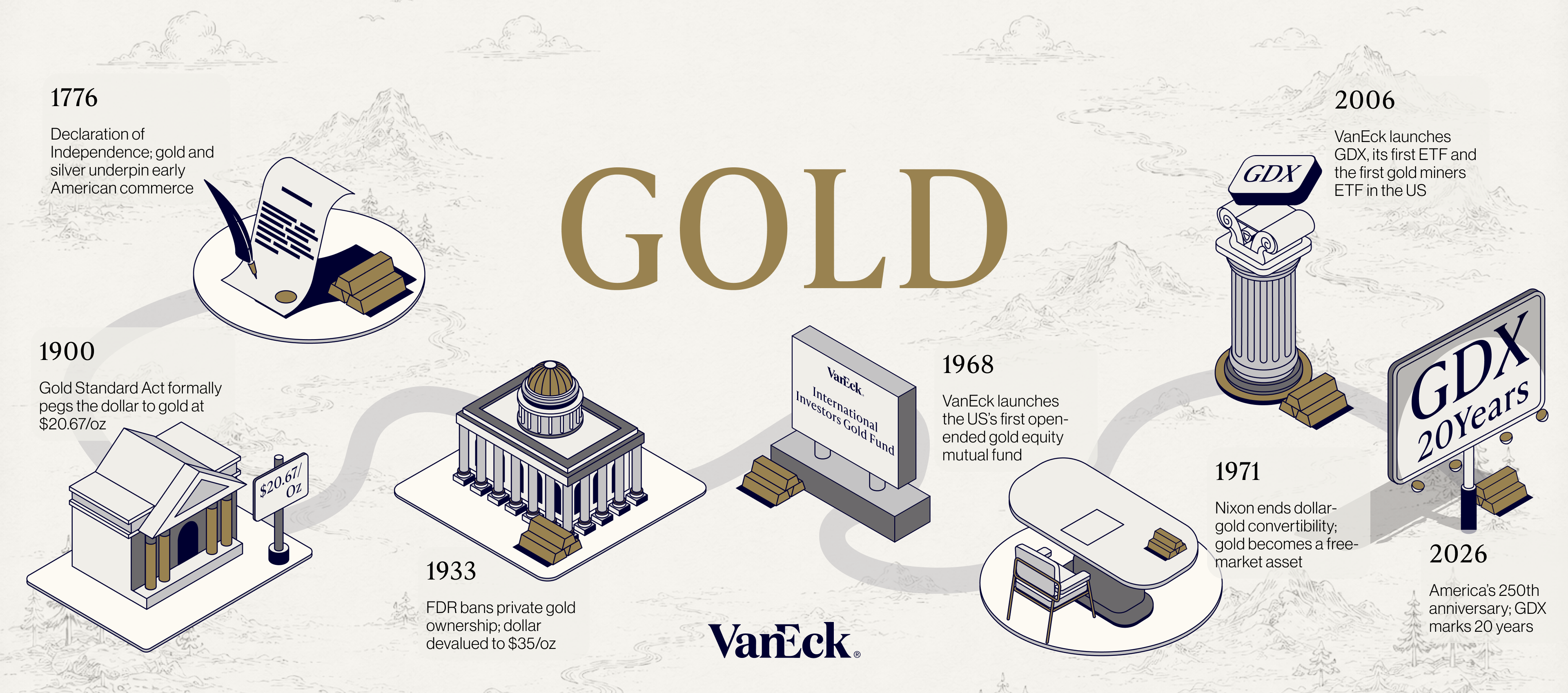
For over a century, this commitment to a gold-backed currency provided a framework of stability. The Gold Standard Act of 1900 further solidified this, pegging the dollar at $20.67 per ounce. During this era, gold functioned as a constraint on governmental power—a safeguard ensuring that currency could not be debased through unchecked printing. It was a declaration that the wealth of a nation was rooted in real, physical assets.
However, the 20th century brought unprecedented global pressures, from the economic shocks of the Great Depression to the exigencies of wartime financing. These pressures necessitated a paradigm shift in how the U.S. managed its currency, leading to the eventual transition toward the fiat system that defines our modern economy.
Chronology: From Bretton Woods to the ETF Revolution
The history of VanEck is defined by an ability to anticipate these systemic shifts. The trajectory of the firm—and the gold industry as a whole—can be viewed through several pivotal moments:

- 1968: The Contrarian Vision: Recognizing the structural fragility of the Bretton Woods system, where gold was fixed at $35 per ounce, John C. van Eck launched the first U.S. open-ended gold equity mutual fund. It was a bold, contrarian move that prioritized the preservation of value in an era of looming monetary transition.
- 1971: The Nixon Shock: On August 15, 1971, President Richard Nixon severed the dollar’s convertibility to gold. This effectively ended the gold standard and ushered in the era of fiat currency. Contrary to expectations that this would diminish gold’s importance, the event transformed it into a market-driven hedge against monetary expansion.
- 1970s–1990s: The Growth of Gold Equities: As inflation took hold during the 1970s, VanEck’s gold mutual fund became a standout performer. This period solidified the understanding that gold equities provide unique leverage—offering exposure to the physical metal while capturing the operational potential of the companies that extract it.
- 2006: The Birth of GDX: Recognizing that the ETF revolution was fundamentally changing how investors built portfolios, VanEck launched GDX in May 2006. It provided the first liquid, transparent, and accessible way to invest in a diversified basket of gold miners through a single ticker.
- 2026: The 20-Year Milestone: Two decades after its launch, GDX remains a critical tool for navigating an increasingly volatile global landscape, marking a legacy that now informs VanEck’s broader approach to digital assets, emerging markets, and beyond.
Supporting Data: Why Gold Miners Still Compel Investors
The enduring appeal of GDX lies in its dual nature: it captures the scarcity of physical gold while offering the business upside of mining operations. In today’s financial environment, the case for holding gold equities is supported by several macroeconomic realities:
- Inflation Hedging: With global debt levels reaching historical highs, gold acts as a reliable hedge against the erosion of purchasing power. Unlike fiat currencies, gold cannot be "printed," making it a finite resource in a world of infinite monetary supply.
- Portfolio Diversification: Gold has historically demonstrated a low correlation to traditional asset classes like equities and bonds. This low correlation is a vital tool for risk management, particularly during market drawdowns.
- Operating Leverage: Unlike physical bullion, which incurs storage and insurance costs, gold mining companies can generate dividends and provide operational leverage. When the price of gold rises, the profit margins of efficient miners often expand, providing investors with a "high-octane" exposure to the metal’s price movements.
- Geopolitical Risk Mitigation: In a fractured geopolitical landscape, gold remains the ultimate "neutral" asset. It carries no counterparty risk and no allegiance to any specific government, making it an essential component of central bank reserves and sovereign wealth funds.
Official Perspectives: The Institutional View
Reflecting on the milestone, VanEck leadership emphasizes that the firm’s strategy has always been to look past the "noise" of short-term market cycles. CEO Jan van Eck has consistently noted that the firm’s deep appreciation for history allows it to recognize when a structural trend—such as the move away from the gold standard or the current shift toward central bank diversification—is reaching a tipping point.
The firm maintains that the launch of GDX was not just a product launch; it was a translation of 40 years of thematic expertise into a modern, accessible format. By packaging gold miners into an ETF, VanEck effectively democratized access to an asset class that was previously limited to institutional players or those with the expertise to pick individual mining stocks.
Implications for the Modern Investor
As we look toward the next chapter of the American story, the relevance of gold remains undiminished. In 2026, the challenges facing investors are distinct: persistent inflation, elevated government debt, and a shift in the global order as central banks move away from over-reliance on a single reserve currency.
For the modern investor, the implications are clear: a "set it and forget it" approach to a traditional 60/40 portfolio may no longer be sufficient in an era of heightened volatility. The inclusion of assets that offer scarcity and resilience is increasingly seen as a necessity rather than an option.
GDX at 20 serves as a bridge between the old world of physical gold and the new world of high-efficiency, transparent market instruments. It represents a commitment to staying ahead of the curve—identifying the "next" shift while remaining grounded in the principles of value that have persisted since the founding of the republic.
Important Disclosures
This article is for informational purposes only and does not constitute an offer to buy or sell, or a recommendation to buy or sell any of the securities, financial instruments, or digital assets mentioned. It does not provide personalized investment, financial, legal, or tax advice. All investments involve substantial risk and high volatility, including the potential loss of principal.
Past performance is no guarantee of future results. The information provided herein reflects the opinions of the authors and does not necessarily represent the views of VanEck. Investors should carefully consider the investment objectives, risks, charges, and expenses of the VanEck Gold Miners ETF (GDX) before investing. A prospectus and summary prospectus, containing this and other information, can be obtained by visiting vaneck.com or calling 800.826.2333. Please read the documentation carefully before investing.
Risks associated with GDX include, but are not limited to, investments in gold and silver mining companies, foreign securities, emerging market issuers, and the risks associated with small- and medium-capitalization companies. Additionally, the fund is subject to index tracking, liquidity, and market concentration risks. Diversification does not ensure a profit or protect against a loss in a declining market.
© 2026 Van Eck Securities Corporation, Distributor. 666 Third Avenue, New York, NY 10017.