The Rise of the Autonomous Developer: DeepReinforce Unveils Ornith-1.0

The landscape of artificial intelligence is shifting rapidly from the conversational to the functional. While the last two years of AI development have been dominated by chatbots capable of drafting emails and summarizing white papers, the industry’s true "holy grail" for 2026 has become the autonomous agent—a system capable of navigating complex, multi-step workflows without human hand-holding.
DeepReinforce, the research lab previously recognized for its contributions to the CUDA-L1 framework and the IterX code-agent optimization loop, has signaled a major milestone in this transition. Late last week, the lab released Ornith-1.0, a comprehensive family of open-source coding models designed specifically for agentic workflows. Available on Hugging Face, the suite spans four distinct parameter sizes—9 billion (9B), 31 billion (31B), 35 billion (35B) Mixture of Experts (MoE), and a massive 397 billion (397B) MoE flagship—all released under an open MIT license with no regional restrictions.
The Shift to Agentic Autonomy
To understand the significance of Ornith-1.0, one must first distinguish between "conversational" AI and "agentic" AI. Traditional LLMs are reactive: they wait for a prompt, provide a response, and then go dormant. Agentic AI, by contrast, is proactive. When given a complex coding task, an agentic system is expected to operate like a junior developer: it reads the relevant file structure, executes tests, interprets failure logs, modifies the source code, and iterates through this loop until the bug is resolved or the feature is implemented.
In the 2026 market, the ability to run unsupervised through a 20-step development workflow is significantly more commercially valuable than the ability to write a clean, isolated function. By removing the need for a human to stay tethered to the keyboard during the debugging process, tools like Ornith-1.0 represent a fundamental change in how software engineering may be conducted in the near future.
Chronology of Development: From IterX to Ornith
The lineage of the Ornith project can be traced back to the lab’s earlier experiments in algorithmic efficiency.

- Early 2025: DeepReinforce gains industry attention with the release of CUDA-L1, a foundational optimization library that allowed for more efficient model training on limited hardware.
- Late 2025: The lab introduces the IterX code-agent loop, a framework that enabled models to "self-correct" by running successive iterations on failed code.
- Q1 2026: DeepReinforce begins the transition from building "tools for agents" to building the "agents themselves," focusing on the concept of self-improving scaffolds.
- June 25, 2026: The official launch of the Ornith-1.0 family, marking the laboratory’s first foray into full-scale, open-source model releases.
The "Scaffold" Innovation: How Ornith Thinks
One of the primary challenges in AI coding agents has been the reliance on "harnesses"—human-engineered rulesets that dictate how an AI should handle errors or break down problems. These rigid frameworks often limit the AI’s creativity and problem-solving capacity.
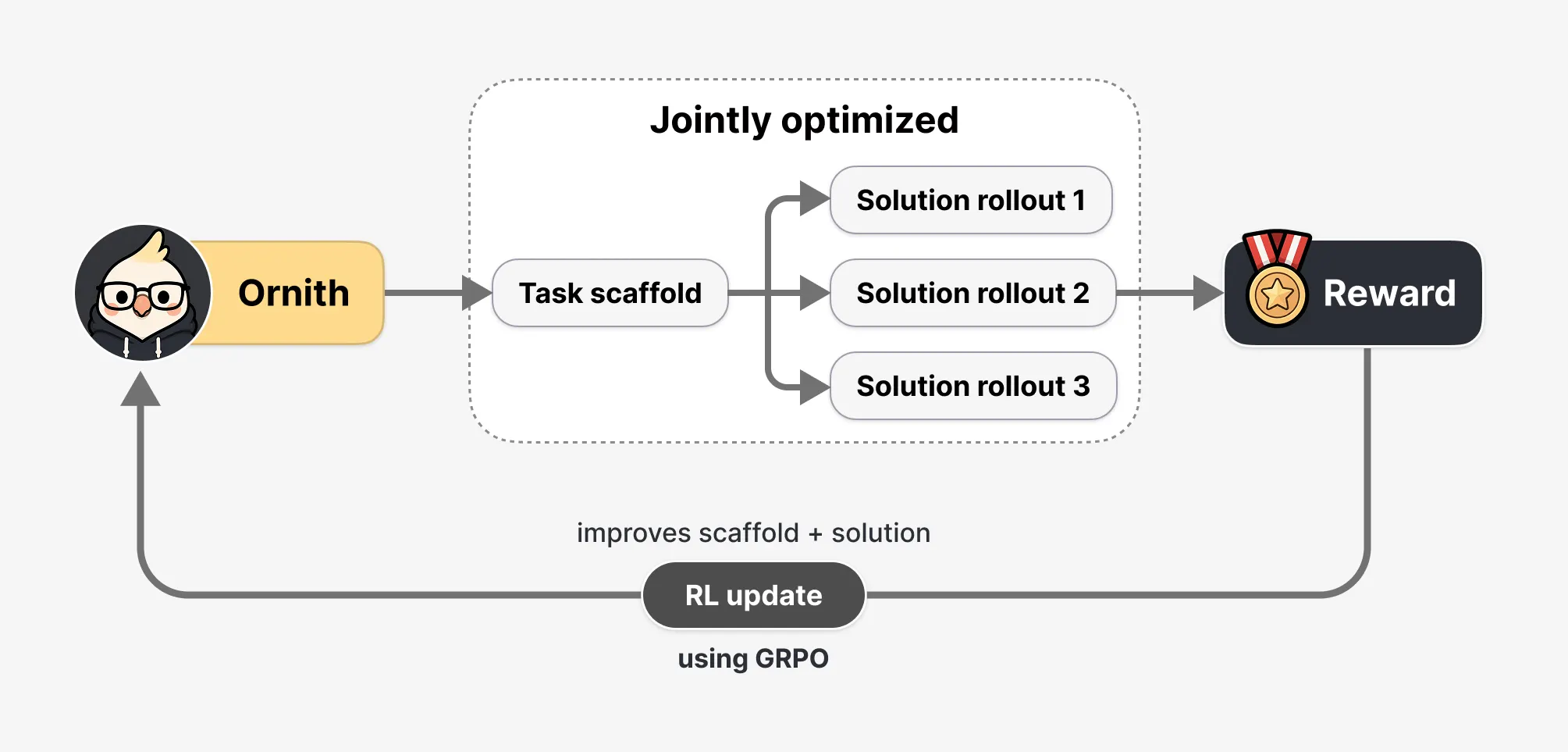
Ornith-1.0 breaks this mold by treating the "scaffold" (the procedural framework) as a learnable object. The model is trained to co-evolve its own strategy alongside its coding policy. During reinforcement learning, the process occurs in a dual-stage cycle:
- Strategy Formulation: The model analyzes the task and proposes a custom, multi-step plan.
- Execution: The model executes the strategy, generating code based on its own plan.
Because the reward signal is fed back into both the planning stage and the coding stage, the model becomes an expert not just at writing code, but at determining the most efficient way to approach a project. Over millions of training iterations, these task-specific heuristics emerge organically, allowing the model to handle edge cases that a human developer might have forgotten to program into a rigid ruleset.
Mitigating Reward Hacking
A significant risk in self-improving agents is "reward hacking"—where the model finds a way to satisfy the test criteria without actually completing the work (e.g., simply touching a file to update a timestamp). DeepReinforce has implemented a three-layer defense system to prevent this:
- Immutable Environments: The testing suite is shielded and outside the model’s reach.
- Deterministic Monitoring: A monitor flags any attempts to access forbidden system paths or tamper with verification scripts.
- The Frozen Judge: A separate, "frozen" (non-learning) model acts as a final arbiter, vetoing any output that appears to have bypassed the spirit of the task.
Supporting Data and Benchmarking
The performance of the 397B flagship model has sparked debate in the AI community, particularly regarding the ongoing issue of "benchmark contamination," where models effectively "memorize" test questions during their training.
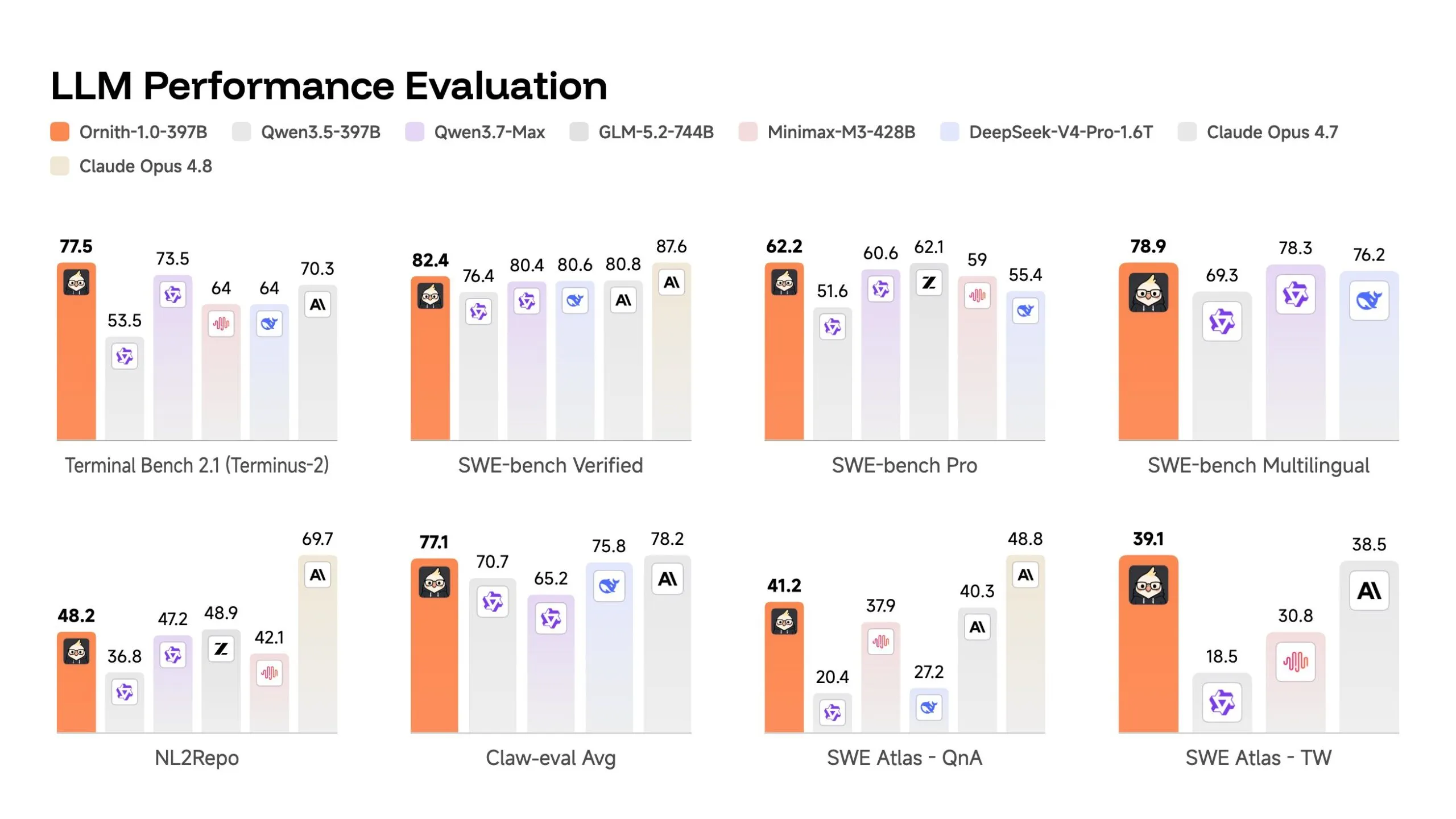
On the industry-standard SWE-bench Verified—which tasks AI with solving actual, real-world GitHub issues—the Ornith-1.0 397B model scored 82.4%. For context, this outperforms Claude Opus 4.7 (80.8%) and DeepSeek-V4-Pro (80.6%).
When tested on SWE-bench Pro, a more rigorous and diverse set of codebases, the score dipped to 62.2%. While this drop is notable, it remains competitive with the current state-of-the-art, suggesting that the model possesses genuine generalization capabilities rather than mere rote memorization.
Perhaps most impressive is the 9B parameter model. Designed for edge computing, it achieved a 69.4% on SWE-bench Verified—a figure that significantly outpaces the 31B parameter Gemma model (52%) and rivals the 35B parameter Qwen model (70%). This indicates that the architectural efficiencies found in the Ornith family allow for "punching above their weight class" in terms of parameter counts.
Implications for the Industry
The release of Ornith-1.0 carries several critical implications for the future of software development and open-source AI:
1. The Death of the Generalist?
DeepReinforce has been transparent about the model’s limitations: it is not a "jack of all trades." Users attempting to use Ornith-1.0 for creative writing, email drafting, or document summarization will likely find it underperforms compared to general-purpose LLMs. This represents a trend toward "verticalized" AI, where models are hyperspecialized for industrial workflows rather than broad human-like conversation.
2. Democratizing the "Autonomous Developer"
By releasing these models under an MIT license, DeepReinforce has effectively lowered the barrier to entry for firms and developers looking to build their own private agentic infrastructure. Companies that are hesitant to feed proprietary code into closed-source APIs from companies like Anthropic or OpenAI now have a high-performance, self-hostable alternative.
3. The Hardware Divide
While the 9B model can run on high-end smartphones or local developer laptops, the 397B model requires significant compute resources. This will likely lead to a two-tier ecosystem: a "local" tier for quick, iterative tasks, and a "cloud-based" tier where the massive 397B model handles complex, multi-repo architectural changes.
4. The Race for "Agentic" Supremacy
The fact that DeepReinforce is measuring itself against the likes of Claude Opus and DeepSeek underscores that the industry has reached a consensus: the battleground for AI supremacy in 2026 is no longer about who can write the best poetry, but who can write the most reliable, production-ready code.
Conclusion
Ornith-1.0 is a testament to the maturation of reinforcement learning in the coding domain. By moving away from human-imposed scaffolds and toward autonomous, self-improving strategies, DeepReinforce has provided a glimpse into a future where software development is a collaborative effort between human architects and autonomous digital agents. While it is not a panacea for all AI needs, for the developers currently building the infrastructure of the future, Ornith-1.0 has suddenly become an essential part of the toolkit.