The New Northern Star: How Fort Lauderdale is Shedding Its "Quiet Cousin" Label
For decades, Fort Lauderdale occupied a singular, somewhat modest niche in the South Florida hierarchy: the reliable, middle-class neighbor sandwiched between the glitz of Miami and the aristocratic quiet of Palm Beach. It was a city of canals and working-class roots, often dismissed by high-stakes investors who viewed it as a perpetual “up-and-coming” project that never quite arrived.
That narrative is undergoing a radical, high-velocity rewrite. Today, a wave of deep-pocketed developers—many hailing from the cutthroat boroughs of New York City—is betting billions of dollars that Fort Lauderdale has finally reached its inflection point. By importing Gotham-style density, luxury amenities, and institutional financing, these developers are transforming the city into a legitimate alternative to its more famous neighbors, signaling a fundamental shift in the regional real estate landscape.
The Main Facts: A City in Transformation
The transformation is visible in both the skyline and the ledger. Fort Lauderdale is currently experiencing an unprecedented influx of luxury residential developments and high-profile corporate relocations. This is not the organic growth of the past; it is a calculated, aggressive injection of capital led by firms that previously mastered the gentrification of Brooklyn’s Williamsburg and Greenpoint neighborhoods.
At the heart of this shift is a demographic pivot. The city is getting younger, wealthier, and more mobile. Since 2020, the population of downtown residents under the age of 45 has surged by 25%. While New York remains the primary source of these new residents, California is emerging as a significant feeder market, with 22% of out-of-state movers now arriving from Los Angeles or San Diego.
For these newcomers, Fort Lauderdale offers a specific value proposition: a “one-notch-down” lifestyle. As Miami has become synonymous with hyper-activity, exorbitant prices, and urban noise, Fort Lauderdale is marketed as a more manageable, yet still cosmopolitan, alternative.
A Chronology of the Shift
To understand how Fort Lauderdale reached this moment, one must look at the convergence of three distinct eras:
- 1995–2015: The "Up and Coming" Era: For nearly 30 years, Fort Lauderdale existed in a state of arrested development. Real estate cycles saw minor spikes, but the city struggled to shake its identity as a seasonal suburb. It remained a place for retirees and middle-class families, largely ignored by the institutional giants who flocked to the Brickell district in Miami.
- 2020–2022: The Pandemic Catalyst: The COVID-19 pandemic accelerated the migration of remote workers and capital from high-tax, high-density coastal hubs. While Miami grabbed the headlines, Fort Lauderdale’s relative affordability acted as a magnet for those fleeing the chaos of the urban core.
- 2023–Present: The Institutional Inflow: The current era is defined by institutional scale. The arrival of massive, New York-backed projects—such as the 46-story Andare Residences—marks the transition from boutique local development to regional, institutional-grade infrastructure. This period also saw the expansion of the Brightline rail service and a deliberate municipal push to modernize waterfront amenities, such as the $130 million overhaul of the Las Olas Marina.
Supporting Data: The Numbers Behind the Boom
The case for Fort Lauderdale is increasingly supported by hard data, which paints a picture of a market closing its valuation gap with Miami.
Real Estate and Pricing
According to Redfin data, the median sale price gap between Fort Lauderdale and Miami has narrowed significantly. A year ago, the disparity sat at roughly $120,000; today, that figure has shrunk to approximately $70,000. While homes in Fort Lauderdale remain more affordable, the "discount" is evaporating as demand intensifies.
Commercial Real Estate
The commercial sector is witnessing a similar trajectory. According to CBRE, Broward County’s commercial sales volume has hit $3.4 billion this year—the highest growth rate among its immediate neighbors. This surge is underscored by the arrival of major corporate tenants. GXO Logistics, a Greenwich-based supply chain giant, recently secured 35,000 square feet at the $500 million T3 FAT Village project. This lease ranks among the three largest in South Florida since 2023, sitting in the company of heavyweights like ServiceNow in Palm Beach and FIFA in Miami.
The New York Connection
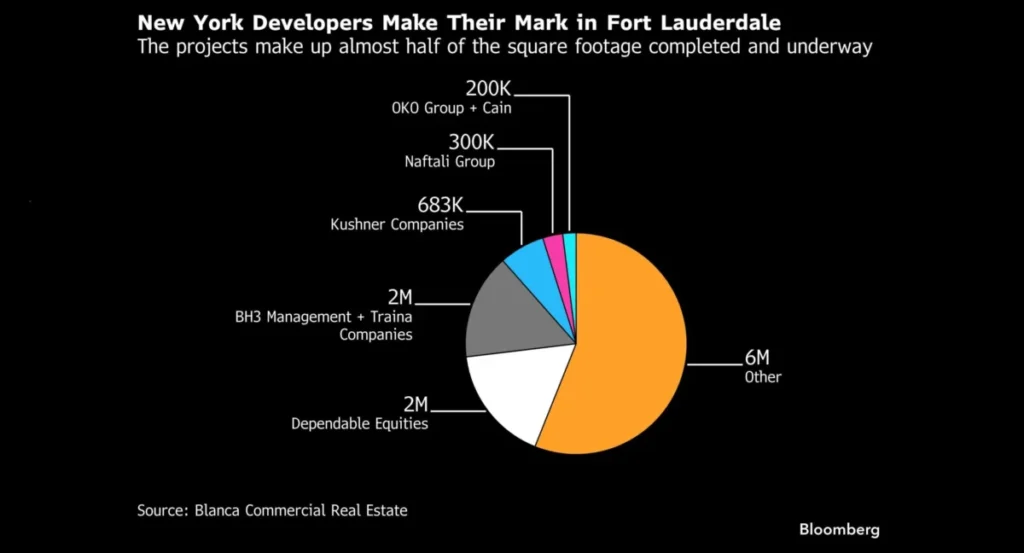
The "New Yorkification" of the market is not just anecdotal. Data from Blanca Commercial Real Estate shows that New York-based firms are currently behind 4.6 million square feet of downtown development, representing nearly 45% of the total pipeline. Perhaps more importantly, these projects are backed by elite financial institutions, such as Apollo Global Management’s Athene Annuity and Life Company, which is financing the city’s future tallest tower.
Official Responses: The Skeptics vs. The Visionaries
The rapid influx of capital has sparked a polarized debate among industry experts and city planners.
The Visionary View
Miki Naftali, a major developer with over 250 units in the Flagler Village district, views the skepticism of the past as irrelevant. "For some people, Miami became too hectic, too busy, too noisy," Naftali explains. "Fort Lauderdale is a fantastic city for those that just want one notch down. We are just at the beginning of the story. In five to ten years, you will see a lot of price appreciation."
Isaac Schlesinger, co-founder of Dependable Equities, draws direct parallels to his success in Brooklyn. His firm’s project, Ombelle, a 754-unit dual-tower development, serves as a litmus test for the city’s future. By integrating high-end amenities like the city’s first Equinox gym, Schlesinger is betting that the local demographic is ready to embrace a luxury lifestyle that mirrors the standards of major global hubs.
The Skeptical View
Not all market observers are convinced the city is ready for such a radical pivot. Peter Zalewski, a prominent South Florida real estate broker, warns that the current luxury boom may be a classic case of developers misreading the room.
"When you’re pitching Fort Lauderdale around the country it makes sense, but then reality hits when you’re on the ground," Zalewski notes. "It’s a suburb with high-rises. The demographic has always been working-class." Zalewski cautions that developers may be overspending, drawing comparisons to the cautionary tale of Panama City, Florida, where outside capital flooded the market only to find that the local economy could not sustain the high-end prices. "We don’t have salaries like Silicon Valley," he warns.
Implications: A City at a Crossroads
The implications of this development wave are profound. For the existing population, the influx of luxury housing brings the promise of improved infrastructure, better retail, and increased tax revenue. The city’s investment in the Las Olas Marina and the commitment to widening sidewalks and improving pedestrian connectivity suggest a municipality intent on curating a "walkable, urban" experience.
However, the rapid escalation in real estate costs threatens the city’s historical appeal as a home for middle-class families. If Fort Lauderdale follows the path of Miami, it risks pricing out the very workers who make the city function, potentially leading to a homogenized urban core that caters exclusively to the affluent.
Ultimately, the success of the current boom will depend on whether the city can balance its newfound corporate identity with its established, laid-back charm. As the New York money continues to pour in and the skyline climbs higher, Fort Lauderdale is no longer just "up and coming." It has arrived at a point of no return. Whether this leads to a sustainable, vibrant metropolis or a glut of empty, high-priced condos remains the defining question of the next decade.
For now, the cranes and the construction crews are the loudest voices in the city, and they are writing the next chapter of South Florida’s history one floor at a time.