The Kimi K3 Shock: How Moonshot AI Upended Global Markets and the Semiconductor Hegemony

The global financial landscape underwent a seismic shift this Friday as the release of Moonshot AI’s latest large language model, Kimi K3, triggered a widespread sell-off across semiconductor and artificial intelligence sectors. The surprise midnight launch, executed with the precision of a strategic military maneuver, sent shockwaves through major exchanges. From Taipei to Tokyo and eventually Wall Street, investors reacted with a familiar, visceral panic: the realization that the moat protecting Western AI incumbents is rapidly evaporating.
Main Facts: The Midnight Breakthrough
Moonshot AI, the Beijing-based startup backed by e-commerce titan Alibaba, dropped Kimi K3 in the early hours of the morning, effectively catching the global tech establishment off guard. The model’s performance metrics have sent ripples of disbelief through the research community. According to the Artificial Analysis Intelligence Index—a composite benchmark evaluating reasoning, coding, mathematics, and general knowledge—Kimi K3 achieved an impressive score of 57.
This puts it in direct, competitive orbit with top-tier models like Claude Fable 5 and OpenAI’s GPT-5.6 Sol, while notably outperforming Claude Opus 4.8 and GPT-5.5. Perhaps more concerning for Western investors is the efficiency of the model; Kimi K3 delivers these performance benchmarks at a fraction of the operational cost of its U.S.-based counterparts.
The company further disrupted the status quo by announcing that full model weights will be released on July 27 under a Modified MIT license. This move ensures that small, independent laboratories and developers worldwide will have access to a state-of-the-art model for free, effectively democratizing the very capabilities that were previously restricted to the world’s most well-capitalized tech giants.
Chronology of a Market Meltdown
The market reaction was swift and unforgiving. As trading desks opened in Asia, the impact was immediate. Taiwan’s benchmark index, heavily weighted by chip manufacturing behemoths, plummeted more than 6%. Japan’s Nikkei followed suit, closing down 4% as the realization dawned that the "AI gold rush" might be facing a supply-demand recalibration.
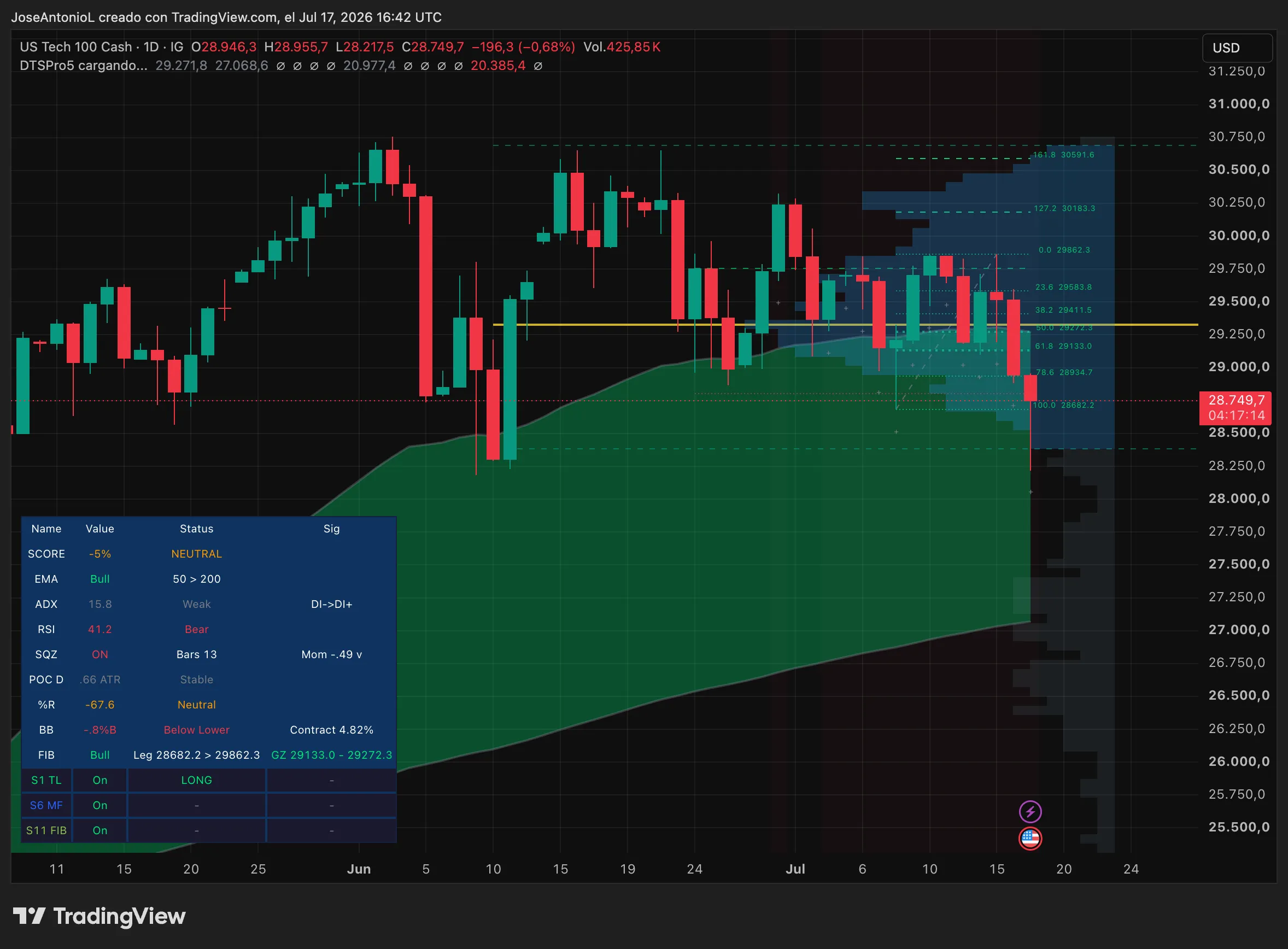
By the time the opening bell rang on the Nasdaq, the contagion had fully crossed the Pacific. The index slid 1.5%, marking its worst trading session of the week. The rout was not limited to software developers or chatbot companies; the hardware backbone of the AI boom—the semiconductor industry—bore the brunt of the selling pressure.
The VanEck Semiconductor ETF (SMH), a bellwether for the chip industry, suffered a technical breakdown, falling below its Exponential Moving Average (EMA) support band for the first time since April. This drop extends a punishing trend that has seen the ETF fall more than 20% from its late-June record high, signaling a potential shift in investor sentiment from "growth at any cost" to "prudent risk management."
Supporting Data: The Erosion of the "Frontier Premium"
The panic surrounding Kimi K3 is not an isolated event; it is a continuation of a narrative that began with the release of DeepSeek’s R1 model in January 2025. That release proved that "frontier AI" does not necessarily require "frontier spending." When DeepSeek R1 hit the scene, it shattered the assumption that massive chip orders and exorbitant data center capital expenditure (CapEx) were the only paths to high-level intelligence. In that single session, Nvidia saw approximately $590 billion in market capitalization vanish.
Kimi K3 represents the next chapter in this erosion. The cost-to-performance ratio provided by the K3 model suggests that the immense, multi-billion-dollar infrastructure investments currently fueling the valuations of U.S. chipmakers may be facing a diminishing return.
The Moonshot Valuation Trajectory
Moonshot AI’s ascent has been meteoric. Founded with the support of Alibaba, which injected $1 billion in 2024 at a $2.5 billion valuation, the startup has seen its paper value skyrocket to approximately $31.5 billion. This valuation, while still a fraction of OpenAI’s or Anthropic’s, is growing at a rate that suggests institutional investors are betting on China’s ability to achieve "algorithmic sovereignty" despite export restrictions on advanced GPUs.
Furthermore, the integration of Kimi models into Western developer ecosystems has been happening under the radar for months. In May, it was revealed that Cursor’s popular "Composer 2" coding assistant had been running on the Kimi K2.5 base model without explicit disclosure. This discovery underscored that the "Made in China" label is no longer a barrier to adoption in the highly competitive U.S. software development market.
Official Responses and Analyst Perspectives
Wall Street’s reaction has been a mix of professional caution and analytical resignation. Bernstein’s Robin Zhu characterized the release as "confirmatory," arguing that the industry should have anticipated this level of progress.
"At a high level, Kimi K3 feels confirmatory of our views that AI state-of-the-art continues to evolve rapidly, and China AI can continue to keep pace with global leaders and take some share over time," Zhu noted in a briefing to clients.
Morgan Stanley analyst Gary Yu took a similar, albeit more measured, stance. He framed the K3 launch not as a sudden "black swan" event, but as the inevitable outcome of steady, compound progress in Chinese LLM research. "K3 has received positive feedback globally," Yu wrote. "It signals an all-round catch-up of Chinese LLMs with U.S. leaders in model size, performance, and pricing."
The sentiment among analysts is clear: the era of unchallenged U.S. dominance in the foundational model space is over. The "catch-up" is no longer a theory; it is a market reality.
Implications: A New Era of AI Geopolitics
The implications of the Kimi K3 launch extend far beyond stock prices.
1. The Shift to Efficiency: The market is now signaling that the "compute-intensive" era of AI development is peaking. If models can achieve similar reasoning capabilities with fewer parameters and lower training costs, the urgency to hoard H100s and B200s may soften, impacting the long-term revenue projections of hardware manufacturers.
2. Open-Source Proliferation: By releasing full weights under a permissive license, Moonshot AI is effectively bypassing the "walled garden" approach of many Western companies. This will likely accelerate the development of localized, enterprise-grade AI in regions that prefer not to rely on US-centric cloud providers.
3. Geopolitical Tensions: The ability of a Chinese firm to iterate at this pace, while operating under restrictive export controls, will undoubtedly lead to renewed debates in Washington regarding the efficacy of current semiconductor sanctions. If China can produce top-tier intelligence with legacy or domestically produced hardware, the strategic objective of "strangling" Chinese AI progress through chip bans may require a significant pivot.
4. Competitive Pressure on Big Tech: Companies like Microsoft, Google, and OpenAI can no longer assume that their lead in intelligence benchmarks is insurmountable. With Kimi K3, the price of entry into the "frontier" has been lowered to near zero. For the incumbents, this means the battle will shift from "who has the best model" to "who has the best distribution and ecosystem integration."
As the market attempts to find a bottom for the semiconductor sector, the Kimi K3 release serves as a stark reminder: in the world of AI, the only constant is the speed of innovation. Moonshot AI has proven that it is no longer just a follower in the global race—it is a frontrunner, and the rest of the world is now playing catch-up to their pace.