The Great Transformation: Why AI and Change Management Dominate the Future of Accounting
The accounting profession stands at a pivotal crossroads. As the digital landscape evolves at an unprecedented pace, the latest CPA Firm Top Issues Survey, conducted by the AICPA’s Private Companies Practice Section (PCPS), reveals that the industry is no longer merely debating the future—it is actively navigating a total systemic transformation. According to the data, change management regarding technology and the rapid proliferation of artificial intelligence (AI) has emerged as the single most critical issue facing CPA firms over the next five years.
This consensus marks a significant departure from previous industry benchmarks, signaling that firm leadership is moving beyond the initial curiosity phase of AI and into the complex, often difficult work of operational integration. While the profession remains fundamentally a "people business," the bridge between human expertise and machine intelligence is currently the most heavily traveled—and contested—territory in the industry.
Main Facts: The New Reality of Practice
The survey, which captured insights from 629 practitioners between April 20 and May 22, paints a picture of a profession grappling with dual pressures: the relentless advancement of automation and the persistent challenge of human capital management.
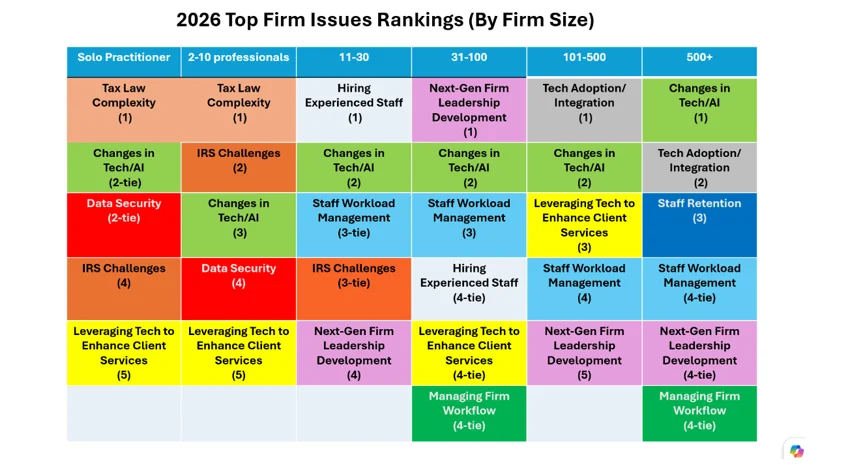
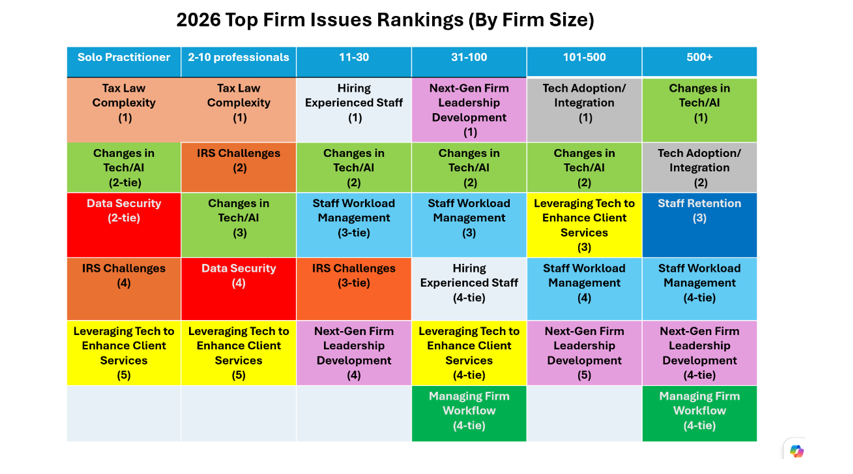
For the first time in recent history, technology-related issues have vaulted from a secondary concern to the primary strategic priority. Two years ago, technology barely cracked the top five for the smallest and largest firm segments. Today, it sits firmly in the top two for five out of the six firm size categories analyzed by the AICPA. This is not just about adopting new software; it is about "change management"—the organizational ability to pivot business models, retrain staff, and redefine service offerings in a world where AI can automate compliance, data entry, and even complex analytical tasks.
Chronology of a Paradigm Shift
To understand how profound this shift has been, one must look at the recent history of the CPA firm landscape.
- 2022: The profession was focused heavily on immediate post-pandemic recovery and the search for qualified talent. Technology was present, but viewed largely through the lens of remote work tools and cloud migration. AI was a background topic, discussed in theoretical terms but rarely identified as an existential priority.
- 2023: As generative AI tools hit the mainstream market, the accounting sector began a rapid evaluation phase. Firms started experimenting with Large Language Models (LLMs) for tax research and document drafting.
- 2024: The current survey reflects the "integration reality." The industry has moved from "What is AI?" to "How do we govern, implement, and profit from AI?" The urgency has shifted from curiosity to a defensive and offensive strategic necessity.
The survey results highlight that as firms grow in size, their relationship with technology changes. For the largest firms (those with more than 500 employees), the struggle is now focused on the logistics of integration and the specific nuances of AI-driven service delivery.
Supporting Data: Disparities by Firm Size
The AICPA report segments firms into six distinct groups, acknowledging that the challenges of a solo practitioner are vastly different from those of a multinational firm. The survey data illustrates a fascinating divergence in priorities based on these operational scales:
The Technology Dominance
Among the two largest firm cohorts (101–500 employees and 500+ employees), technology adoption and AI-related change management hold the top two spots. These firms are at the cutting edge, investing heavily in infrastructure and proprietary AI tools. For them, the barrier to entry is no longer the software itself, but the institutional agility required to implement it across hundreds of workstations.
The Human-Centric Challenges
While technology is the "what," the "how" remains deeply human.
- Solo Practitioners and Small Firms (Up to 10 employees): Tax law complexity remains the primary hurdle. For these practitioners, the sheer volume of legislative change from the IRS leaves little bandwidth to experiment with emerging tech. Data security and IRS communication challenges round out their top concerns.
- Mid-Sized Firms (11–100 employees): These firms are caught in the "growth squeeze." Firms with 11–30 employees identify hiring experienced staff as their primary headache, while those with 31–100 employees are hyper-focused on the next generation of leadership development.
The common thread linking the mid-to-large firms is staff workload management, which appeared in the top four concerns for every group except the smallest practitioners. This indicates that despite the promise of AI to reduce burnout, many firms are currently in the "transition gap," where old manual processes are being phased out but new automated ones have yet to fully ease the burden on staff.
Official Perspectives: The View from the AICPA
Lisa Simpson, CPA, CGMA, and vice president of Firm Services at the AICPA, emphasizes that the survey findings are a reflection of a broader, systemic evolution.
"The top issues for firms tie into the transformation we’re seeing in technology, people skills, and operating models," Simpson stated in the official release. She noted that while firms are generally aware of AI’s potential, the real friction lies in "integrating technology and leveraging it to enhance service offerings."
Simpson also offered a vital reminder for the profession: "On the people side, we’re seeing more focus on reframing job skills, managing staff workload, developing leaders, and evolving services to meet client expectations. Regardless of technology capabilities, accounting is still a people business."
Her comments underscore the danger of "tech-washing" the profession. AI is not a replacement for the CPA; it is a catalyst for the CPA to move into higher-value advisory roles—a transition that requires significant investment in staff training and internal culture shifts.
Implications: The Road Ahead
The implications of this survey are profound for firm owners and the future of the CPA workforce.
1. The Death of the "Compliance-Only" Model
With AI handling the heavy lifting of compliance, tax returns, and basic audit procedures, firms can no longer rely on these services as their sole revenue driver. The data suggests that firms that fail to integrate AI will eventually lose their competitive edge on pricing and efficiency. The firms that succeed will be those that transition their staff from "data processors" to "strategic business advisors."
2. The Talent Re-skilling Imperative
The fact that "job skill shifts" ranked in the top four for all but the two smallest firm groups is a clear mandate for education. Firms must now act as internal training hubs, teaching staff not just accounting standards, but prompt engineering, data analytics, and digital literacy. Recruitment is no longer just about finding someone who knows the tax code; it’s about finding someone who can navigate a tech-forward firm.
3. Quality Management (QM) as a Competitive Advantage
As technology accelerates the speed of output, the risk of error or data security breaches increases. The emergence of "bolstering quality management systems" in the top rankings for larger firms is a direct response to this risk. In an AI-enabled world, trust is the ultimate currency, and robust QM systems are the vault that protects that trust.
4. The Resilience of the Small Firm
Despite the technological focus, it is notable that tax complexity remains the #1 issue for solo practitioners. This highlights the vital role of the "human element" in accounting. Technology cannot solve the political and legislative complexities of the tax code. Small firms that lean into their role as trusted local advisors will likely survive, provided they can master the basic digital tools required to keep their data secure and their operations efficient.
Conclusion
The CPA Firm Top Issues Survey is more than a list of grievances; it is a roadmap for the next five years. The message is clear: the firms that thrive will be those that manage the intersection of human talent and artificial intelligence with intention. The era of "business as usual" is over. Whether it is through navigating the complexity of tax law, managing the stress of a changing workforce, or mastering the integration of AI, the accounting profession is undergoing a profound and necessary evolution. As the data suggests, those who lead the change will define the future of the industry.