The Great Rotation: Why Investors Are Pivoting to Value Amid Tech Volatility

As the global equity markets navigated a turbulent June characterized by a significant technology sector rout, a distinct shift in investor sentiment has emerged. Market participants, rattled by heightened volatility and shifting macroeconomic signals, have begun a decisive migration toward value-oriented strategies. According to the latest fund flow data from State Street Global Advisors, value strategies emerged as the undisputed champion of the month, attracting a substantial $13 billion in net inflows.
This massive wave of capital into value-focused exchange-traded funds (ETFs) has fundamentally altered the landscape of year-to-date allocations. It represents a dramatic reversal from the trend observed over the preceding three months, a period during which growth strategies dominated, capturing a staggering $40 billion. As we move into the second half of the year, this pivot underscores a broader skepticism regarding the sustainability of high-valuation tech momentum and a renewed focus on fundamental strength.
Chronology of the Shift: From Growth Dominance to Value Resilience
To understand the current market environment, one must look at the progression of the last quarter. For much of the spring, investors were riding a wave of AI-driven optimism, pouring liquidity into growth-tilted portfolios. The first three months of this cycle saw growth ETFs acting as the primary engine of portfolio expansion.
However, June marked a "hard pivot." As inflationary concerns persisted and central bank rhetoric remained hawkish, the high-multiple stocks that fueled the growth rally began to experience significant drawdowns. The volatility triggered a flight to safety, or more specifically, a flight to fundamentals. By mid-June, the data from State Street began to reveal a clear trend: investors were no longer chasing speculative upside; they were seeking the defensive insulation of stable earnings, reasonable price-to-earnings ratios, and reliable dividend payouts. This transition wasn’t just a minor reallocation—it was a structural move that has now pushed value-focused ETFs ahead of their growth counterparts on a year-to-date basis.
Deep-Diving For Value: The Structural Advantage of VALQ
In this evolving climate, generic "value" labels are proving insufficient. Many legacy value indices rely on binary style boxes—sorting companies strictly by market capitalization and price-to-book ratios—which can often trap investors in "value traps": companies that are cheap because they are structurally failing.
A more sophisticated approach is found in the American Century U.S. Quality Value ETF (VALQ). Rather than relying on rigid, traditional style boxes, VALQ tracks the American Century U.S. Quality Value Index, which employs a distinct, multi-variable screening architecture. This methodology filters large- and mid-cap U.S. companies based on three non-negotiable criteria:
- High-Quality Earnings: Ensuring the company is generating real profit rather than merely managing accounting outcomes.
- Attractive Relative Valuations: Targeting companies priced at a discount relative to their intrinsic value and peer groups.
- Sustainable Dividend Income: Prioritizing firms with the cash flow health to maintain or grow payouts, providing a floor for total returns during market downturns.
By vetting companies through these three lenses, VALQ effectively filters out speculative "hopes and dreams" plays, focusing instead on firms that can deliver enhanced risk-adjusted returns regardless of broader market noise.

The Role of Tech in Modern Value Investing
A common misconception in the current market is that "value" and "technology" are mutually exclusive. Traditional value indices often exclude tech, fearing the high volatility associated with the sector. However, the performance of VALQ challenges this narrative.
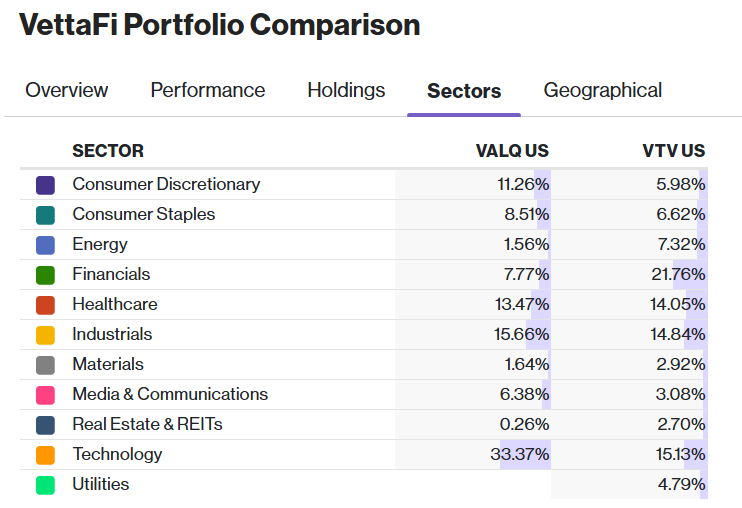
The strategy recognizes that some of the most stable, cash-flow-rich companies in the world now reside within the tech sector. While funds like the Vanguard Value ETF (VTV) lean heavily into traditional sectors such as financials and industrials, VALQ maintains a more nuanced exposure. An analysis of the fund’s holdings reveals that it captures "Quality Tech"—firms that exhibit the fundamental characteristics of value (strong balance sheets, free cash flow) while still operating within the technology ecosystem.
With only a 33% holdings overlap between VALQ and VTV, the divergence in sector allocation is stark. VALQ maintains double the tech exposure of VTV, allowing investors to participate in the upside of the sector without the exposure to the unvetted, high-multiple speculative names that suffered most during the June sell-off. This structural differentiation allows investors to stay invested in the digital economy while maintaining the defensive posture that a value strategy provides.
Data-Driven Performance: The June Attribution
The merit of these fundamental screens was clearly visible in the performance attribution for June. While many traditional value funds struggled to find positive alpha during the tech sell-off, the top performers in VALQ showcased the resilience of companies that possess strong fundamental value.
The top three performers in the fund during June demonstrated that even in a down market, companies with "quality" characteristics—defined by healthy margins and prudent capital allocation—can outperform their benchmarks. This outperformance serves as a proof-of-concept for the fund’s methodology: by filtering for high-quality earnings, the fund successfully navigated the rotation, proving that the right kind of tech exposure is a feature, not a bug, in a value-oriented portfolio.
Implications for the Second Half of the Year
As we enter the latter half of the year, the central question for portfolio managers is whether the rotation into value is a temporary tactical retreat or a permanent shift in investment philosophy. State Street’s recent market commentary suggests that the answer may hinge on the upcoming corporate earnings season in July.
The Earnings Catalyst
The market is currently in a "show me the money" phase. Investors are no longer willing to pay premiums for future growth that may never materialize. If the July earnings season reveals margin compression across the tech sector, we can expect the migration into value strategies to accelerate. Conversely, if tech companies demonstrate an ability to defend their margins through operational efficiency, we might see a more balanced market—one where "Quality Value" funds like VALQ are uniquely positioned to capture both stability and growth.
A Portfolio of Options
The current environment serves as a potent reminder that not all ETFs are created equal. The distinction between "value" and "quality value" is becoming the defining factor in performance. For investors, the takeaway is clear: diversification is no longer just about asset classes; it is about factor granularity.
VALQ stands as a testament to the fact that modern value investing requires a modern approach. By blending the defensive nature of value with the growth potential of high-quality tech, the fund offers a middle path that is increasingly attractive to institutional and retail investors alike.
Strategic Outlook: Beyond the Hype
As investors reassess their allocations for the remainder of the year, the focus will likely remain on risk-adjusted returns. With global macroeconomic uncertainty remaining high—ranging from geopolitical tensions to potential shifts in interest rate policies—the predictability offered by quality-value screens is likely to command a premium.
For those looking to build a resilient portfolio, the lesson of June is that the market is beginning to prioritize the "three pillars": quality, valuation, and income. As these factors gain prominence in the coming months, vehicles that systematically incorporate these metrics will likely outperform traditional, broad-market index funds that remain exposed to the volatility of overvalued, speculative assets.
In conclusion, the migration into value is not just a reaction to a bad month in the markets; it is a recalibration of how investors perceive risk. By focusing on the fundamentals that drive long-term business success, rather than the sentiment that drives short-term price fluctuations, strategies like VALQ provide a roadmap for navigating the complexities of the modern investment landscape.
Disclaimer: VettaFi LLC (“VettaFi”) is the index provider for VALQ, for which it receives index licensing fees. However, VALQ is not issued, sponsored, endorsed, or sold by VettaFi, and VettaFi has no obligation or liability in connection with the issuance, administration, marketing, or trading of VALQ. This article is for informational purposes only and does not constitute financial advice.