The Evolution of the 60/40 Portfolio: Why High Bond Yields Spell a Return to Prudent Risk Management
October 13, 2026
By Ben Carlson
Main Facts
The traditional 60/40 portfolio—consisting of 60% equities and 40% fixed income—has survived a tumultuous decade defying frequent obituaries. Throughout the 2010s and early 2020s, a low-interest-rate environment forced investors to choose between accepting lower projected returns on fixed income or pivoting aggressively toward riskier assets. Many chose the latter, drifting from balanced 60/40 allocations into heavy 80/20 portfolios or diving entirely into the equity markets.
However, contrary to prevailing market narratives predicting the death of diversification, the 60/40 strategy has yielded nearly 8% per year on average over the 2020s. Paradoxically, rather than bonds propping up equities, the equity market carried the heavy load while fixed income struggled under the weight of rising interest rates.
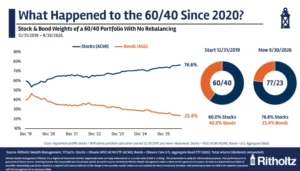
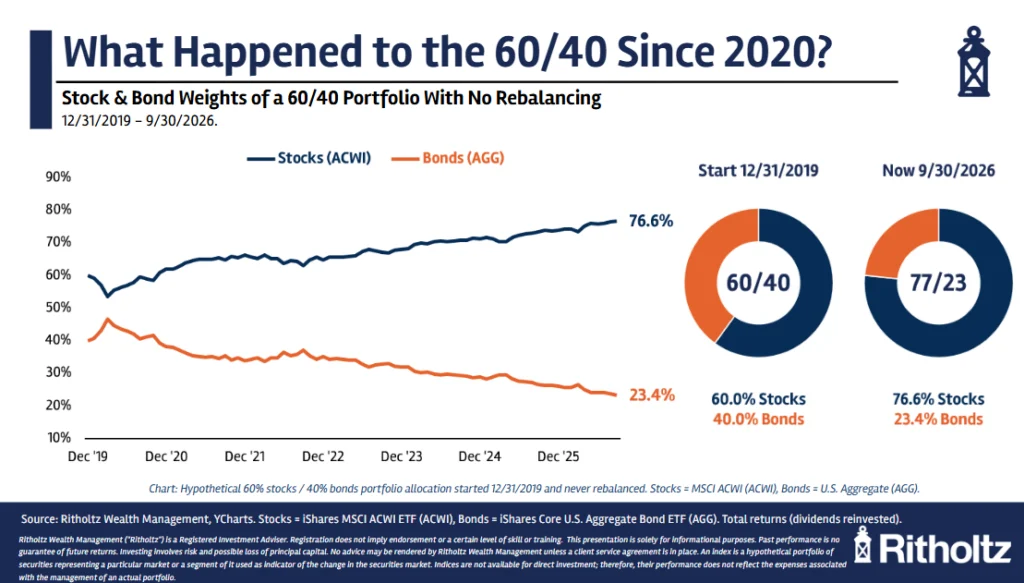
Today, the macroeconomic landscape has fundamentally shifted. For the first time in nearly two decades, high-quality bonds are yielding over 5%. This dramatic recalibration means investors no longer need the stock market to post extraordinary, record-breaking gains to achieve a healthy 7% annual portfolio return. Consequently, financial experts are urging investors to evaluate "style drift"—where an untouched 60/40 portfolio has naturally morphed into a riskier 77/23 allocation due to the historic stock market bull run—and consider rebalancing back to their original target weights.
Chronology
The Low-Yield Era (2010s – Early 2020s)
Following the Global Financial Crisis, central banks around the world pushed interest rates to historic lows. For over a decade, cash and high-quality government bonds yielded close to zero. Investors relying on fixed income to generate income were caught in a yield desert. This forced a massive behavioral shift across retail and institutional investing alike. Portfolios that traditionally relied on bonds to temper volatility were forced to assume significantly higher risk profiles. Many advisors and individual investors systematically abandoned the classic 60/40 split in favor of aggressive equity exposure or alternative risk-on strategies.
The Pandemic Shock and Equity Surge (2020 – 2023)
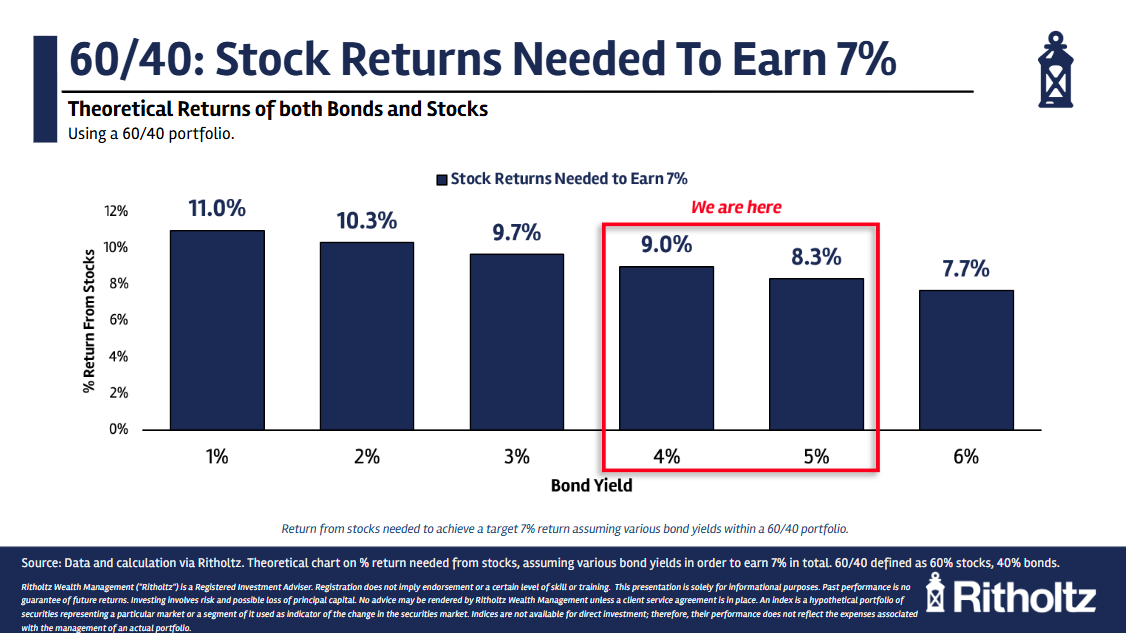
At the onset of the COVID-19 pandemic in early 2020, bond yields plummeted even further, reaching historic lows. Analytical modeling from this period indicated that investors needed unprecedentedly high returns from the stock market simply to achieve a modest 7% blended portfolio return. Fortunately for equity holders, aggressive fiscal stimulus and a massive tech-driven boom ignited an unexpected, multi-year bull market. While bond returns were miserable during the initial inflation spike and subsequent rate hikes, the equity markets more than compensated, keeping balanced funds like Vanguard’s LifeStrategy 60/40 fund on a trajectory averaging nearly 8% annualized returns for the decade.
The Yield Renaissance and The Rebalancing Dilemma (2024 – 2026)
As central banks fought inflation by aggressively raising rates through the mid-2020s, fixed-income yields finally normalized, eventually breaching the 5% threshold for high-quality bonds. This milestone created a completely new paradigm: a generation of investors who had never witnessed meaningful yield in fixed income suddenly had a viable, low-risk alternative to equities. Yet, because the equity market’s bull run proved exceptionally resilient—partially fueled by the massive enterprise buildout of artificial intelligence (AI)—unmanaged 60/40 portfolios organically drifted into heavily stock-weighted allocations (averaging around 77% equities and 23% bonds by late 2026). As a result, financial strategists have begun sounding the alarm on passive risk accumulation, advocating for disciplined rebalancing.
Supporting Data
To understand the mechanics of portfolio return requirements during different interest rate regimes, financial researchers have tracked the mathematical relationship between bond yields and required equity returns:
- The 7% Bogey Benchmark: To achieve a hypothetical 7% annual return in a standard balanced framework when bond yields hover near zero (as they did in early 2020), the equity component must pull immense weight, requiring double-digit returns year after year.
- The Decade Performance: Despite abysmal bond performance during the bond bear market of the early-to-mid 2020s, balanced options such as Vanguard’s LifeStrategy 60/40 fund have posted annualized gains nearing 8% throughout the decade.
- Style Drift Calculations: A hypothetical 60/40 portfolio left completely untouched since the beginning of 2020 has experienced severe style drift. Due to outsized equity appreciation, that classic mix has naturally shifted to approximately 77% equities and 23% bonds, dramatically increasing the portfolio’s overall volatility profile without any active intervention from the investor.
- The New Yield Threshold: For the first time in nearly 20 years, high-quality fixed-income instruments are offering yields north of 5%. This effectively lowers the hurdle rate for balanced portfolios, allowing investors to secure predictable income streams without over-allocating to volatile equities.
Official Responses and Expert Insights
Market analysts and wealth management professionals have weighed in heavily on the psychological and mechanical challenges of managing portfolio risk during extended bull markets.
- On the Survival of Diversification: Financial commentators emphasize that the 60/40 portfolio did not fail; rather, it proved that diversification functions dynamically. While bonds historically buffer equity downturns, the past decade demonstrated that a roaring stock market could successfully carry the portfolio when fixed income lagged.
- On the Psychology of Rebalancing: Industry experts readily acknowledge that rebalancing feels counterintuitive during a roaring bull market. Selling off top-performing assets—such as high-flying technology or AI-adjacent equities—goes against human emotion. However, financial planners stress that rebalancing is not a bet against future growth, but a vital act of disciplined risk management designed to protect capital when market dynamics inevitably reverse.
- On Asset Allocation and Tail Risk: Wealth strategists reiterate that asset allocation must be anchored to an individual’s personal risk profile, time horizon, and emotional disposition rather than short-term market euphoria. Because no one can accurately predict whether the AI infrastructure boom will extend the bull market for another five years or whether an unforeseen economic shock or recession is waiting around the corner, diversification remains the ultimate safeguard against the unknown.
Implications
The transition back to a high-yield fixed-income environment carries profound implications for individual investors, institutional funds, and the broader financial planning industry.
1. The Relief of Lower Return Hurdles
For years, investors chasing a 7% return were forced to accept uncomfortable levels of market volatility. With high-quality bonds now paying upwards of 5%, the math of investing has fundamentally changed. Investors can construct balanced portfolios that generate respectable yields entirely from the fixed-income side, significantly reducing the pressure on equities to "knock it out of the park." This is particularly impactful for retirees and conservative investors looking to de-risk their holdings.
2. Confronting Unintentional Style Drift
Millions of investors who set up balanced allocations years ago are now sitting on portfolios that are far riskier than they realize. An unmonitored 77/23 equity-heavy split exposes portfolios to sharp drawdowns should a sudden market correction or macroeconomic recession materialize. Recognizing and correcting this drift through structured rebalancing is critical to ensuring that an investor’s actual risk exposure matches their psychological tolerance.
3. The Enduring Value of Process Over Prediction
Attempting to time the market—guessing whether the current bull run will persist through continued technological innovation or collapse due to unforeseen shocks—is a fool’s errand. The core lesson of the modern 60/40 evolution is that preparation matters far more than prediction. A robust investment framework relies on three non-negotiable pillars:
- A defined asset allocation tailored to personal goals and constraints.
- A clear diversification strategy designed to minimize regret across different economic environments.
- A disciplined rebalancing policy that removes emotion from portfolio management, ensuring that investors systematically buy low and sell high, no matter how uncomfortable it feels in the middle of a raging bull market.