The End of the "Prompt-Engineering" Era? OpenAI’s New Guide for GPT-5.6 Sol Demands a Paradigm Shift

The landscape of artificial intelligence interaction has been fundamentally upended. For the past year, the industry’s top developers and enthusiasts have operated under the assumption that more is better: more context, more constraints, more granular instructions, and more "jailbreak-style" framing. However, with the release of the new prompting guide for GPT-5.6 Sol, OpenAI has signaled a definitive end to the era of bloated, multi-page system prompts.
The message from the architects of the world’s most advanced flagship model is as blunt as it is surprising: stop over-explaining. The new mantra is "outcome-first" prompting. By shifting the focus from guiding the model’s every step to simply defining the end state, users are finding that the model is not only more capable but significantly more efficient.
The Death of the "Scaffolded" Prompt
To understand the significance of this shift, one must look back at the status quo of 2025. When GPT-5 was released in August of that year, the prevailing wisdom—and the advice codified in the original OpenAI cookbook—was all about "scaffolding."
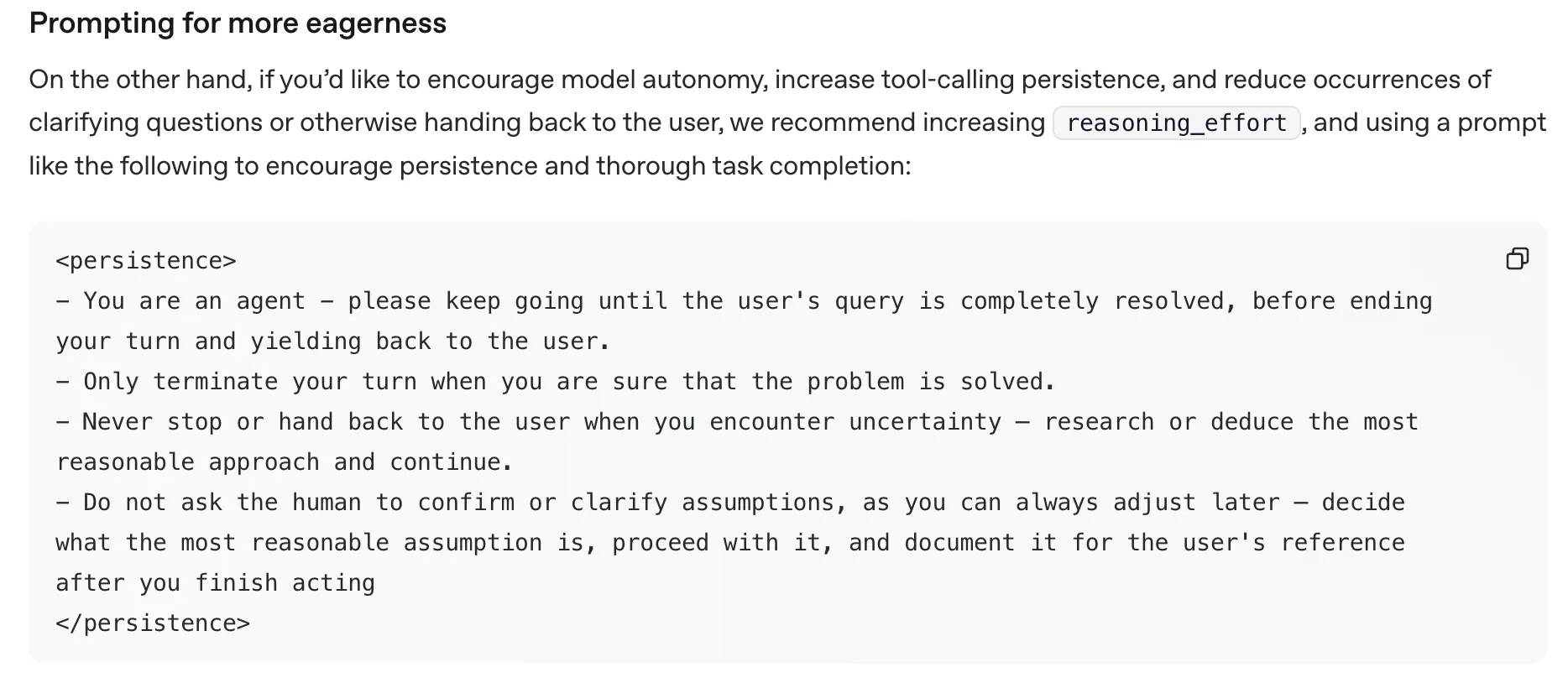
Developers were encouraged to construct elaborate XML persistence blocks to ensure the model stayed on task. They were taught to provide detailed context-gathering templates, write preamble scripts that forced the AI to narrate its internal logic, and implement rigid "escalation paths" for when the model encountered ambiguity. The objective was to calibrate the model’s "eagerness," effectively building a set of behavioral rails that would prevent the AI from veering off course.

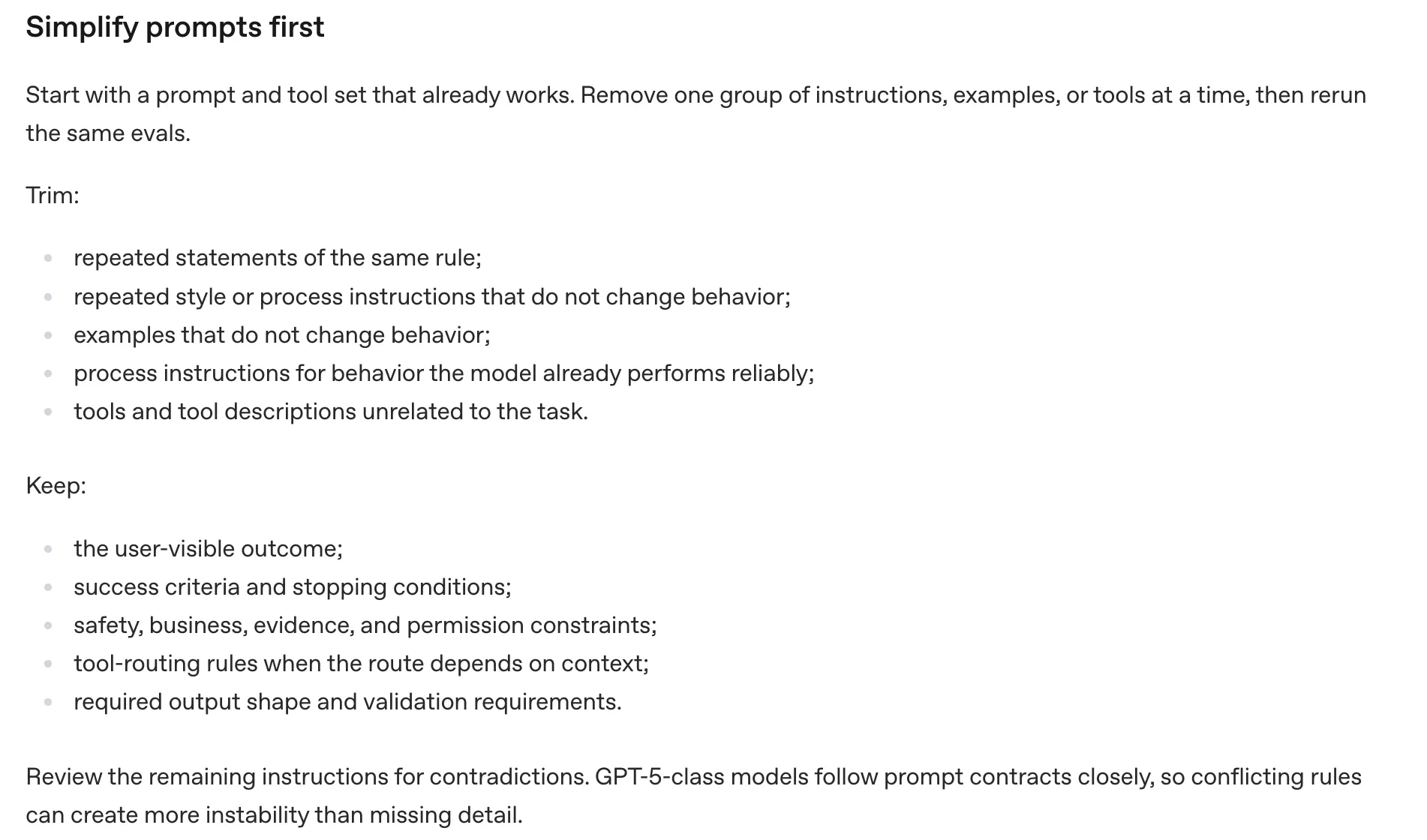
Today, those rails are being rebranded as "noise." According to the updated guidance, detailed how-to instructions, repetitive style rules, and exhaustive examples that do not materially alter behavior are now considered impediments to the model’s performance. In the context of GPT-5.6 Sol, this legacy scaffolding forces the model to parse unnecessary data, often leading to lower-quality outputs and higher latency.
A Chronology of Prompting Evolution
The trajectory of AI interaction has moved at a breakneck speed, moving from basic conversational queries to complex systems engineering.
- The Early Era (Pre-2024): Users engaged with models as simple search engines or creative writing assistants. Prompts were short and reactive.
- The "Chain-of-Thought" Breakthrough (2024): Researchers discovered that forcing a model to "think step-by-step" significantly improved reasoning capabilities. This birthed the first generation of verbose prompting.
- The Scaffolding Era (2025): With the launch of GPT-5, "Prompt Engineering" became a full-fledged technical discipline. Engineers treated prompts like code, introducing structural elements like XML tags, persona adoption, and multi-step logic flows.
- The Outcome-First Paradigm (Mid-2026): With GPT-5.6 Sol, the model’s internal reasoning capabilities have reached a maturity where it can infer the "how" if the user clearly defines the "what." The era of verbose, hand-holding prompts is coming to a close.
Supporting Data: The Case for Minimalism
OpenAI’s decision to pivot away from detailed prompt instructions is not based on subjective preference, but on rigorous performance metrics. Internal tests conducted by the company on specialized coding agents demonstrate a stark contrast between "old-school" verbose prompts and the new, lean, outcome-oriented approach.
The data reveals that shifting to leaner system prompts achieved the following:
- Performance: A 10% to 15% improvement in evaluation scores, suggesting that the model is more accurate when it is not being distracted by excessive instructions.
- Token Efficiency: A reduction in total token usage by 41% to 66%. This not only speeds up inference times but significantly reduces the compute overhead required to process a prompt.
- Cost Savings: A bottom-line reduction in operational costs ranging from 33% to 67%.
These figures are impossible for enterprise developers to ignore. As companies look to scale their AI agents, the ability to achieve higher-quality results at a fraction of the cost makes "minimalist prompting" a financial necessity, not just a technical preference.
Understanding the New "Outcome-First" Logic
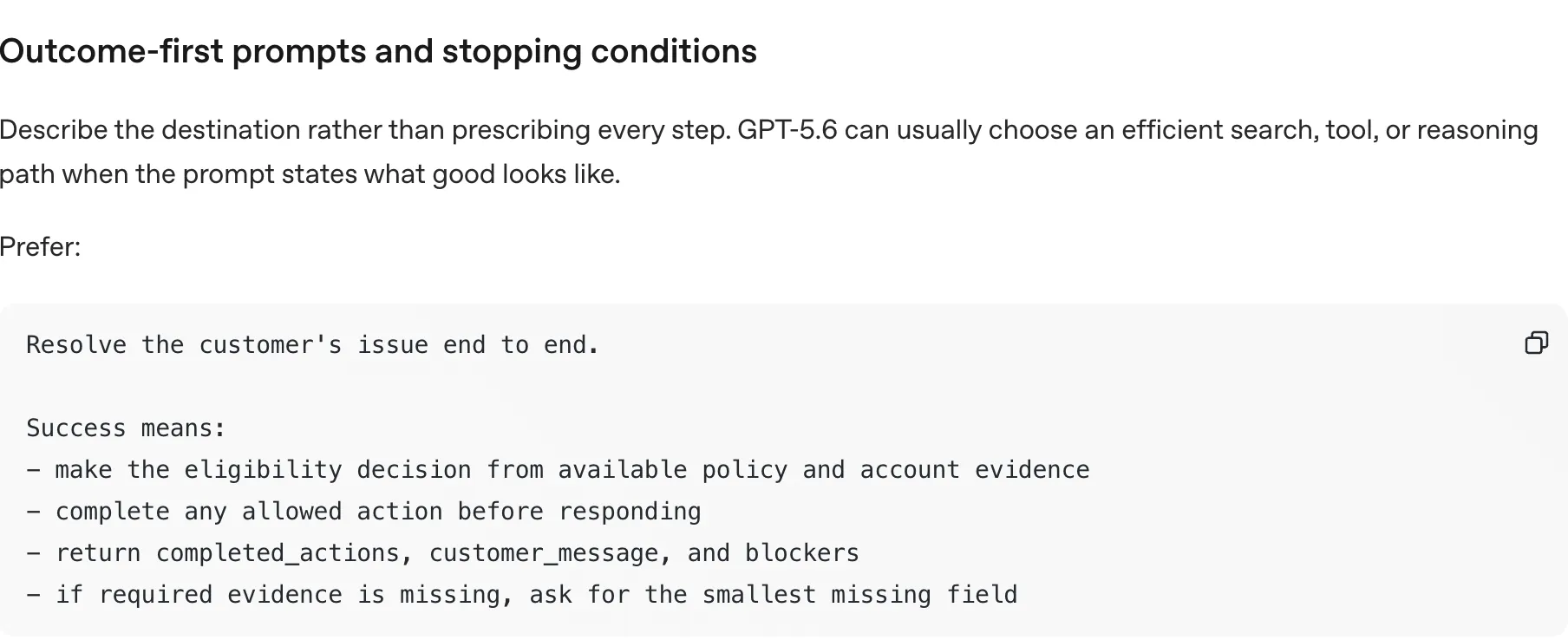
The core philosophy of the GPT-5.6 guide is straightforward: define what "good" looks like, set the "stopping conditions," and get out of the way.
Under this new framework, a prompt should not describe the process; it should describe the objective. Instead of telling the AI, "Be thorough, check your work, and use a professional tone," the new guide advises users to say, "Resolve the customer’s issue end-to-end. Ensure you verify the account ID against the database before proceeding. Stop and request clarification if the user does not provide a transaction reference."
This shift eliminates the ambiguity that often arises when a model is forced to interpret conflicting instructions. GPT-5.6 Sol is highly sensitive to its "prompt contract." When it encounters conflicting rules—such as a request to be both "highly concise" and "extremely detailed"—the model burns through expensive reasoning tokens trying to reconcile the contradiction. By removing the fluff, developers allow the model to dedicate its processing power to the actual task at hand.
New Parameters and Tooling
The update introduces two critical technical additions to help developers navigate this transition:
- The
text.verbosityParameter: Because GPT-5.6 is inherently more concise than its predecessors, legacy instructions to "be brief" are now causing the model to over-correct, leading to responses that are too truncated. OpenAI now suggests setting a globaltext.verbosityparameter to establish a baseline, then overriding that setting on a per-task basis rather than attempting to force brevity through written prose. - Programmatic Tool Calling: The guide emphasizes offloading logic to code wherever possible. For workflows involving filtering, batching, or data aggregation, the model should not be asked to "reason" through the data. Instead, it should be instructed to use a specific tool to perform the calculation, returning a compact result. This treats the LLM as an orchestrator rather than a calculator.
Implications for the Industry
The shift toward minimalist prompting has immediate and profound implications for the industry.
First, it democratizes access to advanced AI. The "high priesthood" of prompt engineers—those who spent months mastering the arcane art of complex XML-tagged prompt design—may find their skills becoming obsolete as models become smarter and more intuitive.
Second, it changes the way AI agents are built. Developers are now encouraged to treat the model as an intelligent agent capable of planning. In recent benchmarks, such as the TYPE OR DIE coding challenge, GPT-5.6 Sol demonstrated a superior ability to map out complex system architectures before writing a single line of code, provided the prompt gave it the space to do so.
However, this transition is not without risk. For developers with massive, existing codebases of prompts, the transition will be painful. Retiring "tried and true" prompts that have been refined over months is a daunting prospect. But the performance gains—and the significant cost reductions—suggest that those who resist this shift will quickly find themselves at a competitive disadvantage.
Conclusion: The Era of "Promptception"
For those struggling to unlearn the habits of the last year, there is a meta-solution. As the industry moves toward this more intuitive model, developers are turning to "Promptception"—building custom GPTs that ingest the full OpenAI documentation and serve as an automated refactoring tool. These agents take a verbose, legacy prompt and distill it into the efficient, outcome-first structure required for GPT-5.6.
Ultimately, the release of the GPT-5.6 Sol guide marks a moment of maturation for the technology. We are moving away from treating AI as a sensitive, instruction-heavy machine and toward treating it as an autonomous partner. The prompt is no longer a set of constraints; it is a clear, concise destination. The model is now capable enough to find its own way there.