The Closing Gate: How the New Student-Visa Policy Signals an Erosion of the American Dream
By Pinelopi Koujianou Goldberg
July 22, 2026
For generations, the United States distinguished itself on the global stage not merely through the sheer scale of its economic output or the reach of its military prowess, but through a unique, foundational promise: that a person’s potential was not bound by the coordinates of their birth. The "birthplace lottery" was a hurdle that America—the land of opportunity—promised to help ambitious individuals overcome. By welcoming the world’s brightest minds, the U.S. cemented its status as the global epicenter of innovation, academia, and cultural exchange.
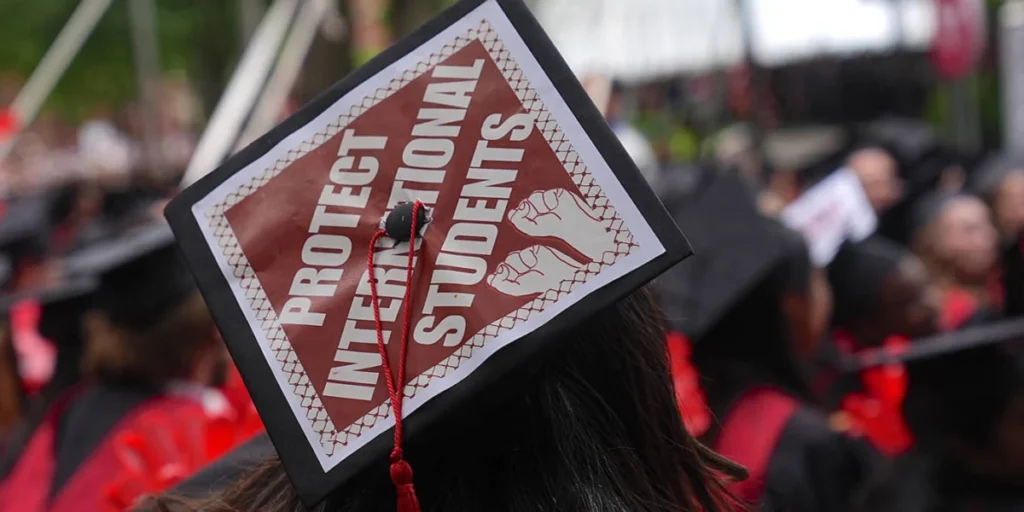
However, the Trump administration’s newly finalized policy regarding international student visas threatens to dismantle this legacy. While officials have framed the policy as a modest, technical administrative adjustment aimed at curbing "visa abuse," the reality is far more significant. This shift represents a calculated retreat from the openness that once defined the American project, signaling to the global community that the doors to the American dream are no longer swinging wide, but are slowly being bolted shut.
The Core of the Change: What the New Policy Entails
At its heart, the new directive from the Department of Homeland Security (DHS) introduces a complex layer of oversight for international students, particularly those enrolled in programs that the administration deems susceptible to exploitation. While the official DHS press release suggests the rule is designed to "strengthen program integrity," the practical application creates an environment of profound uncertainty for prospective and current students alike.
The policy mandates more rigorous reporting requirements for universities and imposes stricter time limits on stay-durations for specific visa categories. By tightening the criteria for "duration of status" (D/S), the administration is effectively placing international students under a state of permanent probationary observation. What was once a predictable path—allowing students to complete their studies and gain professional experience through Optional Practical Training (OPT)—has now been recast as a precarious privilege, subject to the shifting whims of bureaucratic interpretation.
A Chronology of Retrenchment
To understand the weight of this decision, one must view it not as an isolated event, but as the culmination of a decade-long shift in immigration sentiment.
- 2017–2020: The initial Trump administration term set the tone with the "Buy American, Hire American" executive order, which began the process of scrutinizing H-1B visas and tightening the pathways for foreign-born graduates to transition into the U.S. workforce.
- 2021–2024: During the intervening years, despite a pivot toward more liberalized immigration policies, the infrastructure for restriction remained in place, and a growing domestic political consensus began to view "foreign dependence" in education as a national security risk.
- Early 2026: The Department of Homeland Security initiated a review of student visa issuance, citing concerns regarding the oversight of "non-traditional" degree programs.
- July 16, 2026: The administration officially published the final rule, codifying the restrictions into federal law, effective immediately for new applicants.
- July 22, 2026: The policy meets immediate outcry from the higher education sector, with major universities warning of a precipitous drop in international enrollment.
Supporting Data: The Economic and Academic Cost
The decision to restrict student visas comes at a time when the American higher education sector is already reeling from demographic shifts and rising costs. International students have long served as a vital financial lifeline for American universities, subsidizing research and keeping smaller institutions solvent.
According to data from the Institute of International Education (IIE), international students contributed over $40 billion to the U.S. economy in the 2024–2025 academic year alone. Beyond the tuition revenue, the academic impact is profound. In critical fields such as Artificial Intelligence, quantum computing, and biotechnology, international graduate students constitute the majority of researchers at many top-tier American institutions.
"If you restrict the talent pipeline, you are not just hurting the universities; you are sabotaging the future of American technological hegemony," argues Dr. Elena Vance, a senior analyst in education economics. "The data shows a direct correlation between the presence of foreign-born STEM researchers and patent filings. When we make it harder for these students to stay, they do not simply vanish; they move to Canada, the UK, or Germany, taking their innovation—and their future tax dollars—with them."
Furthermore, the "visa abuse" argument—the administration’s primary justification—remains statistically thin. DHS internal audits have consistently shown that visa overstay rates for students are among the lowest of any immigration category, consistently hovering below 1.5%. By focusing on this sector, the administration is solving a problem that does not exist while creating a barrier to entry that is already being exploited by global competitors.
Official Responses and Political Friction
The administration’s stance remains resolute. In a statement released following the publication of the rule, a DHS spokesperson emphasized that the changes are "essential for national security," arguing that the U.S. must ensure its educational system is not being used as a "backdoor for foreign interests to gain unfettered access to American intellectual property."
However, this rhetoric has found little support among university presidents and corporate leaders. The Association of American Universities (AAU) issued a sharp rebuttal, calling the rule "counterproductive and exclusionary." In a joint statement, the presidents of the Ivy League institutions warned that "the strength of American research is built on the diversity of our scholars. By turning away the best and brightest, we are choosing to dim our own future."
On Capitol Hill, the reaction has been predictably polarized. While populist factions within the Republican party have lauded the move as a long-overdue step toward "protecting American students," Democratic lawmakers have characterized the policy as a xenophobic overreach. "We are effectively telling the world that America is no longer the destination for those who want to build the future," said Senator Marcus Thorne (D-CT). "This isn’t about security; it’s about closing our borders to the world’s talent because we fear the competition."
Implications: A Shift in Global Standing
The implications of this policy extend far beyond the ivory tower. We are witnessing a fundamental recalibration of American soft power. For decades, the ability of the United States to attract the world’s most ambitious youth served as a form of diplomatic insurance. Students who studied in the U.S. often returned to their home countries as "ambassadors" of American values, democratic norms, and free-market ideals.
By making the U.S. a less hospitable environment, the administration is actively ceding this cultural influence. As international students look toward alternatives in Europe and Asia, the long-term ties that bind the U.S. to the global elite will begin to fray.
Moreover, the psychological impact on the "outsider" cannot be overstated. The message being sent is that the United States is no longer a meritocracy that rewards ambition, but a gated community concerned with protecting its borders from the very people who have historically driven its prosperity.
The Road Ahead
As the 2026 academic year approaches, the true cost of this policy will begin to manifest in empty desks, stalled research projects, and a palpable decline in the diversity of thought that has long been the hallmark of American excellence. The administration may view this as a victory for "order," but history will likely view it as a costly error.
America’s strength has never been a static quality; it has always been a dynamic process, fueled by the arrival of the next generation of dreamers. By choosing to restrict that flow, the United States is not protecting its interests—it is merely accelerating its own decline. We are entering an era where the gate is closing, and the light of the American dream is, perhaps, dimming in the eyes of those who once looked to us as their beacon of hope.