The Android Moment for Robotics: Alibaba Unveils the Qwen-Robot Suite
In a move that signals a seismic shift in the field of embodied artificial intelligence, Alibaba’s Qwen team officially unveiled the Qwen-Robot Suite this Tuesday. This modular, full-stack foundation model ecosystem aims to serve as the "operating system" for the next generation of physical agents. By decoupling the "brain" of a robot from its specific hardware, Alibaba is attempting to do for robotics what Android did for mobile computing: creating a standardized, scalable software layer that can power a diverse array of physical machines.
The suite comprises three distinct, interoperable models: Qwen-RobotNav for navigation, Qwen-RobotManip for physical manipulation, and Qwen-RobotWorld for simulating the physics that underpin these actions. While these models function as independent units, they are designed to be composable, offering a comprehensive, language-conditioned architecture that translates human intent into physical reality.
The Full-Stack Strategy: A Vertical Bet
Alibaba occupies a unique position in the global technology landscape. As one of the few organizations in China—and indeed the world—that possesses end-to-end control over the technological value chain, the company maintains stakes in everything from proprietary AI chips and cloud computing infrastructure to foundation models and consumer-facing applications.
For Alibaba, the Qwen-Robot Suite is not merely a research project; it is the physical manifestation of their broader AI strategy. By integrating these models into their existing cloud and hardware ecosystems, the company is positioning itself as the primary architect of the "embodied AI" era. While competitors often rely on fragmented partnerships, Alibaba’s ability to control the stack from silicon to simulation allows for a level of optimization that few others can replicate.
Chronology of Development: From LLMs to Physical Agents
The transition from traditional machine learning to generative AI for robotics has been marked by a shift in how agents process information. For years, robotics relied on rigid, task-specific models that excelled in controlled environments but failed when faced with the unpredictability of the real world.
- Pre-2024: Robotics development was largely siloed, with navigation and manipulation treated as separate, non-overlapping engineering problems.
- Early 2025: Research began to coalesce around "Embodied AI," the concept that an AI agent needs a world model—an internal understanding of physics—to interact safely with its environment.
- Tuesday, June 16, 2026: Alibaba officially introduces the Qwen-Robot Suite, bridging the gap between large language models (LLMs) and physical action.
- Post-Launch: The company initiates pilot programs, focusing on integrating the suite with hardware partners including AgileX, Franka, Universal Robots, and Unitree.
Supporting Data and Technical Breakthroughs
The effectiveness of the Qwen-Robot Suite is anchored in massive data synthesis and novel architectural designs that address the "long tail" of robotics failure.
Qwen-RobotNav: The Unified Navigator
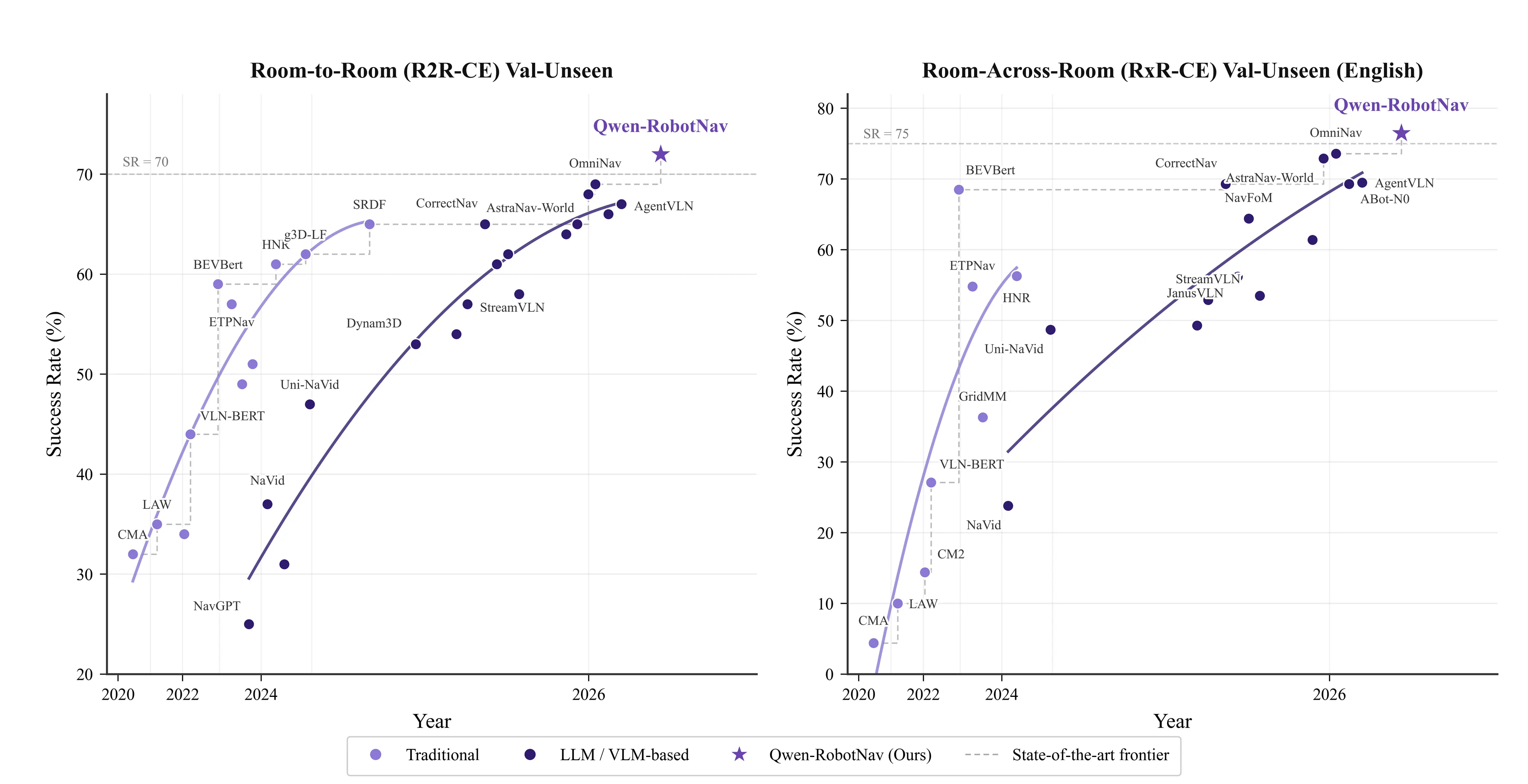
Most navigation models are "hardcoded" to a specific visual strategy. Qwen-RobotNav breaks this mold by offering a parameterized interface that allows a planner to adjust its "token budget," "temporal decay," and "per-camera weights" in real-time. Trained on 15.6 million samples with randomized parameters, the model has set new industry standards:
- 76.5% success rate on the VLN-CE RxR benchmark, which tests vision-and-language navigation in complex, real-world environments.
- 90% tracking accuracy on the EVT-Bench, proving the agent’s ability to maintain focus on moving targets despite visual noise.
Qwen-RobotManip: Bridging Incompatible Action Spaces
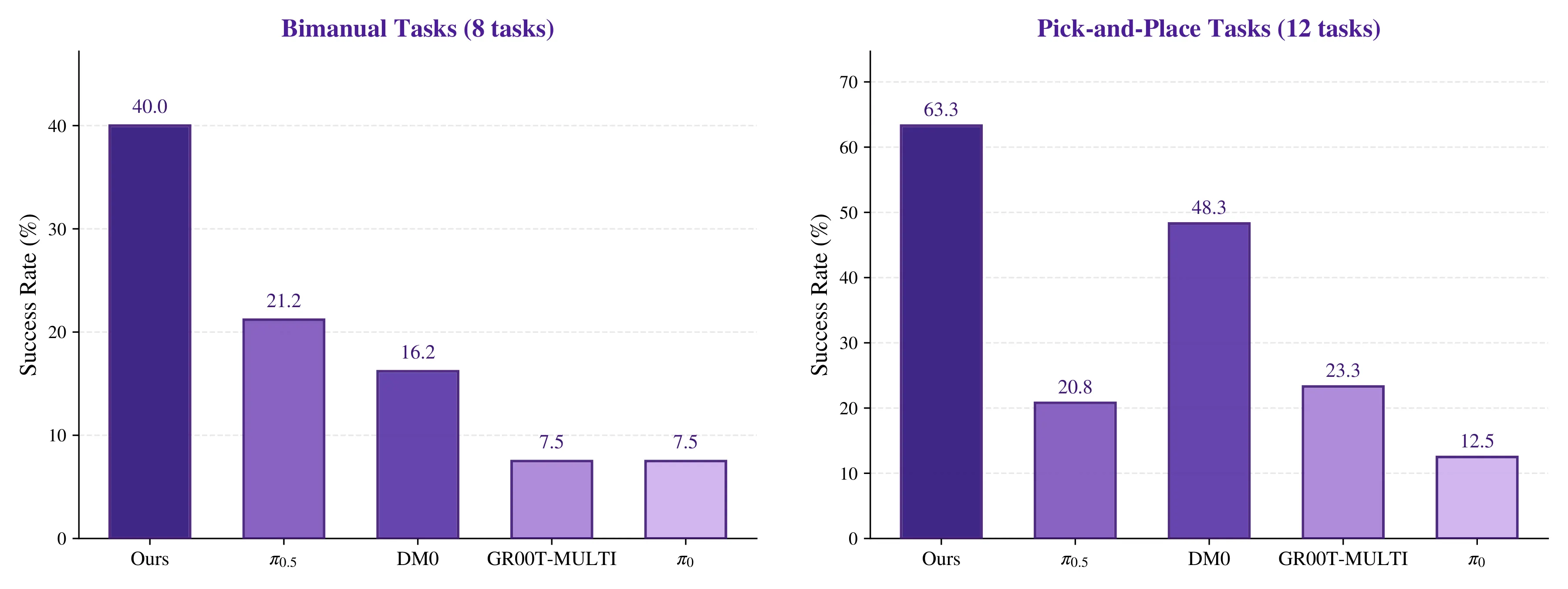
A primary hurdle in robotics is "morphological incompatibility." A seven-axis Franka arm and a bimanual ALOHA robot represent movement in entirely different coordinate systems. Qwen-RobotManip addresses this by synthesizing 38,100 hours of training data from open-source datasets and human videos. By learning to map various action spaces into a common latent representation, it has achieved the top rank on the RoboChallenge Table30-v1, outperforming previous state-of-the-art approaches by a 20% margin.
Qwen-RobotWorld: The Physics Engine
Qwen-RobotWorld serves as the suite’s "world model," treating natural language as a universal interface for physical outcomes. With a corpus of 8.6 million video-text pairs—amounting to 200 million frames—the model demonstrates a profound understanding of Newton’s laws, mass conservation, and fluid dynamics. It consistently outperforms open-source alternatives on benchmarks like EWMBench and DreamGen Bench, proving that it doesn’t just predict that an object breaks, but how it breaks, including shatter patterns and secondary collisions.
Official Stance and Clarifications
In its technical blog and public statements, the Qwen team has been careful to manage expectations. They emphasize that these models are "brains, not bodies." They do not manufacture the robots; they provide the cognitive architecture that allows these machines to interpret and react to the world.
Furthermore, the team distinguishes their work from standard LLMs. While a chatbot predicts the next word in a sequence, Qwen-RobotWorld predicts the next state of a physical system. The distinction is critical: where an LLM provides a semantic description of an event, the Qwen suite provides the spatial and causal planning necessary to prevent or facilitate that event.
Implications: The Long Road to Autonomy
The implications of this launch are profound, yet the path toward widespread adoption remains fraught with challenges.
The "Demo-to-Reality" Gap
Alibaba acknowledges a fundamental truth in robotics: the transition from a controlled lab demo (such as picking up a red cup) to a reliable home-assistant robot is immense. The "long tail" of edge cases—sensor drift, lighting changes, unexpected surface textures, and mechanical wear—has humbled countless engineering firms. While the suite’s simulation benchmarks are impressive, they are only the first step.
Competitive Dynamics
Western labs such as Google DeepMind, Nvidia, and Physical Intelligence are pursuing similar, highly capable models. However, Alibaba’s unique differentiation lies in its "open-source-first" foundation for research, which serves to accelerate the collective intelligence of the robotics community. By providing an open platform, they are effectively building a moat not through exclusivity, but through standard-setting.
Future Outlook
As of now, Alibaba has remained tight-lipped regarding pricing models, commercial timelines, and the specific companies involved in their pilot programs. However, the industry consensus is clear: we have moved past the era of static, pre-programmed industrial robots.
The Qwen-Robot Suite represents a shift toward "generalist" physical intelligence. If successful, this technology will move beyond the factory floor and into warehouses, hospitals, and eventually, the home. While we are years away from a domestic robot that can handle the unpredictability of a busy household, Alibaba has provided the most cohesive, scalable, and physically aware toolkit to date.
The "Android moment" for robotics is no longer a hypothetical future; with the release of the Qwen-Robot Suite, the infrastructure for a world of intelligent, physical agents is finally being laid. The question is no longer whether robots will become general-purpose, but how quickly they can learn to navigate the messy, chaotic reality of our human world.