The AI Supercycle: How Thematic ETFs are Redefining Market Architecture in 2026

The global financial markets are currently undergoing a structural transformation as profound as the dawn of the internet age. As we pass the midpoint of 2026, the narrative is no longer just about the promise of artificial intelligence; it is about the massive, tangible capital expenditure (capex) cycle required to sustain it. Investors are increasingly viewing AI not as a transient trend, but as a multi-decade "supercycle" that is fundamentally reshaping computing, infrastructure, and industrial productivity.
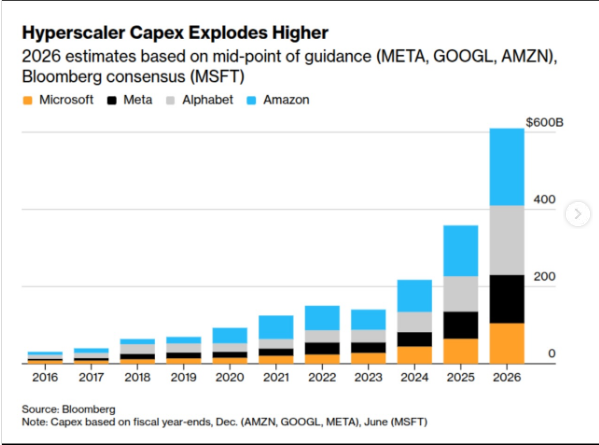
This shift is underscored by staggering levels of investment from the world’s largest technology firms. Bloomberg estimates that hyperscalers—specifically Alphabet, Microsoft, Amazon (via AWS), and Meta—are projected to deploy over $600 billion in aggregate capital this year alone to build out the AI ecosystem. This massive liquidity injection is acting as the bedrock for a new era of "agentic AI," where autonomous systems facilitate complex tasks—from travel logistics to intricate communications—without human intervention.
The Chronology of the 2026 AI Surge
The second quarter of 2026 served as a crucible for thematic investing, cementing the dominance of AI and its peripheral sectors in institutional and retail portfolios alike.
- Early April: The launch of the Roundhill Memory ETF (DRAM) on April 2 set the tone for the quarter. By focusing on the critical bottleneck of AI—high-speed memory production—the fund tapped into an insatiable demand from hyperscalers.
- Mid-June: The long-awaited SpaceX IPO on June 12 acted as a catalyst for the space economy, drawing significant attention to thematic ETFs and forcing index providers to expedite the inclusion of the aerospace giant into major benchmarks, including the NASDAQ 100.
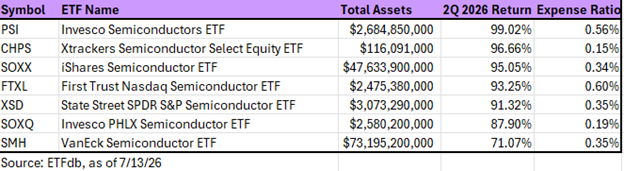
- End of Q2: By June 30, the thematic ETF landscape had recorded performance figures that defied historical averages, with specialized semiconductor and AI-focused funds posting triple-digit gains, effectively decoupling from broader market volatility.
Supporting Data: The Anatomy of the AI Boom
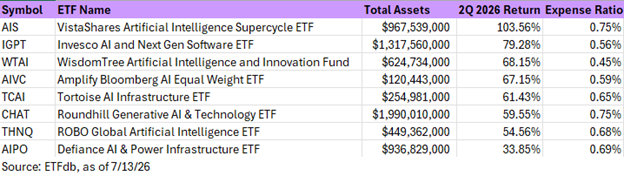
The performance of thematic ETFs in Q2 2026 provides a clear window into how capital is flowing through the semiconductor and infrastructure stack.

The Rise of AI-Thematic Leaders
The VistaShares Artificial Intelligence Supercycle ETF (AIS) emerged as the clear leader in the AI category. By adopting an actively managed approach with a global basket of infrastructure-heavy names, AIS delivered a remarkable 103.6% gain during the quarter. Similarly, the Invesco AI and Next Gen Software ETF (IGPT) leveraged its concentration in the semiconductor sector—where 52% of its 102 holdings are directly exposed to chip equipment—to drive strong double-digit returns.
The Semiconductor Bottleneck
The standout performer in the history of thematic ETF launches is undoubtedly the Roundhill Memory ETF (DRAM). Since its April 2 inception, the fund has returned 161.5% and accumulated nearly $23 billion in assets by June 30. This meteoric rise reflects a market realization: AI is not just about software; it is about the physical hardware, specifically memory and storage, required to process massive datasets in real-time.
Geopolitical Exposure: The South Korean Edge
The South Korean equity market, inextricably linked to the global semiconductor supply chain, has been a major beneficiary of this cycle. Giants such as Samsung and SK Hynix—which together comprise nearly 50% of the country’s market indices—are the primary engine for this growth. Consequently, ETFs like the Franklin FTSE South Korea ETF (FLKR) and the iShares MSCI South Korea ETF (EWY) saw massive inflows, gaining 66.51% and 64.13% respectively in Q2.
Official Responses and Expert Analysis
The rapid expansion of the thematic ETF market has drawn commentary from industry leaders regarding the evolution of investment vehicles. Roxanna Islam, Head of Sector and Industry Research at VettaFi, emphasizes that investors are increasingly comfortable with the "ETF wrapper" as a means of gaining surgical exposure to complex trends.
"Every year, more investors are appreciating the benefits of the ETF wrapper," Islam notes. "It’s not just for existing strategies; we are seeing increasingly innovative strategies being placed into the ETF wrapper that are attracting massive attention."
The data supports this sentiment. U.S.-listed ETFs have absorbed over $1 trillion in 2026 alone, putting the industry on track to shatter the previous record of $1.5 trillion set in 2025. This surge in volume suggests that the "thematic" label has moved from a niche market segment to a core component of modern portfolio construction.
The "Space" Factor: A New Frontier for Thematics
The space economy experienced a unique volatility profile during the second quarter. The excitement surrounding the SpaceX IPO forced a tactical reallocation of capital. Many thematic space ETFs, which had previously held stakes in secondary aerospace firms, saw large-scale outflows—totaling roughly $500 million—as investors rotated capital to participate in the IPO directly.
However, for those who remained committed to the category, the Tema Space Innovators ETF (NASA) proved to be the standout performer. As the only ETF to hold SpaceX in pre-IPO form through a special purpose vehicle (SPV), it captured a 20.68% gain. Other players, such as the ARK Space & Defense Innovation ETF (ARKX) and the Procure Space ETF (UFO), also posted solid performance, albeit with slightly lower returns of 16.25% and 13.21% respectively.
Implications for the Future: Bubble or Supercycle?
The central debate currently occupying the minds of institutional analysts is whether the current AI surge is a sustainable decade-long transformation or a classic speculative bubble.
The Bull Case
Proponents of the "supercycle" theory point to the fundamental nature of the investment. Unlike speculative bubbles of the past, the current capex cycle is being driven by the world’s most cash-rich, profitable companies. These firms are not merely burning cash; they are building the "picks and shovels" of a new industrial revolution. The decentralization of AI—where agentic capabilities are moving from massive data centers to local laptops and mobile devices—suggests that the utility of these investments will only increase as the year progresses.
The Bear Case
Conversely, skeptics argue that the valuations of semiconductor and memory companies have outpaced the immediate revenue generation of AI software. The risk, they suggest, lies in the "overbuild"—a scenario where the supply of hardware far exceeds the market’s current ability to monetize AI applications, leading to a sharp correction in capital expenditures once the infrastructure phase reaches saturation.
Conclusion: Thematic Investing as the New Standard
The first half of 2026 has definitively proven that thematic ETFs are no longer peripheral assets; they are the primary vehicles through which capital is allocated to the most disruptive sectors of the global economy.
As we look toward the remainder of the year, the dominance of memory, semiconductor, and infrastructure-focused funds will likely remain the defining characteristic of the market. The success of the DRAM ETF alone—which has gathered nearly as much capital in six months as the entire thematic category did in the previous year—indicates a sea change in investor behavior.
Investors are no longer satisfied with broad-market index tracking. They are demanding granular, thematic exposure that allows them to participate in the specific technological breakthroughs that define our age. Whether the AI supercycle continues at its current velocity or undergoes a period of consolidation, one thing is certain: the ETF structure has been permanently upgraded to facilitate the rapid, efficient, and targeted deployment of capital in the digital age.
For more news, information, and analysis on the evolving landscape of thematic investing, visit the Thematic Investing Content Hub.
Disclaimer: VettaFi LLC is the index provider for THNQ and UFO, for which it receives an index licensing fee. VettaFi does not issue, sponsor, endorse, or sell these funds, and holds no liability regarding their administration or trading.