Market Paradox: Why Crypto Stocks Are Rallying Despite Bleak Financial Forecasts

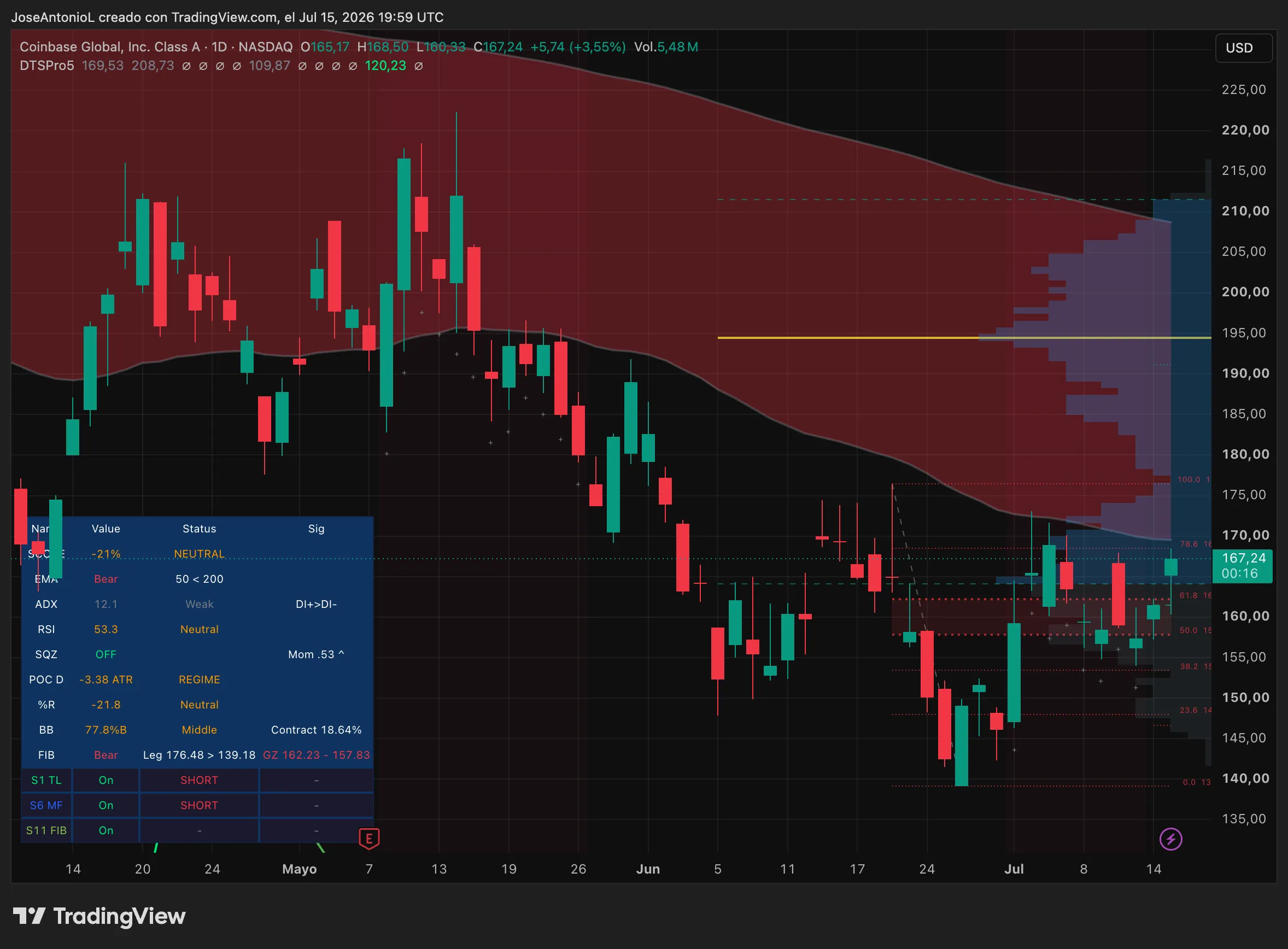
In a curious display of market resilience, Coinbase (COIN) and Circle (CRCL) stocks climbed between 3% and 4% on Wednesday, seemingly ignoring a wave of pessimistic financial outlooks. This counterintuitive performance underscores a growing trend in the digital asset sector: the belief that the "worst-case scenario" has already been priced into the market, and that the industry is poised for a structural shift in the coming years.
The Financial Landscape: William Blair’s Bearish-Yet-Bullish Outlook
The primary catalyst for the day’s market movement was a detailed research note from William Blair, the storied Chicago-based investment bank founded in 1935. Known for its rigorous analysis of the tech and growth sectors, the firm issued a sobering assessment of Coinbase’s near-term profitability while maintaining its "outperform" rating.
The core of the firm’s argument is that the pain—characterized by falling volumes and tightening margins—is already fully reflected in the current stock price. Analysts Andrew Jeffrey and Adib Choudhury slashed their revenue estimates for Coinbase by 12% for 2026 and 13% for 2027. Even more striking was their downward revision of adjusted EBITDA projections, which were gutted by 34% for both years.
Despite these grim numbers, the firm’s message to investors was clear: "Stay involved." The analysts posit that Coinbase’s earnings are expected to trough in the second half of 2026 before entering a recovery phase in 2027. This projection hinges on the belief that spot crypto volume is finally finding a floor, mirroring the stabilization of Bitcoin’s own price action.
Chronology: From 2022 Turbulence to 2026 Maturity
To understand why analysts remain cautiously optimistic, one must view the current cycle through a historical lens. The market landscape today is fundamentally different from the volatility of 2022.
- 2022: A year defined by contagion, systemic collapse, and a lack of institutional guardrails.
- 2023-2024: The emergence of regulatory clarity and the initial buildup of institutional infrastructure.
- June 2025: Circle, the stablecoin giant, makes a splashy debut on the New York Stock Exchange at $31 per share, marking a significant milestone for crypto-native financial institutions.
- Early 2026: Coinbase and the broader crypto market face significant headwinds, with COIN falling nearly 30% year-to-date and Bitcoin sliding roughly 26%.
- July 2026: Analysts identify the "trough" of the current cycle, with William Blair projecting that trading volumes will bottom out at $669 billion this year—a 44% decline—before rebounding by over 32% in 2027.
The maturation of the regulatory environment, combined with the permanent fixture of spot Bitcoin ETFs, has created a "floor" that did not exist during previous market drawdowns.

Supporting Data: The Case for a Structural Shift
The William Blair report highlights that Coinbase is no longer just a "spot trading exchange." Its revenue base has diversified significantly, insulating it from the whims of retail volatility.
The Role of Base and Derivatives
Coinbase’s layer-2 network, Base, has emerged as a powerhouse for ecosystem growth. Furthermore, the company has aggressively expanded into retail derivatives and prediction markets. Notably, retail derivatives alone crossed the $200 million annualized revenue mark in the first quarter of 2026.
The Divergent View: Piper Sandler
Not all voices on Wall Street are singing the same tune. Piper Sandler analyst Patrick Moley, while maintaining a "neutral" rating, recently lowered his price target for Coinbase from $170 to $155. Moley pointed to the intense competition in the perpetual futures market as a significant threat heading into the third quarter. He noted that the World Cup acted as a unique catalyst for prediction market activity in Q2, but questioned whether that growth pace is sustainable without similar global events.
Technical Analysis: John Bollinger’s "W" Pattern
Beyond the fundamental balance sheets, technical analysts are finding solace in chart patterns. John Bollinger, the architect of the globally utilized Bollinger Bands, has been tracking a "W" double-bottom formation on Bitcoin’s daily chart since early July.
In a technical sense, a double-bottom is a classic reversal formation. It suggests that two consecutive swing lows have been met with sufficient buying pressure to prevent a further slide. Bollinger has described the pattern as "perfectly fractal," noting that smaller versions of this "W" appear within the larger structure on both daily and weekly timeframes.
Bollinger’s take is particularly significant because he has historically been cautious about labeling trends. However, he recently stated: "In a bear market, bullish setups break; in a bull market, bearish setups break. If this ‘W’ pattern is successful, I would see it as a confirmation of a change in trend." This represents a definitive shift in sentiment for one of the most respected names in technical analysis.
On-Chain Evidence: Is the Bottom In?
Glassnode’s recent weekly analysis provides the "on-chain" corroboration that many institutional investors require. According to their data, the selling pressure from long-term holders—the primary weight on the market for much of 2026—peaked two weeks ago and is now in a distinct downtrend.
Accumulation Patterns
Data shows a broad wave of accumulation occurring at the June lows across wallets of all sizes. Interestingly, Bitcoin has begun to decouple from traditional U.S. equities, showing a deeper, inverse relationship with the U.S. dollar. When recent inflation data came in "soft," Bitcoin reacted more sharply than the S&P 500 or the Nasdaq, suggesting that the asset is regaining its role as a macro-sensitive hedge.
Implications: The Road to 2027
The overarching narrative across both Wall Street and on-chain analysis is one of patience. The "fear premium" in the options market is easing, and the excessive leverage that plagued the early 2026 market is unwinding.
However, a critical gap remains: the lack of sustained, high-conviction spot buying. While the derivatives markets are cooling down and sellers are thinning, the "smart money" is waiting for a clear inflection point. William Blair’s forecast for 2027—a 32% rebound in trading volume—serves as a roadmap for what that recovery might look like.
Key Takeaways for Investors:
- Earnings Trough: The financial pain for crypto firms is expected to hit its lowest point in late 2026, setting the stage for a rebound.
- Product Diversification: The shift toward prediction markets and L2 scaling solutions (like Base) provides a more sustainable revenue stream than pure spot trading.
- Technical Validation: The "W" pattern identified by John Bollinger provides a technical trigger for a trend reversal, provided it holds above key support levels.
- Macro Sensitivity: Bitcoin’s renewed sensitivity to macro indicators like inflation prints suggests that it is returning to a state of maturity, where it reacts to economic reality rather than just speculative fervor.
Ultimately, the market is signaling that while the immediate future may be characterized by "gutted" projections and trimmed price targets, the long-term infrastructure for digital assets is stronger than ever. Investors are now tasked with determining if they have the stomach to remain "involved" during the final, quiet months of this cycle before the projected 2027 recovery takes hold.