From Crypto Crackdown to Artificial Intelligence: Jay Clayton Takes the Helm of Washington’s New AI Task Force
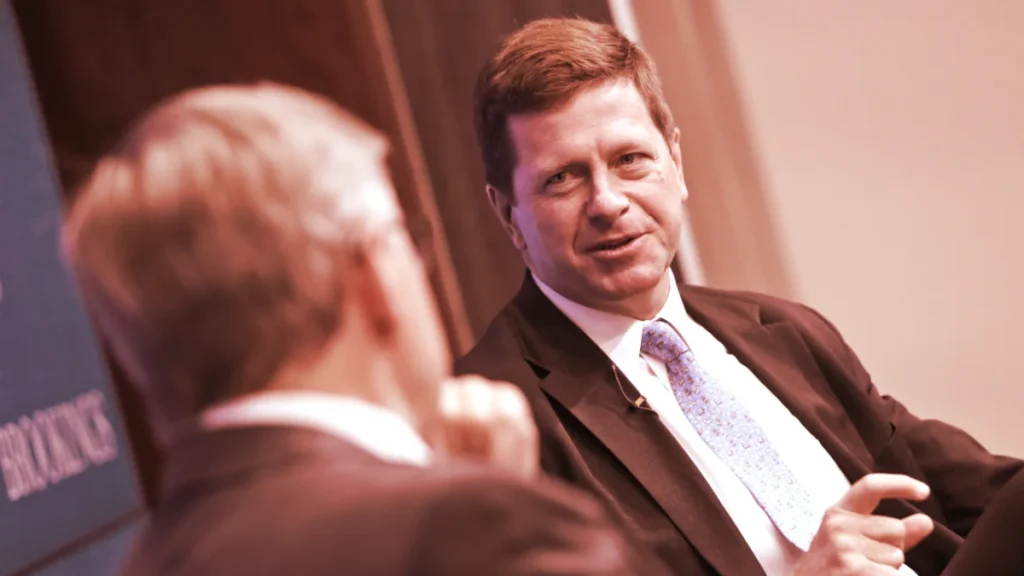
WASHINGTON — In a move that signals a profound pivot in federal technology governance, President Donald Trump has officially established the "Super Intelligence Force," a high-powered federal task force designed to streamline and coordinate the United States’ sweeping approach to artificial intelligence. Heading this formidable new initiative is Jay Clayton—a figure whose name still elicits visceral reactions across the digital asset industry as the architect of the Securities and Exchange Commission’s (SEC) initial onslaught against cryptocurrency.
Clayton’s transition from chief securities regulator to Washington’s de facto "AI czar" bridges two of the most disruptive technological frontiers of the 21st century. While the White House has framed the newly minted task force as a vital national security and economic imperative aimed at maintaining American dominance in AI, Clayton’s appointment brings a complex, highly polarizing regulatory history directly into the heart of federal technology policy.
Main Facts: The "Super Intelligence Force" and Its Mandate
The creation of the task force was announced by President Trump via Truth Social on Sunday. The initiative establishes a centralized body tasked with synchronizing federal oversight, engagement, and strategic planning for artificial intelligence—referred to by the administration primarily as "Super Intelligence."
According to the administration’s framework, the task force will act as a primary nexus between the federal government and various societal sectors, including:
- Consumers and public interest organizations
- Religious and community institutions
- Critical infrastructure providers
- Commercial AI developers and enterprise stakeholders
While the administration has not yet published an exhaustive mandate, explicit timeline, or formal executive order detailing binding regulatory metrics, the operational structure of the force is clear. Jay Clayton, currently serving as Director of National Intelligence, is listed first among the leadership roster and is widely recognized as the principal driver of the initiative.
Clayton will not operate in a vacuum. He is joined on the task force by a heavy-hitting roster of administration officials:
- Andrew Ferguson, Chairman of the Federal Trade Commission (FTC)
- Emil Michael, Under Secretary of War for Research and Engineering
- Scott Kupor, Director of the Office of Personnel Management (OPM)
The Super Intelligence Force will report directly to President Trump and White House Chief of Staff Susie Wiles, cementing its status as a core priority of the executive branch.
The announcement closely follows a high-stakes gathering at the White House, where leadership from major tech giants—including OpenAI, Google, and Nvidia—met with the administration. This culminated in what the White House has termed the "Historic White House Accord on Super Intelligence," a voluntary agreement wherein leading AI firms formally acknowledged their strategic responsibilities to the American public.
Chronology: Jay Clayton’s Path from Wall Street Regulator to AI Czar
To understand the weight of Clayton’s new appointment, it is necessary to examine his extensive and evolving footprint within the federal government and the private technology sector over the past decade.
1. The SEC Years and the Genesis of Crypto Enforcement (2017–2020)
Appointed by Donald Trump during his first presidential term, Jay Clayton took the helm of the SEC in May 2017. At the time, the crypto market was experiencing a wild west era defined by Initial Coin Offerings (ICOs). Under Clayton, the SEC shifted from cautious observation to aggressive intervention, pioneering the "regulation-by-enforcement" paradigm that would define American crypto policy for years.
During his tenure, Clayton brought roughly 57 enforcement actions against various crypto firms, blockchain startups, and token issuers. His parting shot remains legendary in digital asset history: in December 2020, on one of his final days in office, Clayton’s SEC filed a landmark $1.3 billion lawsuit against Ripple Labs, alleging that its native asset, XRP, was sold as an unregistered security. This lawsuit served as a foundational blueprint for the subsequent, even more aggressive enforcement wave carried out under his successor, Gary Gensler.

2. Private Sector Pivot and Advisory Roles (2021–2024)
True to the classic Washington-to-Wall Street revolving door, Clayton’s stance on digital assets softened—or at least diversified—after his departure from the SEC. In 2021, he joined One River Asset Management as an adviser focusing on digital assets and blockchain technology. Additionally, he lent his expertise to the advisory board of institutional crypto custodian Fireblocks, signaling that while he had prosecuted the industry, he clearly recognized its enduring financial viability.
3. Return to Government and Prosecution (2020–2025)
Clayton’s relationship with federal leadership remained robust. Trump initially sought to install Clayton as the U.S. Attorney for the Southern District of New York (SDNY) in 2020 while he was still leading the SEC—a controversial nomination that ultimately stalled.
However, in 2025, Clayton officially returned to the trenches of federal law enforcement as the interim U.S. Attorney for the SDNY. Under his watch, the office aggressively pushed forward high-profile cyber and crypto prosecutions, notably advancing the case against Roman Storm, a developer of the crypto privacy protocol Tornado Cash.
4. The AI Era (2026 and Beyond)
Now, Clayton’s career has taken another dramatic turn. Moving away from the courtroom and securities ledgers, he is stepping onto the global stage of technological geopolitics, tasked with steering Washington’s approach to the most transformative computing paradigm in history.
Supporting Data: The Regulatory Blueprint
The structural mechanics of the Super Intelligence Force reflect a whole-of-government strategy, drawing power from intersecting federal domains: national intelligence, trade regulation, defense research, and federal human capital.
- National Intelligence Oversight: With Director of National Intelligence Jay Clayton at the helm, the task force inherently ties artificial intelligence policy to national security, foreign espionage defense, and macroeconomic competition—particularly against geopolitical rivals like China.
- Antitrust and Consumer Protection: The inclusion of FTC Chairman Andrew Ferguson ensures that the task force maintains a watchful eye on market consolidation, algorithmic bias, and fair competition among foundational model developers.
- Defense Integration: Emil Michael’s presence as Under Secretary of War for Research and Engineering highlights the deepening nexus between commercial AI breakthroughs and military applications, autonomous systems, and strategic defense infrastructure.
- Federal Workforce Adaptation: Scott Kupor’s role as OPM Director underscores the administration’s secondary objective: integrating AI safely and efficiently into the federal bureaucracy itself, retraining government workers, and managing automated public administration.
Official Responses and Stakeholder Reactions
The announcement of the Super Intelligence Force—and specifically the appointment of Clayton—has generated immediate ripples across political, technological, and financial circles.
Silicon Valley executives, fresh off signing the voluntary White House Accord on Super Intelligence, have expressed cautious optimism regarding a centralized government interlocutor. Major tech firms have long lobbied for a unified federal approach to AI to avoid a fragmented, state-by-state patchwork of safety and privacy laws reminiscent of early data privacy regulations.
However, civil liberties groups and public interest organizations have raised early concerns regarding the heavy intelligence and law enforcement background of the task force’s leadership. Critics note that Clayton’s career has been defined by prosecutorial rigor and systemic enforcement rather than open-source advocacy or digital rights protection.
Within the crypto community, reactions are deeply mixed. While many veterans of the "Crypto Wars" harbor lingering resentment over the Ripple lawsuit and the era of regulation-by-enforcement, others view Clayton’s pivot to AI as an indicator that the administration values seasoned institutional operators who can successfully execute complex federal mandates against entrenched corporate giants.
Implications: What the Super Intelligence Force Means for the Future
The creation of the Super Intelligence Force and the elevation of Jay Clayton mark a decisive shift in how the United States intends to govern disruptive technologies.
- Centralization of Power: Rather than allowing AI policy to remain decentralized across disparate agencies like the National Institute of Standards and Technology (NIST), the Department of Energy, and the FTC, the Trump administration has concentrated strategy directly within the Executive Office, reporting straight to the Chief of Staff and the President.
- National Security First: Clayton’s background as DNI and a federal prosecutor ensures that AI will not be viewed merely as a commercial consumer product, but as a critical national asset and a potential geopolitical battleground.
- A Blueprint for Compliance: Just as Clayton’s SEC established clear, albeit painful, boundaries for digital asset compliance through high-profile litigation, tech industry observers anticipate that his leadership on the Super Intelligence Force could quickly pivot from voluntary accords (such as the recent White House agreement) to strict regulatory guardrails if compliance falters.
As the Super Intelligence Force begins drafting its operational protocols, the tech sector, Wall Street, and international allies will be watching closely to see whether Clayton brings the same unyielding enforcement mindset to artificial intelligence that he once brought to the nascent world of cryptocurrency.