Echoes from the Fontainebleau Forest: How France’s Youth Protests Foretell a Generational Reckoning
By Jonathan Levy
October 20, 2026
PARIS—As their schools deteriorate and the planet grows hotter, a pervasive sense of despair has settled over the youth of France. For millions of teenagers and young adults, the future no longer looks like a promise of progress, but rather a cascading series of compounding crises—economic stagnation, crumbling educational infrastructure, and the accelerating toll of climate change.
The recent wave of demonstrations gripping the nation’s capital and regional hubs is not merely another chapter in France’s storied tradition of street protest. Instead, sociologists, political analysts, and demonstrators themselves warn that these unrests foreshadow a much deeper, structural conflict: a generational cold war between an entrenched older political class that wields institutional power and a disenfranchised younger demographic that will inevitably inherit the wreckage.
After weeks of mounting tension on the streets of Paris, my wife and I decided to take our six-year-old daughter and leave town during Saturday’s protests. When the main demonstration assembled at 2 p.m. at the Place de la République, we were hiking in the forests southeast of Paris near Fontainebleau, once an autumnal retreat and hunting ground for French kings.
Surrounded by the ancient canopies and quiet sandstone boulders of Fontainebleau, the contrast between the tranquil rhythms of nature and the volatile political climate back in the capital could not have been starker. Yet, even among the trees, the weight of the future felt inescapable. What kind of world, we wondered, will our daughter inherit when she reaches the age of the teenagers currently clashing with riot police in the heart of Paris?
Main Facts: The Anatomy of the French Youth Unrest
The current crisis stems from a convergence of systemic pressures that have collided in French high schools and universities over the academic year.
- Infrastructure Decay: Decades of underfunding have left hundreds of French secondary schools (lycées) and universities structurally compromised. Students routinely report leaking roofs, broken heating systems during harsh winters, mold-infested classrooms, and a severe shortage of basic learning materials.
- Climate Anxiety: Beyond immediate educational grievances, the youth mobilization is deeply rooted in eco-anxiety. Successive heatwaves across Europe, coupled with perceived governmental inaction on carbon emission targets, have radicalized a generation that feels the state is prioritizing short-term economic stability over long-term planetary survival.
- Economic Precarity: Entry-level job market prospects, rampant inflation affecting housing and food, and proposed reforms to student welfare programs have combined to create an atmosphere of economic claustrophobia. Young French citizens face a reality where traditional paths to middle-class security—obtaining a university degree followed by stable employment—are increasingly out of reach.
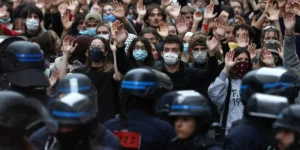
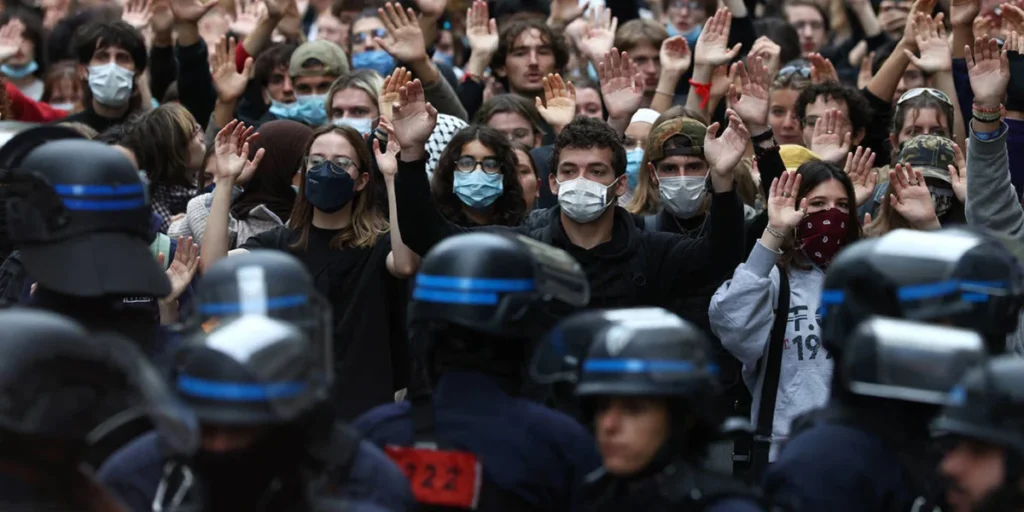
- The Clashes: What began as peaceful school walkouts and localized blockades has escalated into violent confrontations in major urban centers, notably Paris, Marseille, Lyon, and Toulouse. Demonstrators have utilized barricades, while security forces have responded with tear gas, baton charges, and mass preemptive arrests.
Chronology of Escalation: From Classroom Walkouts to Nationwide Mobilization
To understand how France arrived at this precarious juncture, it is essential to trace the rapid escalation of events over the past two months.
Phase 1: The Spark in the Suburbs (Early September 2026)
The unrest did not materialize overnight. It began quietly in the banlieues surrounding Paris, where students at several dilapidated vocational and general high schools staged localized walkouts. Their demands were initially hyper-local: immediate funding for repairs, adequate heating, and smaller class sizes. School administrations, constrained by tight regional budgets, offered little more than promises, sowing deep distrust among the student body.
Phase 2: Coalition Building and Eco-Demands (Late September 2026)
By the final week of September, student unions—most notably the Union Nationale Lycéenne (UNL)—began coordinating across municipal boundaries. Environmental groups, energized by recent IPCC warnings regarding Mediterranean climate trajectories, joined forces with the student organizers. The movement expanded its platform from structural school repairs to systemic government accountability on climate change and social equity. Social media platforms, particularly TikTok and Instagram, played a pivotal role in organizing flash mob blockades that caught law enforcement off guard.
Phase 3: The General Strike Call and National Disruptions (Early October 2026)
As October commenced, university students and labor union sympathizers threw their weight behind the younger high school protesters. Transportation unions threatened sympathetic slowdowns, and university campuses in central Paris were occupied. The government’s refusal to negotiate directly with unrecognized student committees hardened resolve on both sides.
Phase 4: The Boiling Point and the Fontainebleau Exodus (Saturday, October 20, 2026)
Saturday marked the scheduled convergence of regional student movements at the historic Place de la République in Paris. Anticipating widespread property damage, transit shutdowns, and heavy-handed police interventions reminiscent of the Gilets Jaunes era, thousands of Parisian families evacuated the city center for the weekend.
While the Place de la République filled with tear gas, sirens, and chanted slogans demanding systemic political reform, my family and I sought refuge beneath the autumn leaves of Fontainebleau—a haunting reminder of an older, monarchical France that also failed to heed the rumblings of revolutionary change until it was too late.
Supporting Data: Statistics of Discontent
The grievances voiced in the streets are corroborated by hard data regarding the state of French youth welfare, infrastructure, and ecological outlook.
| Indicator | Metric / Finding | Source |
|---|---|---|
| School Infrastructure Deficit | Over 40% of French secondary schools require urgent structural renovations. | Ministry of National Education Audit |
| Youth Unemployment Rate | Hovering around 17.5% for citizens aged 15–24, nearly triple the national average. | National Institute of Statistics and Economic Studies (INSEE) |
| Climate Pessimism | 78% of French youth aged 18–30 report feeling "frightened" or "extremely anxious" about the future of the planet. | IPSOS Climate Sentiment Survey |
| Trust in Political Institutions | Only 19% of individuals under 30 express confidence in the current parliamentary leadership. | Cevipof Political Trust Barometer |
| Poverty Vulnerability | 22% of young adults in France live below the poverty line, disproportionately impacted by urban housing crises. | Eurostat |
These numbers paint a stark portrait of a demographic living on the margins of prosperity, watching their immediate environments crumble while global threats loom unchecked.
Official Responses: Between Conciliation and Condemnation
The response from the Élysée Palace and key government ministries has walked a precarious tightrope between acknowledging legitimate youth concerns and maintaining strict public order.
Prime Minister and senior cabinet ministers issued a joint statement earlier this week condemning the violence and vandalism that marred the fringes of the protests while expressing "profound empathy" for the psychological pressures facing the younger generation.
"We hear the eco-anxiety of our youth; we recognize the urgent imperative to modernize our educational spaces," stated the Minister of National Education during a televised address. "However, blockading public infrastructure and engaging in urban violence cannot and will not be tolerated. Dialogue is open, but it must occur within the bounds of republican institutions, not behind barricades of burning bins."
The government has pointed to its recent multi-billion-euro green transition package and incremental funding boosts for regional school boards as proof of its commitment. Yet, critics argue these measures are too little, too late, and systematically fail to address the fundamental structural inequality baked into the French education and economic models.
Meanwhile, opposition leaders from both the left (La France Insoumise) and the right (National Rally) have sought to capitalize on the unrest. The left has praised the youth for awakening the national conscience on climate and social justice, while the right has blamed the chaos on institutional laxity and a breakdown of parental and state authority, calling for a restoration of law and order above all else.
Implications: A Generational Reckoning for the Republic
The events of this autumn in Paris and beyond point toward a profound philosophical and political crisis that extends far beyond the borders of France.
At its core, the friction witnessed on the streets of the capital represents a breakdown in the intergenerational contract. Historically, older generations in democratic societies have acted as stewards, accumulating capital and building institutions with the implicit promise of handing over a stable, prosperous world to their descendants. Today, that contract appears broken. Young people are being asked to service national debts, endure a degraded biosphere, and study in physical structures that resemble relics of a bygone industrial age, all while political leaders enact policies tailored to aging electoral bases.
If the French state fails to meaningfully integrate youth perspectives into its long-term planning—particularly regarding climate adaptation, economic restructuring, and educational reinvestment—the current wave of protests may only be a rehearsal.
Back in the serene expanses of the Fontainebleau forest, far from the tear gas of the Place de la République, the historical echoes were difficult to ignore. France has a long history of turbulent transitions, where ruling elites ignored the cries of the streets until the foundations of the regime itself gave way. As the sun set behind the ancient oaks, casting long shadows across the royal hunting grounds, one question lingered in the crisp autumn air: Will today’s leaders heed the warning of the youth before the fractures in French society become entirely irreparable?