The Price of Time: How Economic Extremes and Shifting Interest Rates Reshape Modern Markets
In the ongoing discourse surrounding modern monetary policy, few concepts hold as much foundational weight as the price of money. Edward Chancellor’s seminal book, The Price of Time, provides an illuminating lens through which to view interest rates not merely as bureaucratic levers pulled by central banks, but as the fundamental heartbeat of a functioning economic system.
Interest rates dictate how human society values capital today versus capital tomorrow. They sculpt the behaviors of households, corporations, and governments, steering collective decisions regarding saving, investing, borrowing, and risk-taking. As Chancellor eloquently summarizes:
"The most encompassing view of interest is contained in the notion of interest as the ‘time value of money’ or, simply, as the price of time. From a technical viewpoint, capital consists of a stream of future income discounted to its present value. Without interest, there can be no capital. Without capital, no capitalism."
Despite the theoretical elegance of these mechanisms, the practical application of interest rate policy over the past two decades has been anything but steady. Instead, the global economy has been subjected to dramatic whiplash, transitioning from an unprecedented era of artificially suppressed borrowing costs to a rapid, aggressive tightening cycle.
Examining this historical trajectory reveals a startling truth: the pursuit of a "normal" interest rate is a phantom chase. There is no historical baseline of normality, and the whiplash between monetary extremes has exposed deep structural vulnerabilities—most notably within the American housing market.
Main Facts: The Anatomy of Modern Monetary Policy
To understand the current economic landscape, one must confront the legacy of the Zero Interest Rate Policy (ZIRP) era that emerged in the wake of the 2008 Great Financial Crisis.
For much of the 2010s, central banks across the developed world held benchmark interest rates near absolute zero. Critics, including Chancellor and numerous conservative economists, warned that prolonged ultra-low rates were a ticking time bomb. The core arguments against ZIRP suggested that such policies would:
- Encourage reckless, excessive risk-taking among institutional and retail investors.
- Severely punish traditional savers relying on fixed-income yields.
- Distort the true price of time, leading to inflated asset bubbles.
- Artificially prop up "zombie companies"—unprofitable enterprises that would otherwise fail in a free market.
- Weaken the structural integrity of the broader economy, inviting hyperinflation or a collapse of the U.S. dollar.
Yet, history took a surprising turn. Many of the apocalyptic prognostications associated with ZIRP failed to materialize in the exact manner critics anticipated. While asset prices certainly climbed, the broader equity boom of the 2010s was driven less by cheap debt and more by a structural shift: the tech sector behemoths stepped in to generate unprecedented, genuine corporate profits following the "lost decade" of the 2000s.
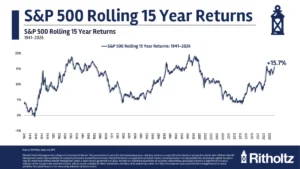
Paradoxically, when central banks reversed course in the 2020s and hiked rates to combat surging post-pandemic inflation, the stock market did not collapse. In fact, the S&P 500 in the 2020s has outperformed its 2010s counterpart, surging upward even as benchmark rates hovered around 4% to 5%. This resilience proves a vital lesson: market participants are often driven by profit growth and momentum far more than the nominal level of interest rates.
Chronology: A History of Abnormal Yields
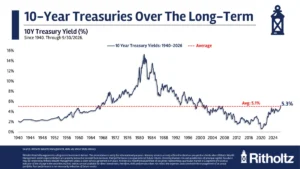
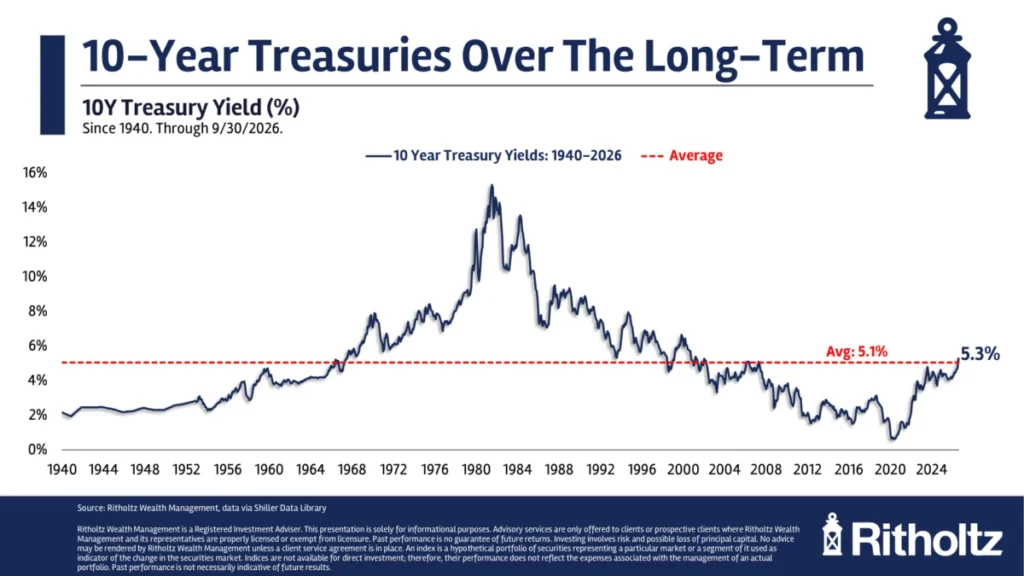
A primary misconception among modern investors is the belief that interest rates possess a natural, historical equilibrium. A survey of the 10-year U.S. Treasury yield going back to 1940 shatters this illusion. Interest rates have almost never been normal.
1. The World War II Suppression (1940s)
To finance massive wartime expenditures, the U.S. government and the Federal Reserve actively capped borrowing costs, keeping Treasury yields artificially subdued regardless of underlying economic pressures.
2. The Great Inflation Era (1950s–Early 1980s)
As post-war economic expansion gave way to structural inflation, interest rates embarked on a decades-long ascent. By the early 1980s, the 10-year Treasury yield routinely averaged well into the double digits, surpassing 10% as Federal Reserve Chairman Paul Volcker aggressively broke the back of inflation.
3. The Great Disinflation (1980s–2020)
For four decades, the global economy experienced secular disinflation. Bond yields marched steadily downward, culminating in the emergency pandemic measures of 2020, where central banks once again drove yields to the floor.
4. The Post-Pandemic Tightening (2020s–Present)
Following the reopening of the global economy, the return of rapid inflation forced central banks into one of the fastest monetary tightening cycles in modern history. Bond yields spiked, bringing an abrupt end to the era of free money.
Supporting Data: The Housing Market Paralysis
While ZIRP did not trigger the systemic macroeconomic hyperinflation that many bears predicted, its true toxicity lay elsewhere: it left zero margin for safety when rates inevitably normalized.
Consider the mortgage market. Historically, a 7.5% 30-year fixed mortgage rate is not an aberration. Throughout the 1980s, mortgage rates never dipped below 9%, and the 1990s average comfortably exceeded 8%.
The crisis of the 2020s is not that 7.5% mortgage rates exist; it is that the entire housing ecosystem was engineered around the illusion that 3% mortgages were permanent. When the Federal Reserve hiked rates, housing prices remained anchored to a low-rate reality. The resulting collision—unaffordable home prices paired with punishingly high borrowing costs—has completely paralyzed the housing market.
Stagnant Sales Amid Population Growth
The data reveals a stark contraction in real estate activity:
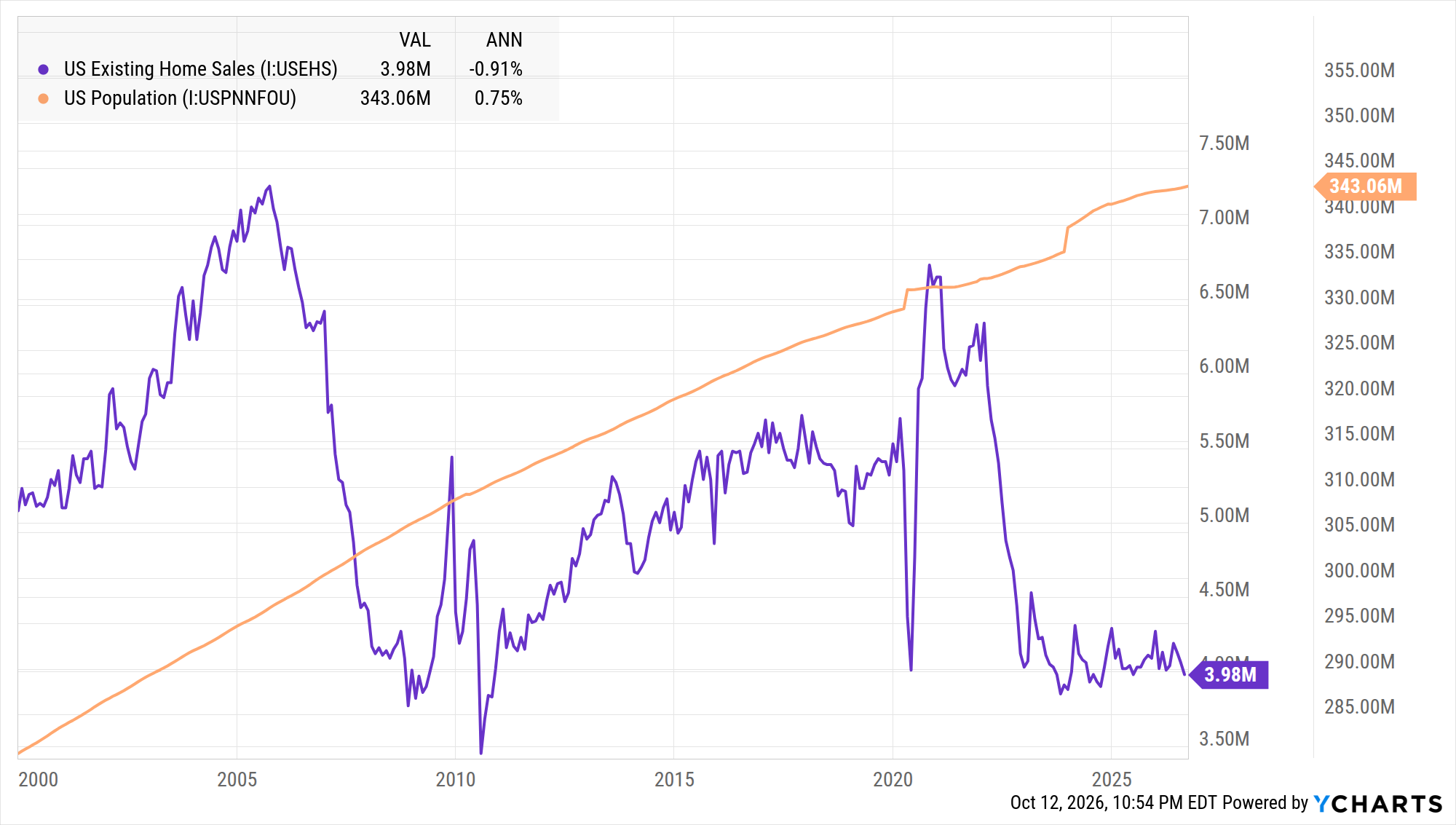
- The Year 2000: The U.S. population stood at roughly 280 million with 105 million households. Despite this smaller footprint, the nation recorded over 5 million existing home sales annually.
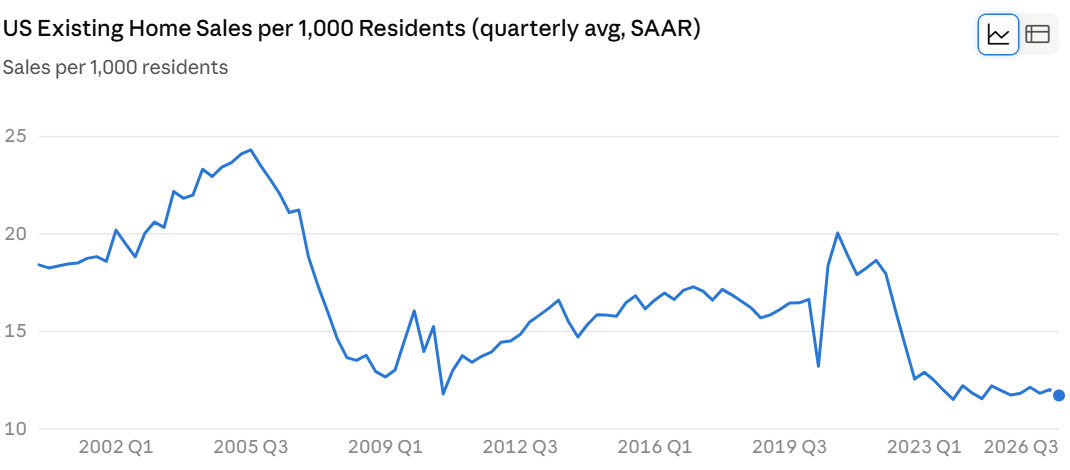
- The Modern Era: The U.S. population has ballooned past 340 million, encompassing over 135 million households. Yet, existing home sales have stagnated at just under 4 million units per year.
Adjusted for population growth, current home sales figures are worse than the absolute bottom recorded during the 2008 housing bust—and this stagnation has persisted for three consecutive years.
Official Responses and Economic Impact
Policymakers often operate under the assumption that financial systems can easily pivot between macroeconomic extremes. However, the transmission mechanisms of monetary policy are fraught with unintended consequences.
According to economic analyses from firms like John Burns Research and Consulting, the broader housing sector accounts for roughly 20% of total U.S. economic activity, encompassing construction, real estate services, financial products, and consumer home-goods spending.
By executing a whiplash transition from near-zero rates to restrictive monetary policy, central bankers effectively neutralized this massive economic engine.
- The "Lock-In" Effect: Millions of homeowners holding 3% mortgages refuse to sell their properties, choking off inventory.
- First-Time Buyers Sidelined: Aspiring homeowners face an exclusionary market defined by high prices and doubled borrowing costs.
While central bank officials defend higher rates as an indispensable tool to cool inflation and restore price stability, critics argue that insufficient attention was paid to the collateral damage inflicted upon specific segments of the economy—particularly young families and the domestic housing sector.
Implications: The Dangers of Policy Whiplash
The overarching takeaway from the past two decades of monetary experimentation is not that low interest rates are inherently superior to high rates, or vice versa. Markets have proven capable of thriving under varying yield environments, provided there is clarity and stability.
The true peril lies in volatility and systemic whiplash. When monetary authorities pin rates to zero for over a decade, they invite structural dependencies that cannot be unwound overnight. Moving from one monetary extreme to another in a compressed timeframe creates severe dislocations, penalizing prudent savers during low-rate regimes while abruptly locking out borrowers and homeowners when rates normalize.
Ultimately, the lesson of Edward Chancellor’s The Price of Time remains urgent: time has a price, and capital has a cost. When policymakers ignore these fundamental laws by maintaining artificial extremes, the bill eventually comes due—often paid in the currency of generational housing unaffordability and economic polarization.