The Unyielding Historian: How Marvin Dunn is Defying Erasure to Save Florida’s Black History
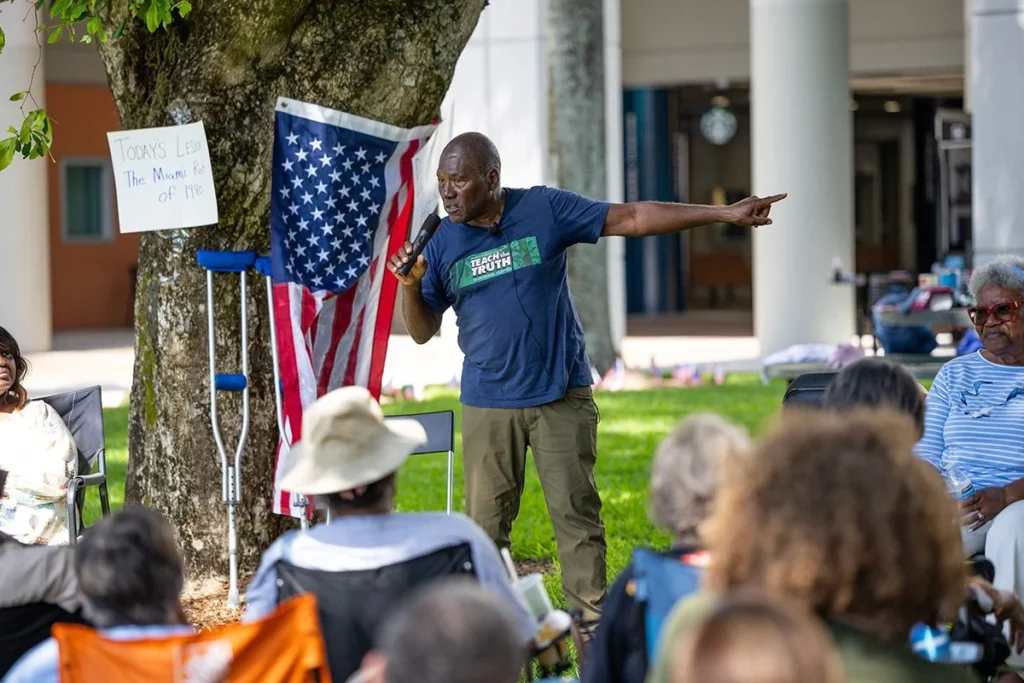
At 86 years old, most would consider a life of quiet reflection a well-earned reward. Yet, for Dr. Marvin Dunn, the past is not a place to retreat to—it is a battlefield. With the posture of the naval officer he once was and the unwavering resolve of a man who survived the Jim Crow era, Dunn has emerged as a singular, towering figure in the fight against the systemic sanitization of American history.
As the founder of the Miami Center for Racial Justice, Dunn has dedicated his later years to a mission that is as simple as it is subversive: telling the truth. In an era defined by legislative attempts to scrub uncomfortable realities from the public consciousness, Dunn is using textbooks, tours, and community gardens to ensure that the stories of Florida’s Black community remain indelible.
The Architect of Memory: A Life in Service
Born in the 1940s, Dunn’s early life was framed by the rigid, discriminatory structures of the Jim Crow South. He recalls a childhood where Black history was kept intentionally small—limited to a handful of "non-threatening" figures like George Washington Carver or Booker T. Washington. The more complex, painful, and revolutionary histories were strictly off-limits.
It wasn’t until the 1980 Arthur McDuffie riots in Miami that the scope of this historical vacuum became glaringly apparent to him. As he attempted to document the social upheaval, he realized with horror that there was almost no literature documenting the local Black experience. This realization shifted his path from observer to activist. He recognized that if he did not preserve these stories, they would be lost to the state-sanctioned amnesia that has long characterized the region’s educational approach.
Chronology of a Crisis: The Battle for Truth
The urgency of Dunn’s work intensified following the 2020 murder of George Floyd, which served as a national catalyst for racial reckoning. While the country debated systemic inequality, Florida began a sharp pivot toward historical retrenchment.
- 2020: Dunn founds the Miami Center for Racial Justice to serve as a hub for archival preservation and public education.
- 2022: Governor Ron DeSantis signs the "Stop WOKE Act," a sweeping piece of legislation designed to restrict discussions of race and gender in public schools. The act, later ruled unconstitutional by federal courts, created a chilling effect that prompted many educators to pull books from shelves for fear of retribution.
- 2025: Dunn releases his comprehensive textbook, The History of African Americans in Florida, specifically designed for middle and high schoolers.
- Late 2025/2026: Dunn launches a legal challenge against Miami-Dade College regarding the donation of public land for the proposed Trump Library, arguing that public assets should not be utilized to glorify political figures at the expense of community interests.
Unearthing the Ashes: The Rosewood Legacy
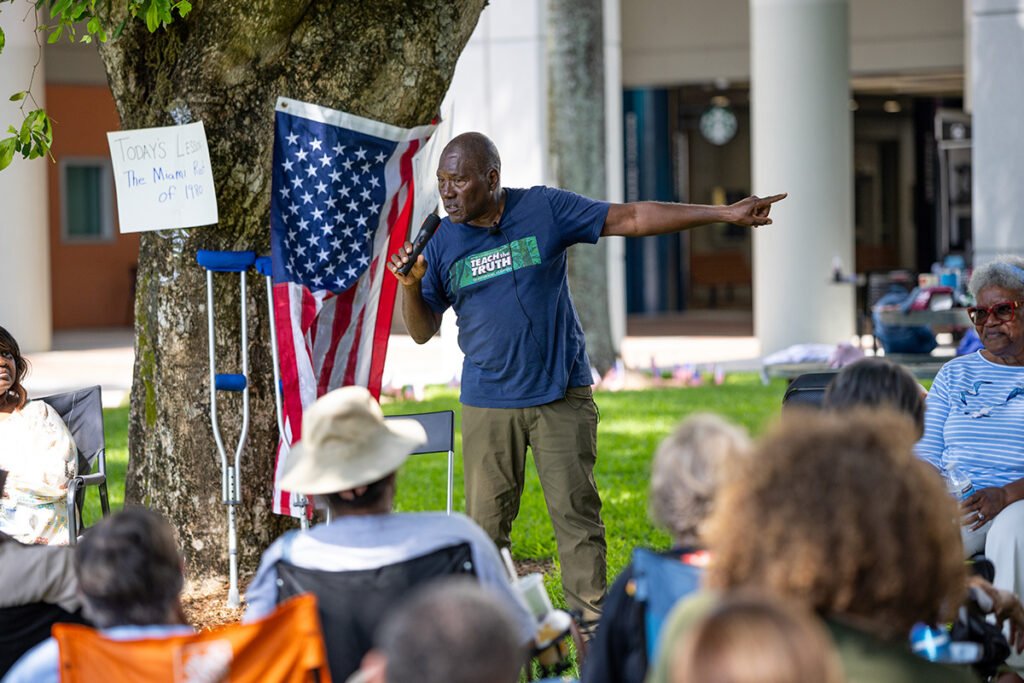
Central to Dunn’s "Teach the Truth" tours is the town of Rosewood. In 1923, the prosperous, independent Black community of Rosewood was decimated when a white mob burned every home to the ground, lynching residents and driving the survivors into the swamps. The event was erased from public discourse for decades.
Dunn’s tours do more than lecture; they offer a pilgrimage to the soil where these atrocities occurred. He describes his first solo visit to the site as a transformative moment: "I remember the way I felt when I walked on that railroad track, how much it brought back the story, just being in the physical space where that had happened."
These tours serve as a visceral counter-narrative to the "Stop WOKE" ideology. By bringing diverse groups to towns like Ocoee and Rosewood, Dunn forces a confrontation between the sanitized history books favored by the state and the blood-soaked reality of the past.
The Mechanics of Advocacy: Tours, Texts, and Technology
Dunn’s strategy is multifaceted, bridging the gap between physical activism and digital reach.
The Power of the "Teach the Truth" Garden
Located in Miami’s Overtown neighborhood, the Teach the Truth Garden stands as a symbol of resilience. Once an abandoned lot, it is now a green sanctuary where volunteers cultivate callaloo, collards, and tomatoes. For Dunn, the garden is a dual-purpose site: it is a place where local police officers take breaks, fostering unexpected community connection, and a place where he recharges his own mental health. It represents the "positive" side of his work—the ability to grow life and community in the same soil that once held the history of trauma.
The Digital Frontier
Dunn understands that while his physical tours reach thousands, his digital reach is global. He encourages participants to document their tours on TikTok and social media, creating a digital ripple effect that bypasses traditional state-controlled gatekeepers. "I’m reaching people in Africa, Thailand, and England," he notes. By weaponizing digital storytelling, he ensures that the "suppression" tactics of the state are rendered largely ineffective in the global marketplace of ideas.
The Rosewood Peace House
Currently in development, the Rosewood Peace House is designed to be a "sacred space" built to mirror the homes lost in the 1923 massacre. It is intended to be a site for conflict resolution, where individuals who disagree on fundamental issues can come together and find common ground.
Official Responses and Legal Friction
The legal landscape in Florida remains hostile to the type of inquiry Dunn champions. The "Stop WOKE" Act, while struck down as unconstitutional, signaled a willingness by state officials to weaponize the law against pedagogical freedom.
Dunn’s lawsuit against the Trump Library project at Miami-Dade College underscores his broader philosophy: that public institutions are being co-opted to serve a political narrative that further marginalizes the history of the Black community. By challenging the "secrecy" behind the land deal, he is attempting to hold institutions accountable for how they use public resources, framing the issue as a theft from the future of Miami-Dade’s children.
Implications: The Long Arc of Justice
The broader implication of Dunn’s work is the preservation of American democracy itself. He argues that we are witnessing a return to the "old Jim Crow"—a environment of increased isolation and the systemic silencing of minority voices.
"I believe American democracy will be saved," Dunn says with a pragmatism born of age. "It’s just taking so damn long."
His approach to this crisis is rooted in intergenerational dialogue. He views himself as an elder with a mandate to prepare the next generation. He does not believe that young people are beyond saving; rather, he sees them as "not yet tarnished" by the political cynicism of their elders. His, and by extension the reader’s, responsibility is to ensure these stories are passed down at the dinner table, in the classroom, and across social media feeds.
Conclusion: The Persistence of Hope
Marvin Dunn’s life is a testament to the idea that history is not just a record of what happened, but a tool for determining what happens next. He rejects the label of "retired," choosing instead to view his work as a vital, daily commitment.
As he tends to his garden in Overtown, sharing coffee and stories with volunteers, the message is clear: the most effective way to combat the erasure of history is to keep planting, keep teaching, and keep speaking. The state may aim to keep children in the dark, but as long as individuals like Dr. Marvin Dunn are walking the ground, sharing the truth, and building houses of peace, the light of history will continue to burn.
"In our country, there are more people who want us to live together in peace than there are people who want to divide us," he says. That belief is the bedrock of his endurance, the fuel for his activism, and the promise he holds for the future of Florida and the nation.