Navigating the New Economic Frontier: AI Transformation, Resilient Consumers, and Long-Term Market Projections
Published: September 23, 2026
Author: Ben Carlson
Source: A Wealth of Common Sense / Animal Spirits Analysis
Main Facts
As the global economy advances through the third quarter of 2026, financial markets and macroeconomic indicators present a complex landscape of technological optimism and consumer resilience. Recent data highlights a stark divergence in economic outlooks: while coastal tech hubs anticipate an unprecedented productivity boom driven by artificial intelligence, traditional financial analysts continue to model steady, moderate growth patterns.

At the center of current market discussions are contrasting long-term forecasts for the S&P 500. Notably, Goldman Sachs models a potential 14% compound annual growth rate (CAGR) for the S&P 500 over the coming decade under an optimistic "Goldilocks + AI boom" scenario. However, this bullish trajectory is juxtaposed against a much more conservative 4% CAGR projection should the macroeconomic environment slide into stagflation.
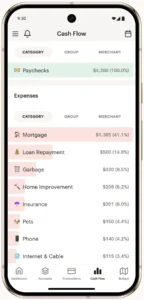
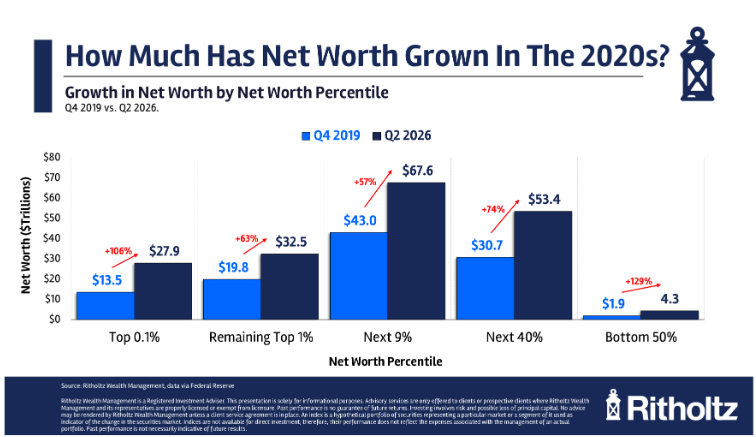
Simultaneously, retail banking and credit data from institutions such as Capital One and Wells Fargo indicate unexpected strength across American households. Contrary to fears of a tightening credit squeeze, consumer spending remains robust, bank balances are holding steady, and loan charge-offs are performing better than initial corporate expectations. Lower-income brackets are experiencing positive wage growth trajectories, narrowing historical wealth gaps and complicating traditional "K-shaped recovery" narratives.
Chronology of Recent Market and Economic Developments
The shifting economic narrative has accelerated across late summer and early autumn 2026, underscored by key data releases, corporate earnings readouts, and technological milestones:
- Mid-September 2026 (Wage Growth Metrics): Data highlights that after-tax wage growth for lower-income households continued to outpace that of higher-income earners through August, signaling a continued flattening of the traditional economic "K-curve."
- September 16–17, 2026 (Banking & Regional Divides): Major financial institutions released consumer health updates. Capital One reported "striking strength" across multiple income tiers, mirroring positive sentiment from Wells Fargo ($WFC). Simultaneously, prominent market commentators highlighted a cultural and economic split: West Coast tech sectors anticipate revolutionary economic transformation, while East Coast economists project a return to baseline 2.1% GDP growth.
- September 21, 2026 (AI Integration Milestones): Consumer-facing AI applications demonstrated practical, real-world utility. Viral reports showed autonomous AI agents (such as travel assistants) successfully navigating complex corporate customer service systems—resolving flight delays, securing financial compensation, and rebooking itineraries autonomously within minutes.
- September 22, 2026 (Long-Term Equity Projections): Financial heavyweights released updated decade-long market outlooks. Goldman Sachs’ modeling of a 14% S&P 500 CAGR under an AI-accelerated growth scenario drew widespread attention across institutional and retail trading communities.
- September 23, 2026 (Publication & Broadcast): Comprehensive market data packages, analytics charts, and discussions regarding consumer credit health and technological disruption were synthesized for public release.
Supporting Data and Market Indicators
The contemporary economic debate is fueled by a robust set of quantitative metrics tracking consumer behavior, labor market dynamics, and technological adoption:
- Equity Market Scenarios: Goldman Sachs’ dual-track model for the next decade illustrates the immense leverage modern markets hold over productivity and inflation variables. The 14% CAGR projection relies on sustained productivity gains from generative AI and automation, while the downside 4% scenario accounts for persistent inflationary pressures coupled with sluggish economic output.
- Consumer Credit Health: Credit card and retail banking indicators from institutions like Capital One and Bank of America ($BAC) reveal delinquency rates running below historical stress-test averages. Spending is holding firm across discretionary ($XLY) and broad financial sectors ($XLF), demonstrating that consumers have successfully absorbed the cumulative effects of previous interest rate adjustments.
- Labor and Wage Dynamics: Recent tracking of after-tax earnings confirms that lower-income demographics have sustained positive real wage growth relative to inflation, helping insulate the broader retail economy from sharp contractionary shocks.
- Technological Efficiency Gains: Micro-level consumer data highlights the rapid transition of AI from enterprise software to everyday consumer utility. Automated customer service interactions are drastically reducing friction in travel, retail, and administrative services, pointing toward substantial corporate margin expansions in service-oriented sectors.
Official Responses and Institutional Perspectives
Financial institutions, market strategists, and economic commentators have increasingly voiced distinct viewpoints regarding the sustainability of the current cycle:
- The Institutional Bull Case: Wall Street strategists leaning into the tech-optimist camp argue that the integration of artificial intelligence into enterprise workflows will mirror the internet revolution of the late 1990s, but with compressed adoption timelines. In this view, labor productivity increases will offset demographic headwinds, supporting elevated equity valuations.
- The Pragmatic Realist Perspective: Conversely, traditional economists caution against over-extrapolating near-term consumer strength into permanent structural stability. Many macro analysts emphasize that structural deficits, geopolitical fragmentation, and sticky service-sector inflation could easily drag growth back toward long-term historical averages of around 2% to 2.5% GDP expansion.
- Corporate Leadership Feedback: Executives from major consumer lenders emphasize that the American consumer is remarkably adaptable. Despite higher borrowing costs relative to the ultra-low rate era of the early 2020s, employment stability has provided a reliable floor for household balance sheets.
Implications for Investors and the Broader Economy
The intersection of artificial intelligence integration, resilient consumer spending, and bifurcated regional outlooks carries profound implications for asset allocation and monetary policy moving forward:
- For Equity Investors: The divergence between a potential 14% AI-driven boom and a 4% stagflationary slog highlights the importance of portfolio diversification. While growth-oriented tech allocations offer high upside, maintaining exposure to value, momentum, and defensive sectors remains critical for risk management.
- For Consumer Goods and Financial Services: The unexpected strength across lower- and middle-income consumers challenges the narrative of an imminent retail cliff. Banks and consumer discretionary brands continue to find pockets of growth, though underwriting standards must remain disciplined as credit normalization proceeds.
- For Workforce and Productivity: As AI agents move from novelty tools to operational necessities (such as automated corporate grievance resolution and itinerary management), the labor market will undergo rapid structural shifts. Workers and businesses that successfully leverage these tools will capture outsized economic rents, while those slow to adapt may face margin compression.
Ultimately, the economy of late 2026 exists in a state of high-stakes transition—balancing the deflationary, efficiency-generating promise of advanced technology against the persistent realities of macroeconomic friction.
Disclaimer: Nothing in this article constitutes investment advice, performance data, or any recommendation that any particular security, portfolio, transaction, or investment strategy is suitable for any specific person. Investing in speculative securities involves the risk of loss.