The 2026 Economic Paradox: Surging Inflation, Spiking Yields, and a Resilient Stock Market Defying the Odds
WASHINGTON & NEW YORK — In the playbook of traditional financial analysis, the economic indicators recorded over the first three quarters of 2026 should spell disaster. For decades, conventional market wisdom has dictated that when borrowing costs climb, inflation reaccelerates, and energy prices skyrocket, both corporate profitability and equity valuations should buckle under the pressure.
Yet, as the financial world navigates the autumn of 2026, Wall Street is writing an entirely different script.
Despite a macroeconomic backdrop characterized by tighter credit conditions, stubborn consumer price pressures, and a drastic re-pricing of sovereign debt, the broader U.S. economy continues to chug along at a resilient pace. More arresting still, the stock market has once again posted double-digit gains for the year. This defiance of traditional gravity has left economists, portfolio managers, and retail investors searching for answers, trying to reconcile a punishing set of headline figures with record-shattering corporate fundamentals.
Main Facts: The 2026 Macroeconomic Landscape
To understand the scale of the ongoing financial paradox, one must first examine the severity of the macro headwinds that have materialized throughout the year. According to data compiled through mid-September 2026, financial conditions have tightened significantly across nearly every major asset class:
- Mortgage Rates: The benchmark 30-year fixed mortgage rate has climbed from an already restrictive 6% at the start of the year to a formidable 7%, slamming the brakes on housing market turnover and prospective homebuyer affordability.
- Treasury Yields: In the fixed-income sector, the 10-year U.S. Treasury yield—often considered the bedrock of global borrowing costs—has marched upward from 4% to 5%, signaling sustained expectations of higher-for-longer interest rates.
- Inflation Rebound: After showing signs of cooling late last year, the annual inflation rate, which sat at a tamer 2.4% earlier in 2026, has ticked back up to 3.4%, complicating the Federal Reserve’s monetary policy trajectory.
- Energy Shocks: Perhaps the most visceral pain for everyday consumers has been felt at the pump. Global oil prices have experienced a dramatic surge, moving from under $60 per barrel in January to more than $100 per barrel. This supply-side jolt has driven the nationwide average for retail gasoline from $2.90 per gallon to well over $4.00.
Viewed in a vacuum, this collection of data points should theoretically translate into a severe contractionary cycle. High energy costs act as a direct tax on consumers and corporations alike; high mortgage rates freeze real estate and construction sectors; and elevated Treasury yields compete directly with equities for investor capital.
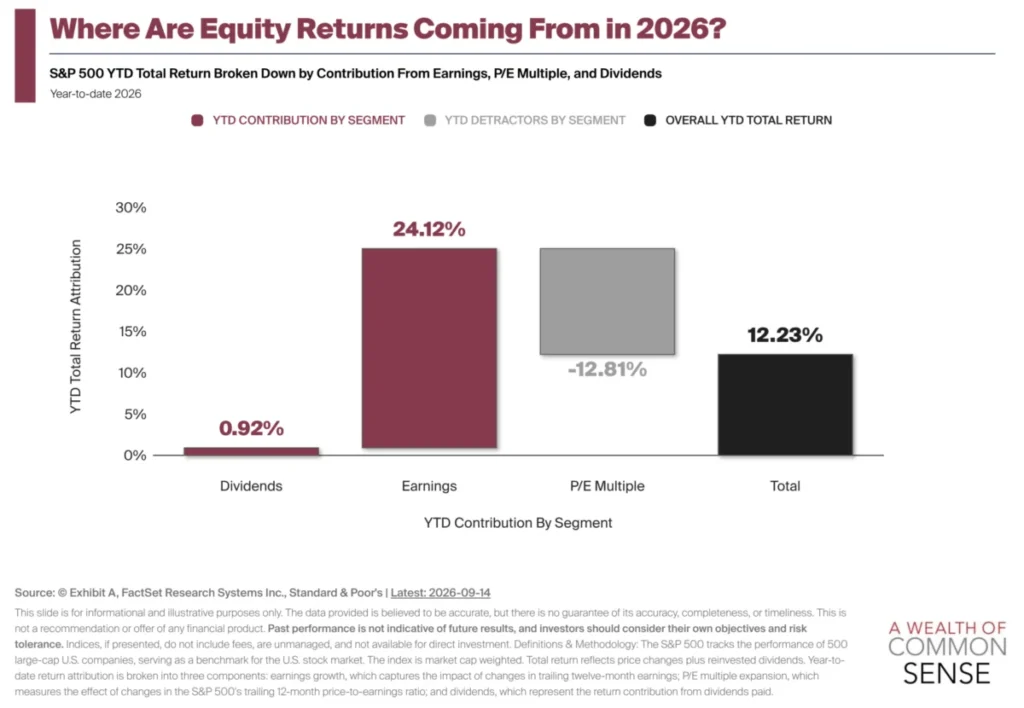
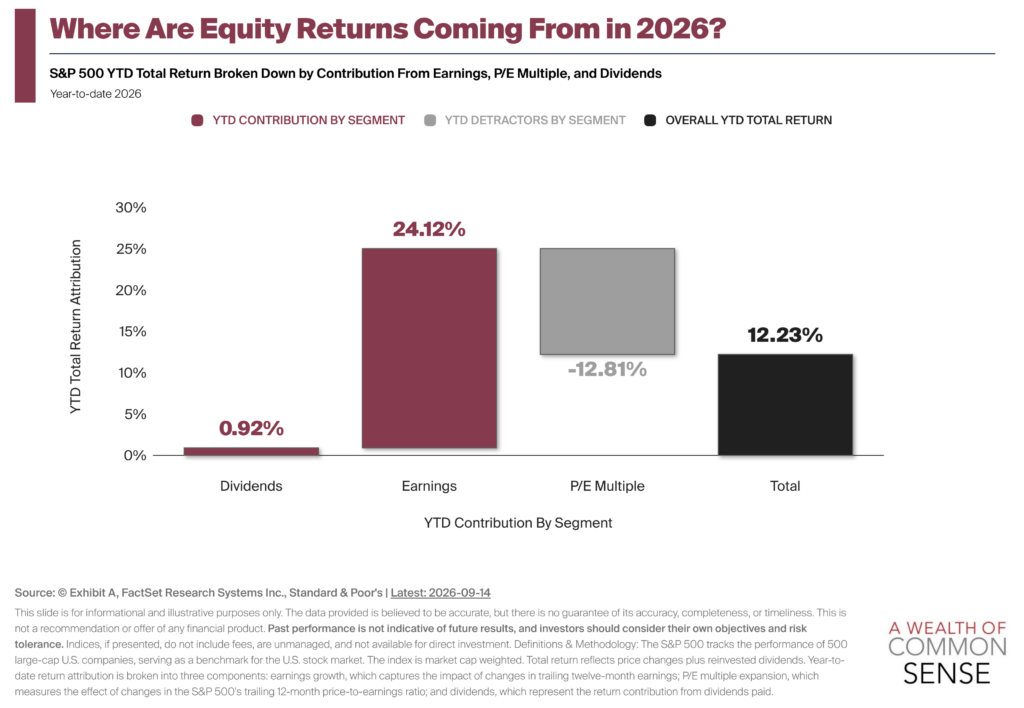
Yet, contrary to these traditional danger signals, the U.S. stock market has surged. Even more intriguingly, this year’s equity returns are not merely the result of speculative multiple expansion or irrational exuberance. Instead, market analysis reveals that the rally is fundamentally driven: corporate earnings are growing at a pace even faster than stock prices, meaning that overall market valuations—measured on a price-to-earnings basis—are actually compressing.
Chronology: How the 2026 Market Narrative Unfolded
The trajectory of the 2026 financial markets has been defined by a series of surprising shifts, moving from early-year cautious optimism to mid-year realization, and finally to the current high-stakes equilibrium.
Q1 2026: The False Sense of Decompression
As the year opened, markets were pricing in a gradual normalization of the post-pandemic economy. Inflation prints hovering near 2.4% gave investors hope that central banks had successfully engineered a soft landing. Mortgage rates hovered near the 6% threshold, and crude oil traded comfortably below $60 a barrel. Equity markets began the year on an upbeat note, largely anticipating that interest rate cuts were just over the horizon.
Q2 2026: The Macro Strains Begin to Show
By late spring, the narrative began to fray. Geopolitical tensions and shifting energy dynamics sent crude oil prices on an aggressive upward trajectory, breaching the $80 and eventually the $90 thresholds. Simultaneously, sticky service-sector inflation forced the Consumer Price Index (CPI) to tick back upward to 3.4%. Bond markets reacted swiftly: the 10-year Treasury yield broke through the psychological 4.5% barrier on its way to 5%, while mortgage rates touched 7%. Analysts braced for corporate profit warnings and a consumer spending slowdown.
Q3 2026: The Earnings Reality Check and the AI Super-Cycle
As mid-year corporate earnings reports rolled in during July and August, the anticipated crunch failed to materialize across the broader market indices. While small businesses and interest-rate-sensitive sectors felt the pinch of 7% mortgages and $4 gas, corporate giants—particularly mega-cap technology firms—reported staggering revenue and profit expansions. It became increasingly clear that a massive capital expenditure (CapEx) super-cycle centered around artificial intelligence (AI) was fueling a massive transfer of wealth and productivity, decoupling the tech-heavy stock market indexes from traditional macroeconomic pain points.
Supporting Data: Earnings Growth Outpacing Valuations
One of the most fascinating anomalies of the 2026 market is the mechanics of its growth. Historically, bull markets driven by high sentiment often see stock prices rise much faster than corporate earnings, leading to inflated, precarious valuations.
This year, however, the script has flipped. Attribution analysis of the S&P 500 total return shows that fundamental earnings growth is doing the heavy lifting. Companies are generating cash flows and net income at such a robust clip that earnings are outpacing the double-digit gains in equity prices. Consequently, aggregate valuation multiples have contracted rather than expanded.
+-----------------------------------------------------------------+
|                   2026 ECONOMIC PARADOX MATRIX                  |
+---------------------------+------------------+------------------+
| Indicator                 | January 2026     | September 2026   |
+---------------------------+------------------+------------------+
| 30-Year Mortgage Rate     | 6.0%             | 7.0%             |
| 10-Year Treasury Yield    | 4.0%             | 5.0%             |
| Inflation Rate (CPI)      | 2.4%             | 3.4%             |
| Crude Oil (per barrel)    | < $60            | > $100           |
| Average Gas Price (gal)   | $2.90            | > $4.00          |
| S&P 500 Performance       | Positive Start   | Double-Digit YTD |
+---------------------------+------------------+------------------+
This data points to a stark divergence: the "old economy"—reliant on traditional borrowing, consumer discretionary spending on non-essentials, and energy-intensive logistics—is absorbing significant pressure. Meanwhile, the "new economy"—anchored by digital infrastructure, enterprise software, and the AI hardware buildout—is operating in an entirely different financial stratosphere.
Market Perspectives and Skepticism: Unraveling the AI Dominance
Despite the stellar performance of equity benchmarks, Wall Street strategists and institutional investors remain deeply divided over the sustainability of this trend. Market observers generally point to three central questions when evaluating the current market dynamics:
- The Sustainability of Hyperscaler Spending: Are investors right to remain slightly cautious despite strong earnings because this growth is heavily concentrated? A vast portion of corporate earnings expansion is currently being driven by massive, unprecedented capital outlays from hyperscale cloud providers and tech giants funding the AI buildout. Skeptics question whether end-user demand will eventually materialize to justify these staggering infrastructure investments once the initial deployment phase matures.
- The Inflationary Threat: With inflation ticking back up to 3.4% and oil prices exceeding $100 a barrel, does the market’s current optimism underestimate the long-term damage of persistent input costs? If sticky inflation forces central banks to maintain restrictive monetary policy—or even consider further tightening—the pressure on asset valuations could intensify rapidly.
- The Bond Market Gravity: Can equities continue to shrug off a 5% 10-year Treasury yield? Historically, a 5% yield provides a compelling risk-free alternative to equities. The fact that stocks continue to attract capital in the face of competitive bond yields demonstrates a profound belief in corporate profit margins, but financial historians warn that gravity eventually reasserts itself.
Most market analysts conclude that the current resilience is likely driven by a combination of these factors. Investors are simultaneously reaping the rewards of unprecedented technological productivity gains while hedging against—or simply ignoring—the creeping risks of inflation and high bond yields.
Implications: Navigating a Concentrated and Complex Future
The implications of the 2026 market paradox extend far beyond the trading floors of New York and London; they touch upon the structural health of the global economy and the future of individual investment portfolios.
For individual investors, the primary takeaway is the danger of relying on macroeconomic headlines to time or direct investment strategies. A portfolio constructed entirely on the premise that "7% mortgages, 5% yields, and $100 oil equal a bear market" would have missed out on one of the most robust, fundamentally driven equity runs of the decade. Conversely, the extreme concentration of market returns means that passive investors tracking major indexes are taking on a heavy bet that the AI infrastructure boom will continue without interruption.
As the financial world looks toward the final quarter of 2026 and into 2027, the overriding sentiment is one of conditional optimism mixed with cautious vigilance. For the time being, artificial intelligence commands the macroeconomic stage—it is effectively the only variable that seems to matter to equity markets.
How long this dominance will persist remains the trillion-dollar question. As financial commentators frequently observe, market trends of this magnitude remain the dominant force until the moment they abruptly stop. And while predicting the exact timing of that shift is impossible, the widening gap between the pressures of the physical economy and the triumphs of the digital earnings machine ensures that the remainder of 2026 will be watched with intense scrutiny.