The Titan Squeeze: Why Record Stock Market Concentration May Be the New Normal, Not a Red Flag
September 6, 2026
By Financial Markets Desk
Main Facts: The Trillion-Dollar Club and the S&P 500
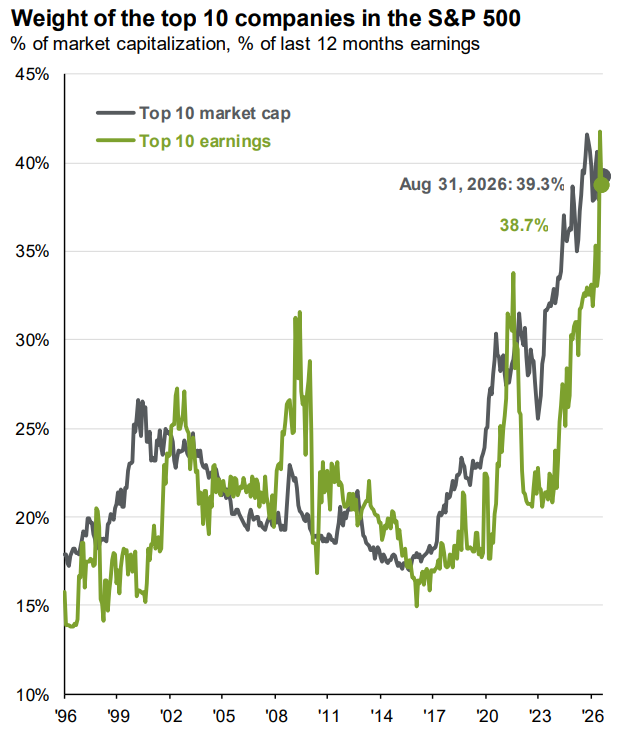
Modern equity markets are experiencing a historic structural shift. As of September 2026, the top 10 companies in the S&P 500 account for a staggering 40% of the entire index’s market capitalization. Every single member of this elite top-tier group boasts a market valuation exceeding $1 trillion, a milestone further underscored by giants like Berkshire Hathaway and Eli Lilly joining the "four-comma club." In total, the 12 largest corporations worldwide now sit comfortably above the trillion-dollar threshold.
To put this concentration into historical perspective, the top 10 companies made up just 17% of the S&P 500 as recently as 2015. For everyday retail investors and institutional portfolio managers alike, this immense skew triggers a persistent anxiety: If a handful of mega-cap behemoths stumble, will they drag the entire broader market down with them?
While the concern is understandable on the surface, a deeper examination of historical data, global market trends, and underlying corporate fundamentals suggests that market concentration is not necessarily a harbinger of imminent doom. Rather, it is a defining characteristic of modern economic expansion, technological disruption, and sustained bull markets.
Chronology: The Evolution of Market Dominance
Understanding how we arrived at this era of unprecedented corporate scale requires looking back at the trajectory of market structures over the past decade:
- 2015: The S&P 500 exhibits a relatively decentralized posture. The top 10 companies account for roughly 17% of the index, representing a diverse mix of financial, industrial, healthcare, and early-stage tech leaders.
- 2018: Early alarm bells begin to ring across financial commentary circles regarding rising market concentration. Analysts point toward the accelerated growth of early cloud computing and platform-based business models. Despite these worries, the market continues an extended upward trajectory.
- 2020–2023: The global pandemic accelerates digitalization. E-commerce, remote work infrastructure, and semiconductor demand propel a select group of technology titans to unprecedented valuations, pushing the S&P 500’s top-heavy profile to new highs.
- 2024–2025: The generative artificial intelligence (AI) boom takes hold. Infrastructure spending skyrockets, cementing the dominance of hardware and software leaders. Discussions around "The New Normal of Stock Market Concentration" become a fixture of institutional investment strategies.
- Late 2026: The S&P 500 reaches a new milestone where the top 10 holdings command nearly 40% of the index. Pre-IPO giants and private sector innovators—such as SpaceX, OpenAI, and Anthropic—loom on the horizon, signaling that future public market entrants could push concentration levels even higher.
Supporting Data: What the Research Tells Us
Financial research from leading institutions reveals that investor anxiety over concentration often stems from recency bias rather than structural flaws. Three core empirical arguments challenge the narrative that high concentration spells disaster:
1. Concentration is a Bull Market Phenomenon
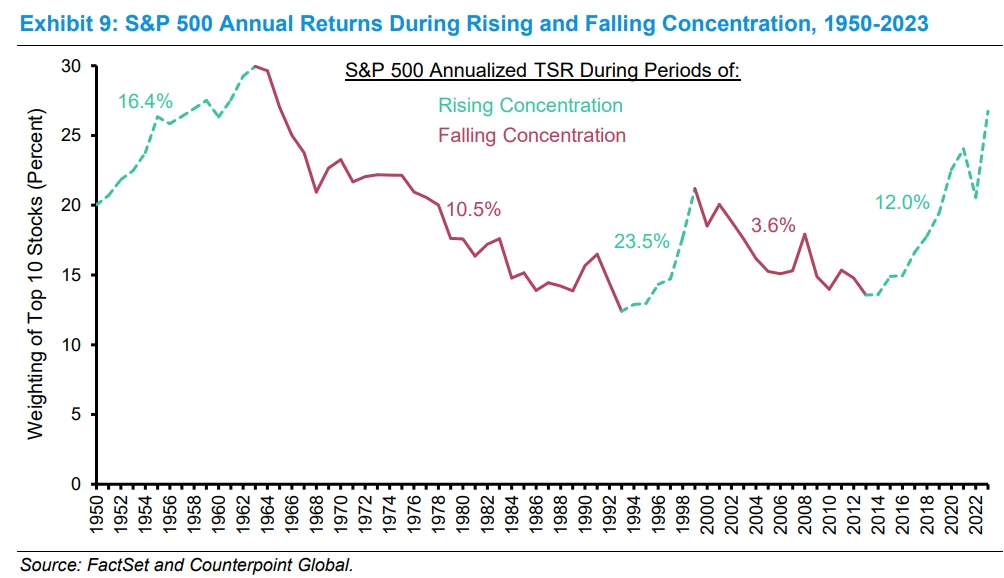
Extensive research conducted by market strategists Michael Mauboussin and Dan Callahan of Morgan Stanley demonstrates a clear historical correlation: S&P 500 returns tend to be above average when market concentration is rising, and below average when it is falling.
Critics who have warned about concentration since the late 2010s have largely missed out on a prolonged, historic bull market. Rising concentration is frequently the byproduct of highly successful companies capturing outsized market share, expanding profit margins, and driving economic growth—qualities that naturally fuel rising equity prices.
2. The Global Context: The U.S. is Not an Outlier
When viewed through an international lens, the American stock market is actually less concentrated than many of its global peers. According to data compiled by Michael Cembalest of J.P. Morgan Private Bank, nearly every major global stock market features higher top-10 concentration levels than the United States, with the notable exceptions of Japan and India.
Extreme examples highlight this global trend. In South Korea, for instance, the top 10 companies account for roughly 80% of the entire national market capitalization, with just two corporate titans driving nearly 50% of the total index. Compared globally, the S&P 500 remains relatively diversified.
3. Fundamentals Back Up the Valuations
Skeptics often worry that mega-cap market valuations are detached from reality. However, fundamental earnings data tells a different story. J.P. Morgan analyses tracking the S&P 500 reveal a tight parallel between market cap weight and earnings share: the top 10 companies generate a share of total S&P 500 earnings that closely mirrors their nearly 40% market cap weight.
In short, these companies are not merely trading on hype; they are producing historic net income that justifies their elevated valuations.
Official Perspectives and Market Responses
Financial analysts, wealth managers, and macroeconomic thinkers remain divided on the broader societal and systemic implications of this trend, particularly regarding wealth inequality and technological disruption.
The modern economy mirrors the stock market in its distribution of wealth. In the United States, the top 10% of households control roughly two-thirds of total national wealth and own approximately 87% of the equity market.

This dynamic has amplified debates surrounding the societal impact of artificial intelligence. Tech leaders and economists hold polarized views on whether AI will democratize opportunity or entrench existing monopolies. OpenAI, Anthropic, and SpaceX represent a new class of private enterprises that, upon entering public markets, could concentrate wealth and market power even further.
Weighing in on this paradox, tech visionary Bill Gates recently remarked:
"In terms of equity, AI will either be the greatest equalizer ever invented, or the worst source of injustice."
Market observers suggest that even if artificial intelligence broadens educational access and lowers the barriers to entry for new startups—serving as a macroeconomic equalizer—the structural gravity of the modern corporate ecosystem will likely continue to favor scale. History indicates that platform economics and network effects naturally funnel capital and revenue toward established category leaders.
Implications: Navigating the Era of the Megacap
For the average investor, financial advisor, and policy maker, the reality of a 40% top-heavy S&P 500 carries several critical takeaways:
- Passive Indexing is Still Active Exposure: Investors utilizing traditional market-cap-weighted index funds must recognize that they are making a heavy tactical bet on mega-cap technology and platform businesses, whether they realize it or not.
- Earnings Justify the Scale: Unlike the dot-com bubble of 2000, where skyrocketing valuations were frequently divorced from revenue, today’s market leaders are cash-flow powerhouses backed by tangible global demand and robust corporate earnings.
- The AI Horizon: As private tech giants prepare for potential public offerings over the coming years, market concentration is unlikely to recede. Investors must prepare for a financial ecosystem where outsized corporate scale is the permanent baseline.
Ultimately, while the headline figures may cause uneherence for traditionalists, market concentration is less a flashing red warning light and more a reflection of a transforming global economy—one where digital scale, technological innovation, and fundamental earnings are more concentrated than ever before.