The Digital Roadmap to Financial Security: A Comprehensive Analysis of Modern Retirement Planning Software

As pensions fade into historical obscurity and the responsibility of funding retirement shifts squarely onto individual shoulders, the demand for sophisticated financial planning technology has surged. Retirement calculators and software platforms have evolved from rudimentary, single-variable estimators into complex, multi-layered simulation engines. For those years away from retirement, these digital tools serve as essential compasses to determine optimal savings rates. For individuals standing on the precipice of retirement, they act as critical guardrails, calculating sustainable annual withdrawal rates to ensure retirees do not outlive their accumulated wealth.
However, the proliferation of these platforms has revealed a critical challenge for consumers: not all retirement tools yield the same results. Because different software packages utilize distinct mathematical methodologies, tax algorithms, and market assumptions, their projections can diverge dramatically. A landmark study evaluating five of the industry’s leading professional retirement planning software packages revealed stark discrepancies in projected outcomes. The researchers concluded with a vital warning: individuals must utilize multiple analytical programs to stress-test their assumptions before executing any irreversible financial decisions.
Main Facts: The Discrepancy in Digital Financial Planning
The modern landscape of personal finance software is divided between simple online calculators and comprehensive financial planning software. While a basic calculator requires only a handful of inputs—such as current age, retirement age, savings balance, and expected return—to generate a linear projection, robust planning software models real-world volatility, evolving tax codes, and complex cash-flow events.
The discrepancies identified in comparative academic research stem from how these platforms handle critical variables:
- Sequence of Returns Risk: The order in which market gains and losses occur, particularly in the years immediately preceding and following retirement.
- Tax Code Integration: How platforms project federal, state, and local taxes over multi-decade horizons, especially concerning required minimum distributions (RMDs) and tax-advantaged account withdrawals.
- Healthcare and Longevity Assumptions: The calculation of rising Medicare premiums, long-term care costs, and personalized life expectancies.
- Simulation Engines: The reliance on static linear growth rates versus Monte Carlo statistical probabilities or historical market backtesting.
To navigate this complexity, financial analysts point to four market-leading platforms that offer the depth required for reliable retirement modeling: Boldin (formerly New Retirement), ProjectionLab, Empower, and Maxifi. Each platform approaches the challenge of retirement forecasting through a unique philosophical and mathematical lens.
Chronology: The Evolution of Retirement Modeling
To understand the sophistication of modern retirement software, it is necessary to trace the historical evolution of retirement planning methodologies over the past several decades.
[1990s: Linear Calculations] ──> [2000s: Monte Carlo Integration] ──> [2010s: Account Aggregation & SaaS] ──> [Present: Hyper-Personalized Tax & Cash-Flow Modeling]The Era of Linear Projections (1990s)
In the early days of personal computing and internet access, retirement planning relied on static, linear calculations. Users input an average annual return (e.g., 7% or 8%) and a fixed inflation rate. The software projected a smooth, uninterrupted upward trajectory during the accumulation phase and a steady, predictable decline during decumulation. This methodology failed to account for market volatility, sequence of returns risk, or major macroeconomic shocks, often leading to overconfidence and premature portfolio depletion.
The Monte Carlo Revolution (Early 2000s)
As computational power democratized, software developers integrated Monte Carlo simulations. Instead of assuming a static annual return, Monte Carlo engines run hundreds or thousands of randomized market trials based on historical volatility and asset class correlations. This shifted the conversation from a single, deterministic "number" to a statistical probability of success (e.g., an 85% chance that the portfolio survives a 30-year retirement).
The Rise of Account Aggregation (2010s)
The introduction of secure application programming interfaces (APIs) allowed platforms to securely link directly to users’ bank, brokerage, and retirement accounts. This eliminated the need for tedious manual data entry and enabled real-time portfolio tracking, automatic asset allocation analysis, and continuous plan updates based on actual market values.
The Era of Hyper-Personalized Tax and Scenario Modeling (Present)
Today’s leading platforms go far beyond asset balances and probability scores. They incorporate dynamic tax engines that model future tax brackets, Roth IRA conversions, Social Security claiming strategies, Medicare premium brackets (IRMAA), and real estate liquidations. This allows users to build highly customized, interactive "what-if" scenarios to optimize their lifetime net worth.
Supporting Data: Comprehensive Analysis of the Top Four Platforms
To assist investors in choosing the appropriate analytical framework, the following section provides a detailed breakdown of the leading retirement planning platforms, including their pricing models, unique features, advantages, and drawbacks.
1. Boldin (Formerly New Retirement)
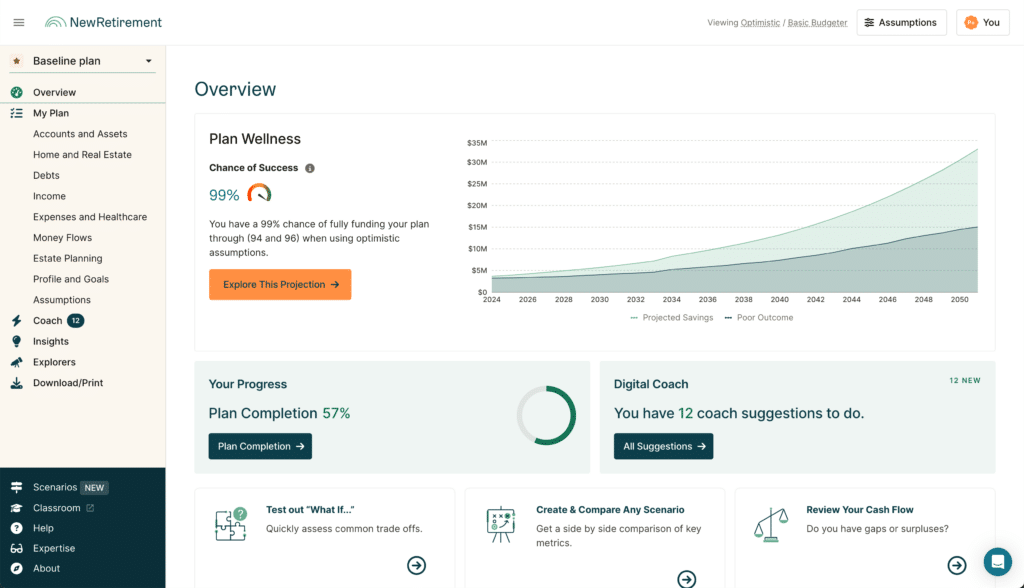
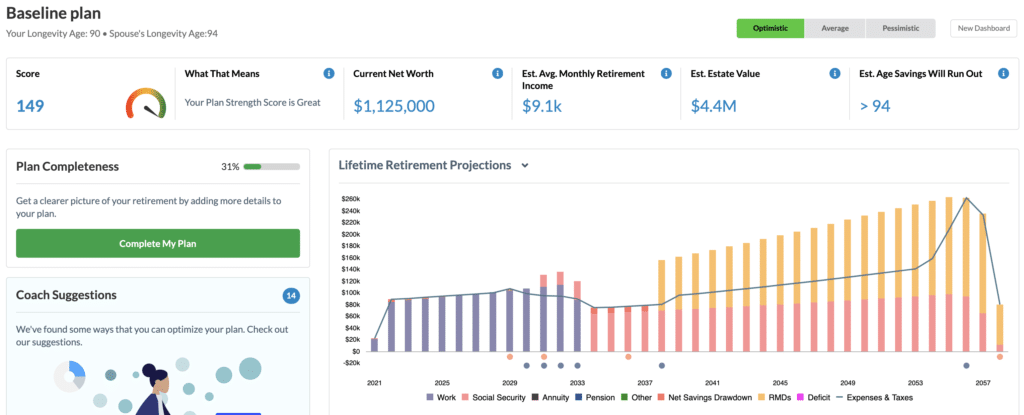
Boldin is widely regarded by financial analysts as one of the most comprehensive cash-flow modeling tools available to individual investors. It is designed to handle highly complex financial profiles without requiring a professional advisor credential.
Boldin Architecture:
[User Inputs: Assets, Debts, Goals] ──> [Dynamic Tax & Cash-Flow Engine] ──> [Optimizations: Roth Conversions, Social Security] ──> [Visual Dashboard Projections]- Platform Type: Web-based SaaS.
- Target Audience: Detailed-oriented planners seeking granular control over annual cash-flow variables.
- Key Features: Custom Roth conversion optimizer, Medicare premium estimator, Social Security claiming strategy modeler, and manual or linked account options.
- Unique Feature: Boldin’s Roth IRA conversion calculator allows users to model the long-term tax implications of converting traditional pre-tax balances to Roth accounts over a multi-year strategy, illustrating the impact on lifetime tax liabilities and required minimum distributions (RMDs).
Performance Metrics & Pricing
- Basic Plan: Free (limited to basic cash-flow projections and manual account entry).
- PlannerPlus Plan: $12 per month (billed annually at $144 per year) after a 14-day free trial.
- Pros: Combines a highly customizable cash-flow engine with an intuitive, chart-driven user interface; offers granular control over annual income and expense modifications.
- Cons: Does not natively support simulations based purely on historical market data sequences (backtesting), relying instead on randomized projections.
2. ProjectionLab
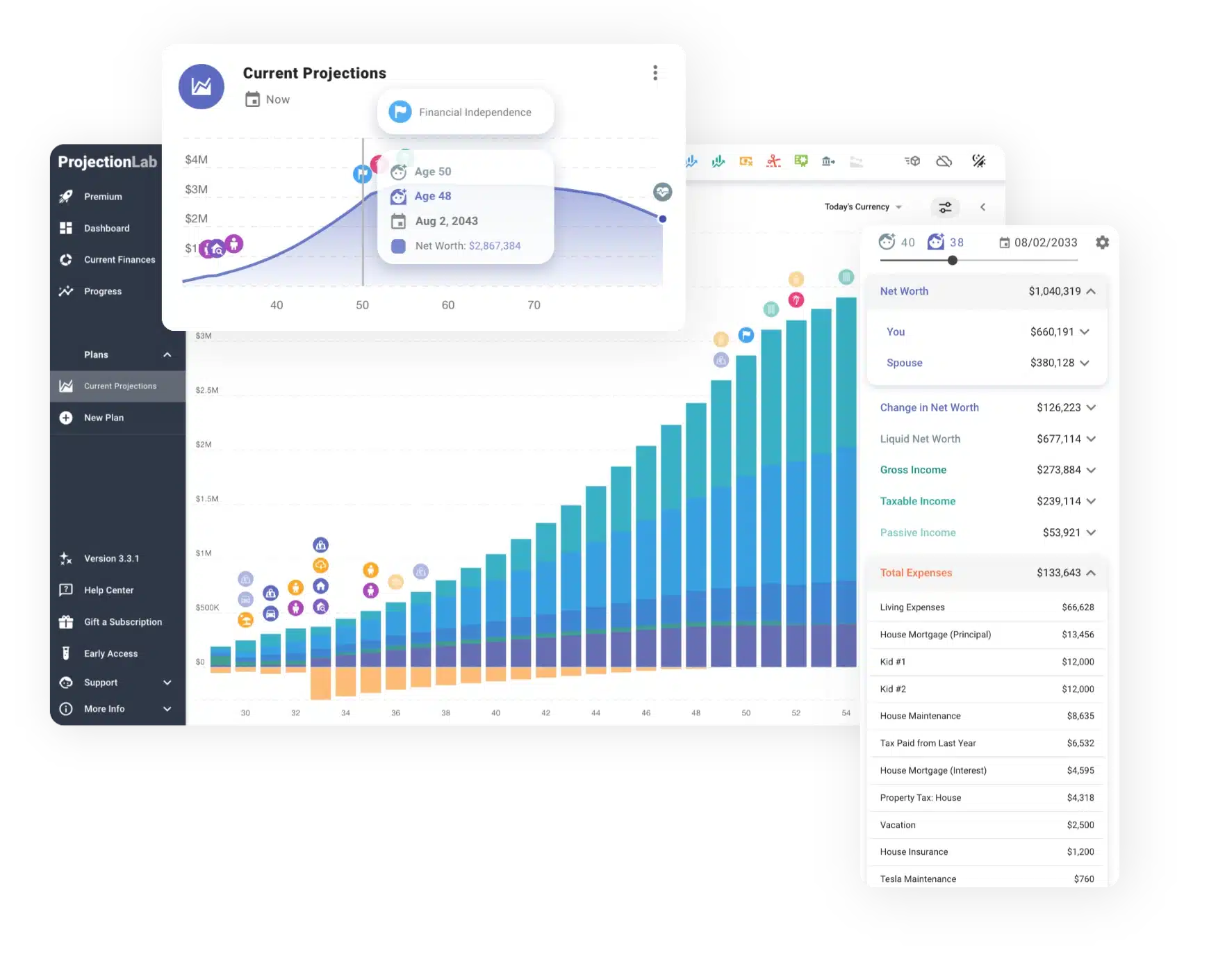
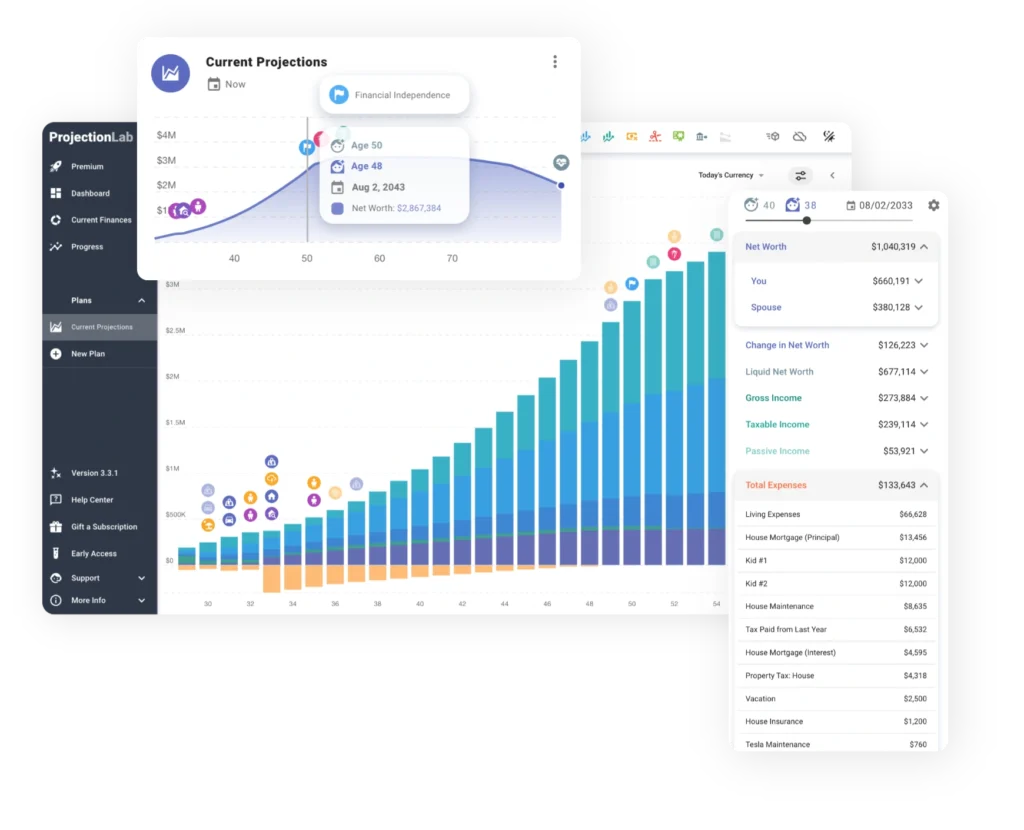
Developed by software engineer Kyle Nolan, ProjectionLab has quickly gained a dedicated following within the personal finance community, particularly among adherents of the Financial Independence, Retire Early (FIRE) movement. The platform is praised for its exceptional user interface, highly customizable charts, and modular design.
ProjectionLab Core Engine:
[Granular Account & Asset Inputs] ──> [Simulation Selection: Monte Carlo OR Historical Backtesting] ──> [Interactive "What-If" Scenarios]- Platform Type: Web-based SaaS.
- Target Audience: Tech-savvy users who want to compare multiple retirement philosophies and run detailed, comparative scenario analyses.
- Key Features: Advanced "what-if" scenario comparisons, variable withdrawal strategy modeling, and highly detailed tax bracket visualizations.
- Unique Feature: Unlike many competitors, ProjectionLab allows users to model and compare complex, dynamic withdrawal strategies, including the traditional 4% Rule, the Guyton-Klinger guardrails, and Variable Percentage Withdrawal (VPW) models.
Performance Metrics & Pricing
- Basic Plan: Free (allows users to build a profile and run basic calculations, but does not support saving progress or account linking).
- Premium Plan: $129 per year (offers full save functionality, account linking via Plaid, and advanced modeling features). A lifetime subscription option is available for $799.
- Pros: Best-in-class user interface and interactive charts; supports both Monte Carlo simulations and historical market backtesting; allows unlimited, side-by-side scenario modeling.
- Cons: Lacks dedicated, automated wizard tools for Social Security optimization and Roth IRA conversions, requiring users to manually construct those scenarios.
3. Empower (Formerly Personal Capital)
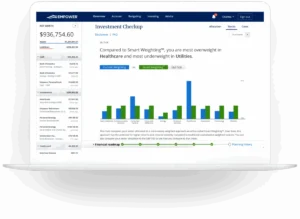
Empower is widely recognized as the gold standard for free wealth management and retirement tracking. By leveraging account aggregation, it provides users with a comprehensive, holistic view of their financial life.
Empower Dashboard Workflow:
[Real-Time API Account Linking] ──> [Automatic Asset Allocation Analysis] ──> [Monte Carlo Simulation Engine]- Platform Type: Web-based and mobile application.
- Target Audience: Investors seeking an automated, hands-off dashboard to monitor net worth, investment performance, asset allocation, and high-level retirement readiness.
- Key Features: Real-time account aggregation, investment fee analyzer, asset allocation review, and Monte Carlo-driven retirement planner.
- Unique Feature: Empower automatically pulls actual holdings data from linked brokerage and retirement accounts to analyze portfolio fees and asset allocation drift, integrating this real-time data directly into its Monte Carlo simulation engine.
Performance Metrics & Pricing
- Cost: Completely free. Empower monetizes its platform by offering optional, paid wealth management services to users with asset balances exceeding $100,000.
- Pros: Highly automated; excellent real-time dashboard; completely free of charge; robust Monte Carlo simulation engine.
- Cons: Offers limited granularity for complex, manual cash-flow adjustments; users cannot easily model highly customized, year-by-year tax strategies; frequent marketing outreach from Empower’s advisory division.
4. Maxifi
Created by Boston University economics professor Laurence Kotlikoff, Maxifi operates on a fundamentally different philosophical model than its competitors. It eschews traditional cash-flow planning in favor of an economic concept known as "consumption smoothing."
Maxifi Economic Model:
[Assets & Income Streams] ──> [Consumption Smoothing Algorithm] ──> [Calculated Living Standard: Fixed Inflation-Adjusted Annual Spend]- Platform Type: Web-based SaaS.
- Target Audience: Users interested in optimizing their lifetime standard of living through mathematically rigorous economic modeling.
- Key Features: Standard-of-living maximization algorithms, Social Security claiming optimization, and deep tax-minimization calculations.
- Unique Feature: Maxifi calculates a user’s "discretionary spending allowance"—the maximum amount they can spend each year of their remaining life to maintain a completely stable, inflation-adjusted standard of living, regardless of when they retire or when their income streams change.
Performance Metrics & Pricing
- Premium Plan: $149 for the first year, with a renewal rate of $109 per year.
- Pros: Backed by rigorous economic theory; excellent at calculating the exact trade-offs of major life decisions (e.g., moving to a lower-tax state, delaying retirement); highly sophisticated tax and Social Security optimization engines.
- Cons: Steeper learning curve than competitor platforms; user interface can feel clinical and less visually engaging; consumption smoothing assumes a flat spending trajectory, which may not align with actual retiree behavior (which typically exhibits a "spending smile" where spending declines in mid-retirement before rising due to late-life healthcare costs).
Official Responses and Expert Perspectives
The financial planning industry has long debated the efficacy of various retirement modeling techniques. Certified Financial Planners (CFPs) and academic researchers caution that while retirement planning software is incredibly powerful, its output is only as reliable as its input assumptions—a concept known in computer science as "garbage in, garbage out."
The Consensus on Software Divergence
The consensus among academic researchers is that software packages often arrive at different conclusions because of their underlying default settings. For example, some platforms default to historical average inflation rates (e.g., 2.5% to 3%), while others allow users to set variable inflation rates for different expense categories, such as health care or housing. Similarly, assumptions regarding equity risk premiums, bond yields, and life expectancies can skew a portfolio’s projected survival rate by 20% or more over a 30-year horizon.
The Cash-Flow vs. Consumption Smoothing Debate
Economists and traditional financial planners frequently clash over the optimal modeling philosophy. Traditional planners favor cash-flow software (like Boldin and ProjectionLab) because it aligns with how people naturally think about money: tracking income inflows against expense outflows.
Conversely, academic economists argue that consumption smoothing (pioneered by Maxifi) is the only mathematically sound way to avoid either underspending during early retirement or running out of money in late retirement. They contend that traditional cash-flow modeling encourages retirees to preserve capital unnecessarily, depriving themselves of a higher standard of living during their active retirement years.
The Role of Monte Carlo vs. Historical Backtesting
Industry experts emphasize that Monte Carlo simulations and historical backtesting should be used in tandem:
- Monte Carlo Simulations are valuable for understanding statistical probability and stress-testing a portfolio against extreme, randomized market conditions. However, critics note that Monte Carlo models often assume market returns follow a normal distribution, potentially underestimating the frequency and severity of market crashes (tail risk).
- Historical Backtesting grounds the plan in actual economic history, showing how a portfolio would have survived real-world crises like the Great Depression, the stagflation of the 1970s, or the Dot-Com bust of 2000. It provides a tangible, historical sanity check that randomized simulations cannot replicate.
Implications: The Future of Retirement Preparedness
The democratization of professional-grade retirement planning software has profound implications for individual financial security, the advisory industry, and broader economic stability.
The Empowerment of the Self-Directed Investor
Historically, access to sophisticated financial forecasting engines was restricted to licensed professionals utilizing expensive proprietary platforms like eMoney or RightCapital. Today, individual investors can access tools of comparable sophistication for a nominal annual fee, or even for free. This shift has empowered individuals to take ownership of their financial futures, demystifying complex concepts like Roth conversions and Social Security claiming strategies.
A New Collaborative Paradigm for Advisors
The availability of these platforms does not render human financial advisors obsolete; rather, it shifts their value proposition. With clients able to run their own baseline projections, the modern fiduciary advisor’s role has transitioned from quantitative calculator to qualitative guide. Advisors are increasingly utilized to validate software-generated strategies, manage behavioral biases during market downturns, and navigate complex estate-planning and tax-mitigation strategies that software cannot fully automate.
Mitigation of Systemic Retirement Risks
As life expectancies rise and public safety nets face structural demographic pressures, the widespread adoption of robust planning tools could help mitigate systemic risks such as longevity risk and public dependency. By allowing individuals to stress-test their portfolios against inflation, market volatility, and healthcare shocks, these platforms encourage proactive adjustments—such as delaying Social Security, working part-time, or adjusting asset allocations—well before a financial crisis occurs. Ultimately, the integration of these advanced digital tools into mainstream financial planning is creating a more resilient, financially literate, and prepared generation of retirees.