The Art of Persistence: How nae vallejo’s Buck Reimagines Memory, Land, and Belonging
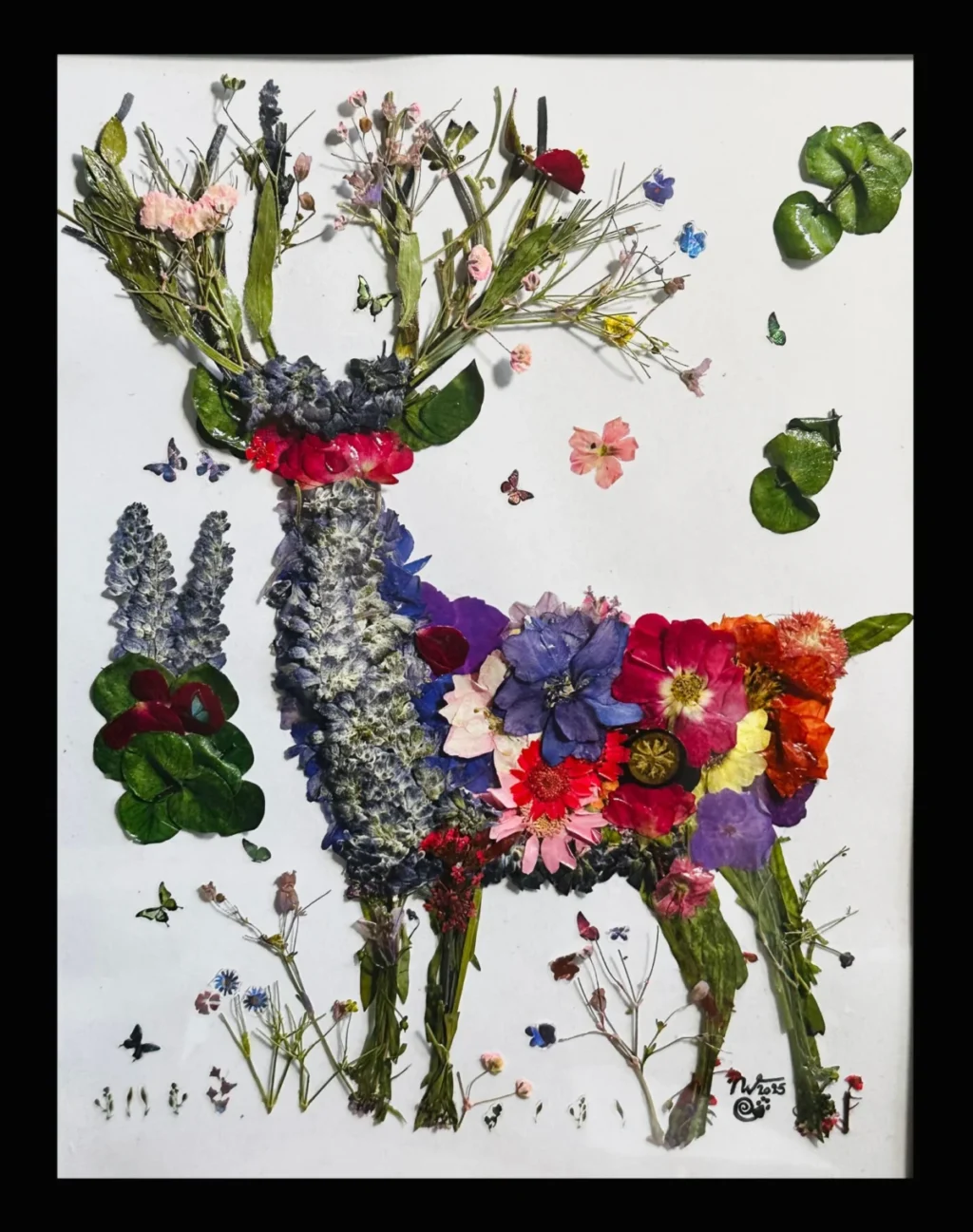
In the quiet intersection of botanical preservation and ancestral storytelling, artist and experiential archivist nae vallejo has unveiled Buck—a striking piece of oshibana (the art of pressed flowers) that challenges the conventional boundaries of how we perceive land, history, and the persistence of memory. By arranging dried flora and preserved plant material into the elegant, watchful silhouette of a deer, vallejo invites a profound dialogue on the nature of transformation and the ethics of stewardship.
Buck is not merely an aesthetic endeavor; it is a meditation on the cyclical nature of life. Through their work, vallejo explores the thesis that memory, much like the organic matter they use, changes form without ever truly disappearing. In a world defined by rapid disruption and shifting landscapes, Buck stands as a reminder that even when the bloom has faded, the essence—the history, the care, and the potential—remains.
Main Facts: The Architecture of Buck
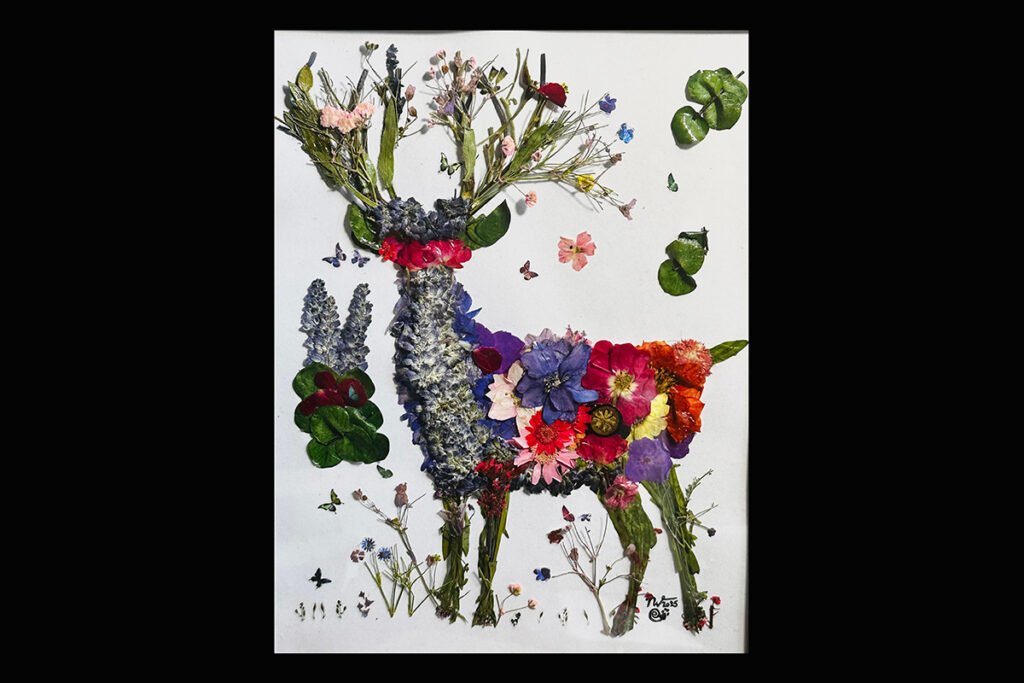
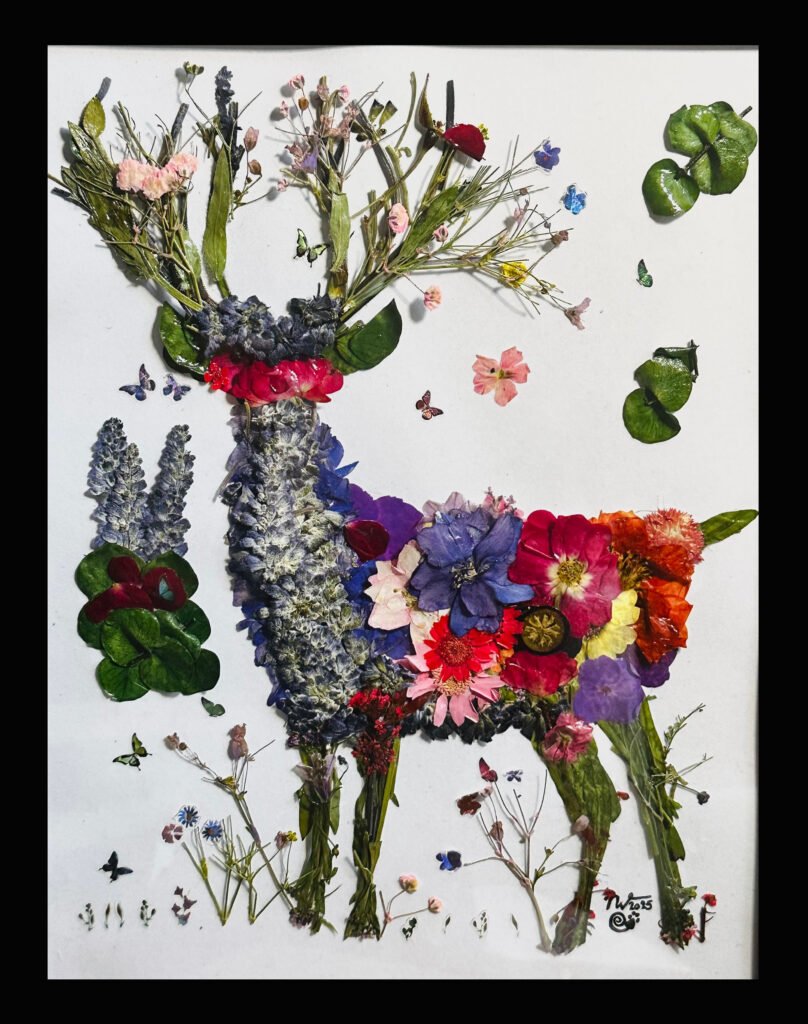
Buck functions as both a sculpture and an archive. The piece is meticulously constructed from plant materials that have been dried and preserved, a technique that requires immense patience and an intimate understanding of biological decay. The silhouette of the deer is intentional, chosen by the artist to represent a specific set of virtues: tenderness, constant alertness, and a profound capacity for relationship.
For the viewer, the image of the deer is recognizable, yet the composition demands closer inspection. Each leaf, petal, and stem serves as a tactile record of a living organism that once thrived, wilted, and was subsequently rescued from obsolescence.
- Medium: Oshibana (pressed flower art).
- Symbolism: The deer as an emblem of adaptation and ecological interdependence.
- Core Philosophy: Memory as an ongoing, living process rather than a static historical artifact.
- Artist Intent: To pivot the conversation surrounding "America" away from nationalistic ownership and toward a collective, ancestral relationship with the land.
Chronology: A Trajectory of Transformation
The creation of Buck did not occur in a vacuum; it is the culmination of vallejo’s long-standing practice as an experiential archivist and founder of naeborhood projects.
- Foundational Development: Long before the first petals were pressed for Buck, vallejo spent years exploring the intersections of disability justice, sensory attunement, and collective care. Their work has consistently interrogated how survivors leave "traces" across bodies and landscapes.
- Conceptualization: The transition toward botanical art emerged from a desire to address the impermanence of the body. vallejo began experimenting with the oshibana technique to capture the "rememory" of natural spaces.
- The Assembly of Buck: The assembly of the piece took place over several months, mirroring the seasonal shifts that the materials themselves underwent. Each stage of the process—collecting, pressing, drying, and arranging—was treated as a ritual of preservation.
- Public Introduction: The work was introduced as a challenge to the contemporary discourse on land rights and national identity, serving as a visual anchor for broader discussions regarding how we inhabit space.
Supporting Data: The Science and Ethics of Preservation
While Buck is an artistic statement, its foundation rests on the scientific reality of botanical decay and the ethical framework of sustainable archival practice.
The Biology of Persistence
The preservation of plant material relies on the rapid removal of moisture to halt enzymatic activity and microbial growth. In the context of vallejo’s work, this scientific necessity takes on a metaphorical weight. By arresting the decay of the plant, the artist creates a "liminal object"—something that is neither fully living nor fully dead, but existing in a state of suspended animation.
The Sociology of Land Stewardship
In current environmental and social discourse, the concept of "ownership" is increasingly being scrutinized. Research into Indigenous land practices and ecological resilience suggests that belonging is historically defined by relationship rather than possession. vallejo’s work draws upon this sociological shift. By utilizing native or locally sourced botanical elements, the piece argues that our connection to the land is a reciprocal agreement—a "covenant of care"—that precedes the arbitrary lines of borders.
Official Perspectives: The Artist’s Statement
nae vallejo, who identifies as a Black, Caddo, Mexican, queer, trans, and disabled artist, views their work as a form of resistance against the erasure of marginalized histories. Their professional background—rooted in disability justice and community-centered design—informs the way Buck is presented to the public.
"The story of ‘America’ is a story about our relationships to land, memory, and one another," vallejo notes. "It is a story that existed long before national borders and continues beyond them."
vallejo emphasizes that Buck is a tool for "rememory," a concept popularized by Toni Morrison, which describes the process by which the past is not behind us, but rather surrounding us, waiting to be recalled. By centering the deer as a symbol, the artist highlights how we must move through landscapes shaped by both beauty and disruption. The deer adapts, not by conquering its environment, but by remaining deeply attuned to the ecosystems that sustain it.
Implications: Reimagining the Future
The implications of Buck reach far beyond the gallery walls. In an era where many feel a sense of displacement or loss of heritage, vallejo’s work offers a roadmap for psychological and cultural survival.
Reframing Accessibility and Memory
As a hard-of-hearing and neurodivergent artist, vallejo’s work inherently pushes back against the rigid, ableist standards of how art should be "read" or "consumed." Buck asks for a slow, sensory-attuned engagement. It implies that to understand the world, one must be willing to engage with the traces left behind by those who came before us—the "ghosts" of the land.
Challenging National Narratives
The most provocative implication of Buck is its critique of the modern nation-state. By stripping away the political rhetoric of "America," the piece forces a confrontation with the land itself. When we stop viewing land as property to be divided and start viewing it as a shared site of growth, loss, and return, the entire premise of "belonging" changes. We do not belong to the land; the land belongs to the network of relationships we foster within it.
A Legacy of Care
Finally, Buck serves as an invitation to engage in the "everyday practices of survival." For the nonprofit sector and community organizers, the piece serves as a metaphor for institutional longevity. Just as the pressed flower retains its structural integrity through careful preservation, organizations that center community, vulnerability, and ritual are more likely to endure the "disruptions" of the modern world.
Conclusion: The Beauty of the Trace
Buck is a profound reminder that we are all, in a sense, preserved collections of our experiences. We are made of the things we have grown, the things we have lost, and the things we have chosen to carry forward.
nae vallejo’s work does not attempt to reverse the passage of time. Instead, it honors transformation as an ongoing, inevitable, and beautiful process. By creating a silhouette that is at once fragile and resilient, vallejo provides a mirror for the viewer. We are invited to ask ourselves: What am I preserving? What am I carrying? And how can I exist in this world in a way that respects the history of the ground upon which I stand?
In the final analysis, Buck is more than an art object; it is an act of resistance against the idea that change equals destruction. It is a testament to the fact that even after a bloom has passed, something of its beauty, its memory, and its possibility remains—waiting to be seen, waiting to be remembered, and waiting to guide us forward.