The Beautiful Game and the Politics of Belonging: Why Deniz Undav’s Heroics Define Modern Germany
By Daron Acemoglu
June 23, 2026
The Convergence of Identity and Achievement
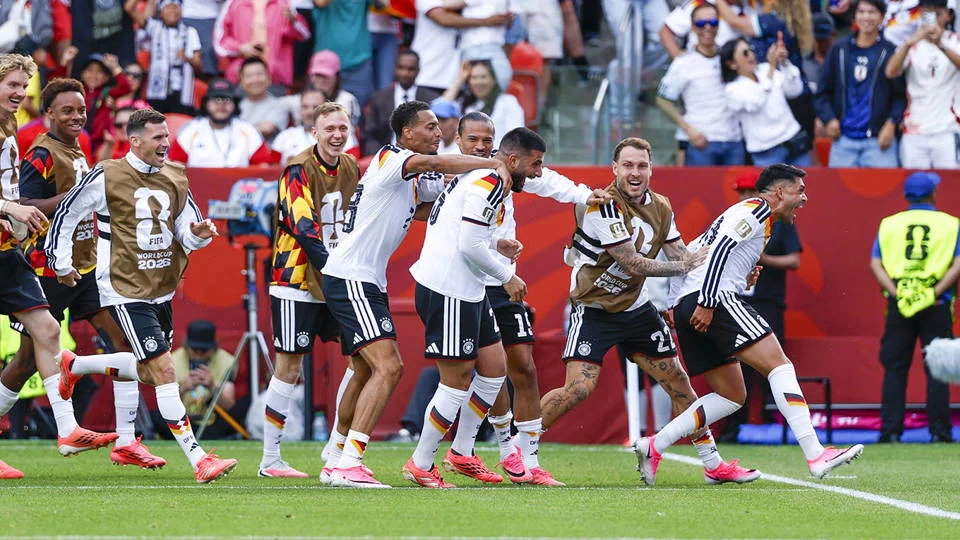
In the summer of 2026, as the world’s eyes are fixed on the World Cup, the football pitch has once again become a mirror for the complexities of the modern nation-state. Nowhere is this more evident than in the recent performance of the German national team. When Deniz Undav, a forward whose ancestry spans Turkish, Syrian, and Kurdish Yazidi heritage, netted two late-game goals to secure a 2-1 victory over Ivory Coast, he did more than just advance his team in the tournament. He provided a visceral, irrefutable answer to the toxic binary of national identity that has increasingly dominated European political discourse.
For years, activists on the far-left and the far-right have sought to partition the citizenry into neat, exclusive boxes. The former often argue that national pride is an inherent precursor to exclusion, while the latter insist that "true" national belonging must be rooted in ethnic or cultural homogeneity. Yet, as the stands erupted in Berlin and beyond, the reality was starkly different: national identity is not a zero-sum game. Loving one’s country and welcoming the contributions of newcomers are not merely compatible impulses; in the eyes of the ordinary citizen, they are frequently inseparable.
Chronology of a Decisive Victory
The match against Ivory Coast, held on the evening of June 22, 2026, serves as a case study in the modern German narrative.
- 18:00 CET: The match begins. Ivory Coast takes an early lead in the 14th minute, putting immense pressure on the German side, which has struggled with consistency in recent international cycles.
- 72nd Minute: German coach Julian Nagelsmann substitutes Deniz Undav, looking to inject pace into a stagnant offense. The crowd’s reaction is one of hopeful anticipation.
- 88th Minute: Undav strikes. A clinical finish from a tight angle levels the score, silencing the Ivory Coast supporters and shifting the momentum of the game entirely.
- 90+4 Minute: In the final seconds of stoppage time, Undav secures the brace. His second goal, a powerful strike from the edge of the box, seals a 2-1 victory.
- Post-Match: Social media trends in Germany are dominated not by debates over heritage or immigration status, but by celebratory tributes to Undav’s clinical finishing and "heroic" composure under pressure.
Supporting Data: The Shifting Demographics of Success
The success of players like Undav is not an anomaly; it is a statistical reflection of 21st-century Germany. According to the Federal Statistical Office (Destatis), over 25% of the German population now has a migration background—a figure that rises significantly among the younger age cohorts from which national football teams are drawn.
When we analyze the success of the German national team over the last decade, there is a clear correlation between the integration of diverse talent and high-level athletic performance. Data from the German Football Association (DFB) indicates that since the early 2000s, youth development programs have shifted focus toward inclusion, casting a wider net to identify talent in marginalized urban centers.
The economic implications are also clear. Diversity in high-performance environments—whether in corporate boardrooms or on the football pitch—leads to higher levels of cognitive diversity and, ultimately, better outcomes. Undav’s performance represents the "talent dividend" that a country reaps when it effectively integrates its population, allowing individuals to focus on excellence rather than proving their right to exist within the national framework.
Official Responses and the Political Climate
The response from the political establishment has been largely reflective of the broader societal shift. While populist factions have historically been quick to criticize the "foreign-ness" of the national team, the sheer scale of the victory has muted traditional dissent.
Chancellor Olaf Scholz, in a brief press statement following the match, noted: "Deniz Undav’s performance is a testament to the strength of our team and the unity of our society. He carries the national emblem with pride, and in return, the nation celebrates him as one of its own."
Conversely, opposition leaders have maintained a more guarded stance. A spokesperson for the Alternative for Germany (AfD) party remarked that while the victory was "athletically significant," the focus should remain on "preserving the core cultural identity of the German state." This reaction, however, appeared increasingly out of touch with the celebratory atmosphere in the streets, where fans of all backgrounds draped themselves in the black, red, and gold, chanting the names of players regardless of their family origins.
Implications: The Future of the Nation-State
The Undav moment provides a critical insight into the future of democratic stability. We live in an era of "identity anxiety," where global migration and economic instability have left many feeling that their traditional sense of self is under siege.
The Myth of the Homogenous Past
The far-right’s obsession with a "pure" past is a historical fiction. Nations have always been, to varying degrees, products of migration, trade, and cultural exchange. The German team of 2026 is merely acknowledging a reality that has existed for centuries but was previously masked by exclusive state narratives.
The Institutional Challenge
The challenge for democratic institutions is to replicate the inclusivity of the football pitch in the spheres of law, education, and economics. If a player like Undav can be a national hero for scoring a goal, why is the process of citizenship and social integration still perceived as a hurdle? The answer lies in the visibility of the contribution. Football provides a transparent, meritocratic framework—a "level playing field"—where effort and talent are immediately rewarded.
In the broader political sphere, the "rules of the game" are often opaque. When individuals from minority backgrounds feel that the institutions are rigged against them, or that their contributions are undervalued, social cohesion fractures. To foster a healthy, unified nation, we must ensure that the meritocratic promise of the football pitch is mirrored in the offices of government and the halls of commerce.
Conclusion: A Lesson for the World
As the 2026 World Cup progresses, Germany’s team stands as a powerful symbol of the potential of the inclusive state. The "Undav effect" suggests that the majority of people are not as polarized as the algorithms of social media or the rhetoric of extremists would have us believe. When a common goal is established—be it winning a trophy or building a prosperous, stable society—the barriers of race, religion, and origin tend to dissipate in the face of shared triumph.
Ultimately, the lesson of June 23 is that belonging is not a fixed, static state. It is a process. It is earned through contribution, recognized through shared experience, and reinforced by the collective will to see one another succeed. If Germany can embrace the son of Kurdish Yazidi parents as its hero on the world stage, it suggests that the promise of a pluralistic, unified society is not only possible but inevitable—provided we are willing to celebrate the talent that defines us rather than fear the differences that make us unique.
As the tournament continues, the world would do well to look at the German side not just as a collection of athletes, but as a roadmap for the modern nation. In an era of fragmentation, the most successful societies will be those that realize that the strength of the collective is derived directly from the diversity of its parts. Deniz Undav has scored two goals for Germany, but he has also scored a point for the future of democracy.