The Rise of the Always-On Teammate: Anthropic Unveils ‘Claude Tag’ for Slack
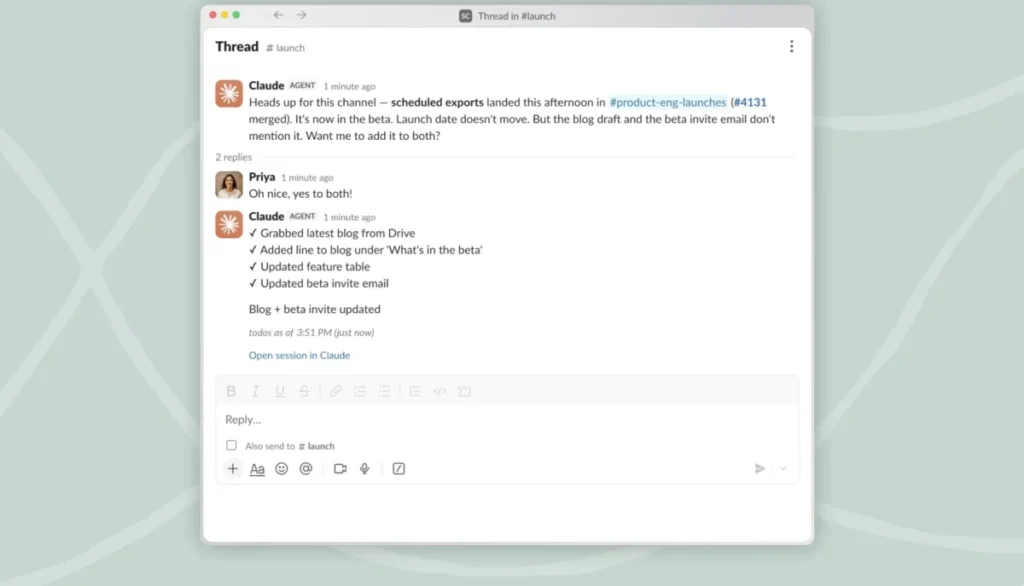
In the rapidly evolving landscape of enterprise artificial intelligence, the barrier between “tool” and “colleague” is becoming increasingly thin. Anthropic, the San Francisco-based AI powerhouse, has officially entered this new frontier with the introduction of "Claude Tag," a sophisticated, always-on AI integration designed to live within Slack. Currently entering a research preview for Claude Enterprise and Claude Team customers, this feature marks a fundamental shift in how organizations interact with large language models (LLMs): moving from episodic, transactional prompts to persistent, context-aware collaboration.
The Evolution of the AI Teammate
Claude Tag represents the next logical step in Anthropic’s strategy to embed its models into the daily workflows of the modern workforce. Previously, Slack users were limited to direct messaging @Claude or tagging the model in channels for on-demand assistance—a method that, while helpful, often lacked the "memory" required to handle long-term projects.
This new iteration builds upon earlier integrations like "Claude Code," which routes specific technical tasks from Slack to web-based coding environments. However, while Claude Code acts as a specialized worker, Claude Tag is designed to function as a persistent team member. By occupying a dedicated space within a Slack channel, the AI tracks project progression, maintains a shared history of decisions, and learns the unique vernacular and workflows of the team it supports.
How Claude Tag Operates: Memory and Context
The core value proposition of Claude Tag is its ability to maintain a persistent state. In traditional AI interactions, context windows are often purged or reset; with Claude Tag, the model "follows along" with the channel conversation.
A Shared Organizational Memory
Perhaps the most significant departure from existing AI tools is that Claude Tag is channel-wide rather than individual-specific. When a user tags @Claude, the resulting interaction is visible to all members of that channel. This democratization of information ensures that any team member can pick up where a previous conversation left off, preventing the siloing of knowledge that often occurs when AI assistance is restricted to private direct messages.
Granular Governance and Scoping
Anthropic has placed a heavy emphasis on security and administrative control, acknowledging the sensitivities of enterprise environments. System administrators retain full authority to define:
- Access Control: Defining which tools and external databases the AI can interact with.
- Channel Scoping: Ensuring that a Claude identity assigned to a legal or compliance channel cannot inadvertently access or "leak" information into an engineering or marketing channel.
- Permissioning: Determining which internal knowledge bases the AI can query to gather facts.
By compartmentalizing the AI’s memory, Anthropic is attempting to solve one of the primary hurdles to enterprise AI adoption: data leakage and unauthorized access.
Ambient Intelligence: The Future of Workflow
Beyond its ability to respond to direct commands, Claude Tag introduces an "ambient mode." This is where the feature truly leans into the persona of a "colleague." Instead of waiting for a prompt, the AI can proactively interject in the chat to:
- Provide Status Updates: Summarizing progress on ongoing tasks without needing to be queried.
- Flag Cross-Functional Insights: Identifying relevant information from other channels (if permitted) that might impact the current project.
- Remediation: Following up on tasks that have stalled or threads that have been abandoned, ensuring that organizational momentum is maintained.
Anthropic posits that this creates a more human-like experience. By working in public view, Claude Tag fosters a sense of transparency, allowing human teams to witness the AI’s reasoning process in real-time, which in turn builds trust and facilitates better oversight.
The Competitive Landscape: The Battle for Enterprise Context
Anthropic is by no means operating in a vacuum. The race to become the "intelligence layer" of the enterprise is arguably the most heated battleground in the current tech cycle.
Microsoft’s Ecosystem Play
Microsoft continues to leverage its massive footprint with the Microsoft Graph, which powers Copilot and Work IQ. By indexing the entirety of a user’s digital footprint—from emails and calendar invites to Word documents and PowerPoint presentations—Microsoft seeks to provide a level of context that is difficult for standalone AI companies to replicate.
Data Foundations: Snowflake and Databricks
Data storage giants are pivoting to become data processing centers. Snowflake and Databricks are aggressively positioning their platforms as the definitive "single source of truth." Their argument is that no matter how smart an AI model is, it is only as good as the data it can access. By hosting the tacit organizational knowledge that agents need, these companies are positioning themselves as the necessary backend support for any successful AI integration.
The Intelligence Layer: The Glean Model
Meanwhile, companies like Glean are building what they describe as an "intelligence layer" that sits between the AI model and the enterprise’s messy, fragmented data. Glean’s approach is to provide a search-and-discovery mechanism that understands company context, ensuring that when an AI model asks a question, it receives an answer that is not only accurate but also relevant to the specific corporate culture and internal jargon.
Official Responses and Implications
In its official messaging, Anthropic has framed Claude Tag as a tool that reduces "cognitive load." By offloading the tasks of summarizing, searching for historical context, and tracking project threads to the AI, human workers are theoretically freed to focus on high-level creative and strategic work.
"Claude Tag is about moving from an AI that waits for orders to an AI that understands the mission," an Anthropic spokesperson noted during the announcement. "By making the AI a visible participant in the Slack thread, we aren’t just automating tasks; we are automating the flow of information."
Implications for Workplace Culture
The implications of this shift are profound. As AI agents become permanent fixtures in digital workspaces, companies will need to grapple with:
- The "Black Box" Problem: If an AI makes a suggestion in a public channel based on a hidden data source, how does the team verify that information?
- Accountability: If an AI "teammate" misinterprets a task or provides incorrect data that leads to a project error, who is responsible?
- The Erosion of Privacy: With an "always-on" AI, employees may feel as though they are under constant surveillance, potentially altering the nature of candid communication within private or team-specific channels.
Chronology: The Road to the Always-On Agent
- Late 2025: The industry sees a surge in "Agentic AI," shifting from simple chatbots to autonomous systems capable of executing multi-step tasks.
- December 2025: Anthropic launches "Claude Code" in Slack, signaling the intent to move AI from the browser to the developer’s primary communication hub.
- January 2026: Anthropic introduces interactive Claude apps, expanding the integration scope beyond simple coding tasks.
- February 2026: The market shifts toward "Contextual AI," with players like Glean and Snowflake defining the importance of organizational knowledge layers.
- Current Day: The launch of Claude Tag in research preview marks the formal arrival of the "persistent teammate" era.
Conclusion: A New Standard for Collaboration
The release of Claude Tag is a clear signal that the era of the "AI chatbot" is ending, replaced by the era of the "AI teammate." While the technical challenges of persistence, memory, and security are significant, the potential for productivity gains is even greater.
For enterprise leaders, the challenge will be managing the integration of these agents into existing workflows without disrupting the human dynamics that define their culture. As Anthropic continues to refine Claude Tag during its research preview, the feedback from early adopters will likely dictate whether this "always-on" approach becomes the industry standard or a cautionary tale about the limits of ambient automation. For now, one thing is clear: the way we work, communicate, and collaborate is changing, and the desk next to yours may soon be occupied by an AI.