Governing Through the Storm: Navigating Institutional Risk in an Era of Disruption
In the current sociopolitical climate of 2026, the mission-driven sector—comprising nonprofits, foundations, and educational institutions—finds itself in a state of unprecedented turbulence. As executive orders, legal threats, and aggressive funding scrutiny reshape the landscape, boardrooms across the country are grappling with a fundamental existential question: How do we maintain our organizational values when the very language of those values has become a target?
For many leaders, the instinct is to retreat. However, as strategist and advisor Dax-Devlon Ross argues, the danger lies not just in the external pressure, but in an organization’s inability to interpret that pressure collectively. When board members view risk through fragmented lenses, the result is often a paralysis that masks fear as "fiduciary caution," ultimately eroding the integrity of the mission they were sworn to protect.
The Chronology of Disruption: A Three-Wave Strategy
The current assault on diversity, equity, and inclusion (DEI) and mission-driven advocacy did not occur in a vacuum. By mid-2026, the administration’s "flooding the zone" strategy—a systematic, high-intensity push to dismantle progressive institutional frameworks—had unfolded in three distinct, calculated movements.
The First Wave: Bureaucratic Overhaul (Early 2025)
The initial phase acted as a "blunt-force trauma" to the federal bureaucracy. Within the first weeks of the year, executive orders shuttered long-standing DEI offices and redefined sex as a strictly biological binary. This move was designed to signal to the entire nonprofit sector that the government’s alignment with equity-focused policies had effectively ended.

The Second Wave: Legal and Educational Encroachment (Spring 2025)
By the second quarter, the administration expanded its reach into the judicial and educational spheres. By revoking disparate impact protections, the government essentially stripped away the legal bedrock that allowed organizations to address systemic inequalities. The April 3, 2025, Department of Education mandate—requiring K-12 institutions to certify compliance with a narrow interpretation of Title VI—transformed national anxiety into immediate, operational fear. Organizations were forced to choose between abandoning their equity commitments or risking their federal funding.
The Third Wave: Private Sector Cleansing (Late 2025)
The final wave targeted the private and philanthropic sectors. From imposing new guardrails on artificial intelligence to redefining the fiduciary duties of investment firms, the administration sought to purge "ideological" considerations from business and charity. This created a volatile environment of enforcement, where the mere mention of systemic barriers could trigger federal investigation.
Analyzing the "Risk Posture Spectrum"
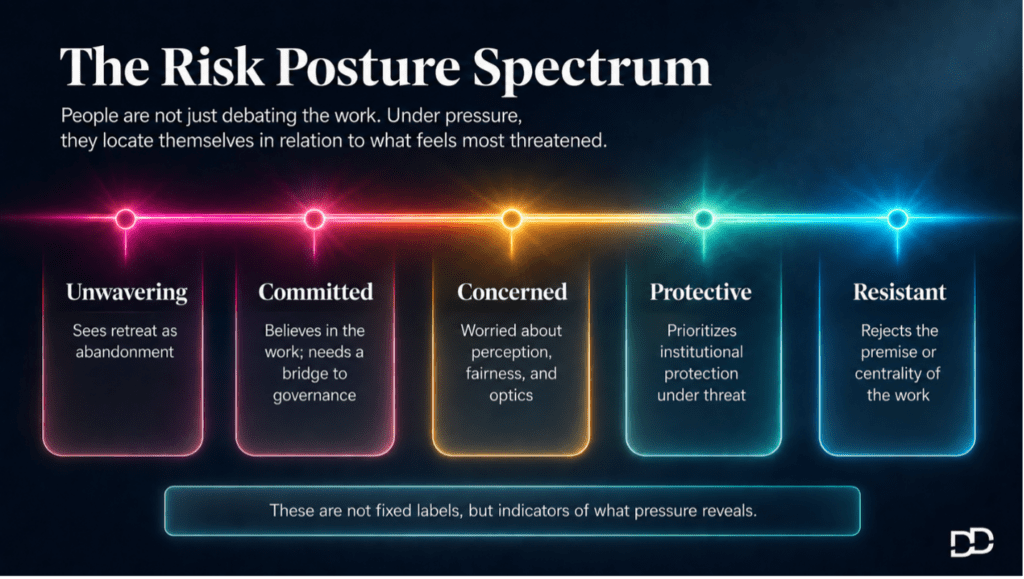
The core of the challenge, as observed in boardrooms from New York to Washington, is that "risk" is not a singular, objective reality. It is an interpretation. Dax-Devlon Ross identifies a "Risk Posture Spectrum" that explains why boards often fail to reach consensus during crises.
The Five Postures of Risk
- The Unwavering: For these members, external backlash validates the necessity of the mission. To them, retreat is not a strategy; it is a surrender of core identity.
- The Committed (Seeking Clarity): These individuals believe in the mission but feel ill-equipped to translate values into governance. They require a stronger bridge between moral conviction and operational safety.
- The Concerned Interpreters: Heavily focused on external optics, they worry about how donors, media, and political narratives will perceive the organization. They often prioritize neutrality to avoid "becoming a target."
- The Protective Reticent: Often fluent in fiduciary language, this group views caution as the highest form of stewardship. They are prone to scrubbing language and delaying action to protect the institution’s longevity.
- The Resistant: While fewer in number, this group fundamentally rejects the premise that equity or identity-based work belongs in the organization. Their opposition often manifests as procedural delay or appeals to "meritocracy."
Understanding this spectrum is critical. When a board fails to identify these internal postures, it manages fear, not risk. True governance requires surfacing these subjective sources so that the board can act as a unified body rather than a collection of anxious individuals.
Supporting Data and the Myth of "Resilience"
The sector has long fixated on the concept of "resilience," but often with a flawed definition. Many equate resilience with "endurance"—the ability to absorb a blow and remain functional. However, historical and anthropological data suggest that the most resilient societies are not those that simply "hold on," but those that learn from repeated disturbance.
Disturbance serves as a form of instruction, but only if the organization is willing to synthesize that data. In the wake of 2020, many organizations adopted equity statements and values-driven policies. Yet, because these were often performative or superficial, they never became "governance muscle." When the 2025 wave of pressure hit, these institutions lacked the collective memory to pivot effectively, leaving them vulnerable to panic.
Official Responses and the Fiduciary Trap
The official response from the administration has consistently framed DEI initiatives as "illegal ideologies." By weaponizing the Supreme Court’s Students for Fair Admissions v. Harvard ruling, the administration has successfully intimidated K-12 and higher education nonprofits into silence.
Conversely, institutional responses have been mixed. Some organizations have quietly removed "equity" and "anti-racism" from their websites, fearing federal audit. Others have doubled down, arguing that their duty to the community outweighs the risk of funding cuts. The data suggests that those who choose to "soften their language" without a deep, mission-aligned justification often suffer a greater loss: the erosion of staff trust and community credibility—risks that are often harder to quantify on a balance sheet but catastrophic in the long term.
Implications: Widening the Aperture
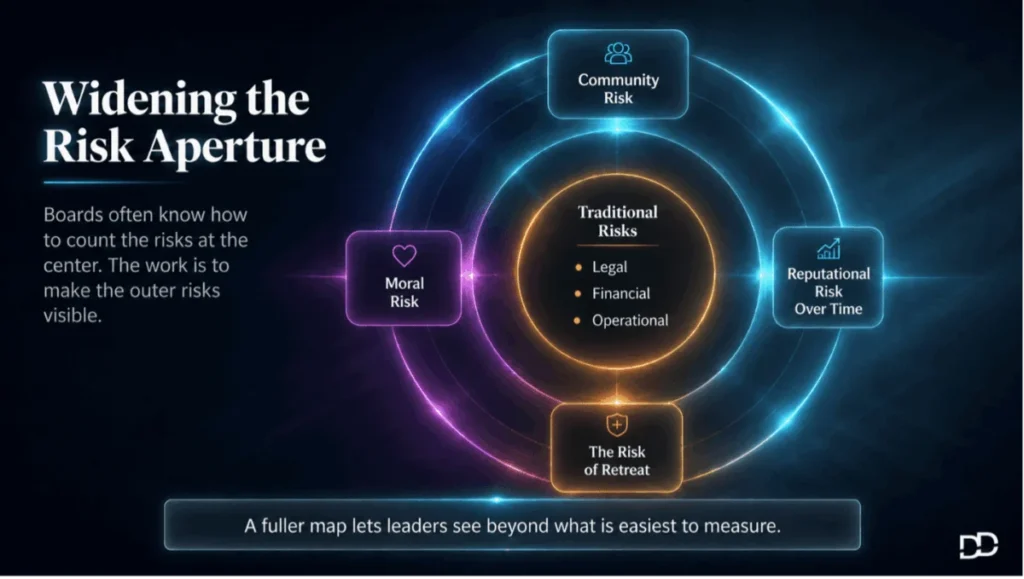
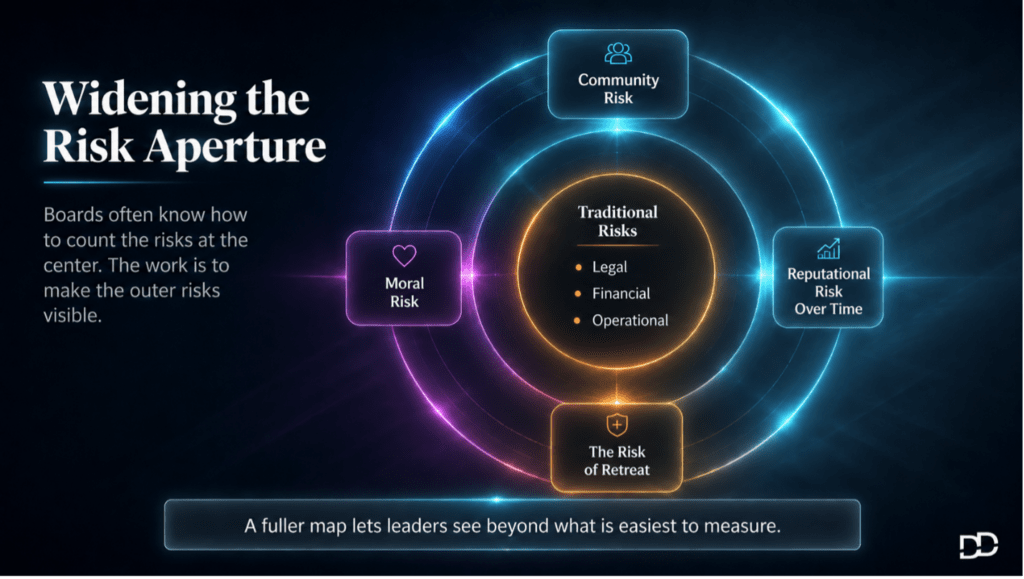
To move forward, boards must widen their "risk aperture." It is insufficient to merely focus on legal exposure or funding stability. Boards must begin to account for:
- Community Risk: What happens to the people we serve if we abandon our values under pressure?
- Integrity Risk: How does a shift in language affect the long-term credibility of our organization?
- Internal Capacity Risk: How does the perception of a "retreat" impact staff retention, morale, and the ability to fulfill the mission?
Conclusion: A Call to Clarity
As Dax-Devlon Ross emphasizes, the goal is not to eliminate fear, but to ensure that fear does not dictate strategy. A board that cannot distinguish between personal anxiety and institutional risk is a board that cannot govern. By creating a space where these differing postures can be voiced, identified, and integrated, organizations can move toward a strategy that is not just a reaction to the storm, but a deliberate exercise of purpose.
In this climate, "fine" is not good enough. To meet the moment, boards must stop managing tension and start understanding it. Only when a board can see itself—and the divergent, subjective ways its members interpret the world—can it truly decide what it is willing to protect, what it is willing to risk, and what it is willing to stand for.