The Collective Intelligence Revolution: How OpenRouter’s ‘Fusion’ Challenges the AI Frontier

In an era where the cost of intelligence is often tethered to the scale of massive, singular foundation models, a new disruption has arrived. OpenRouter, the popular model-routing platform, has launched "Fusion," a sophisticated API architecture built on a singular, provocative premise: that a curated panel of affordable, diverse AI models can systematically outperform, or at least match, the capabilities of the most expensive "frontier" models currently on the market.
At its core, Fusion acts as an intelligent orchestrator. By firing a user’s prompt to multiple models in parallel—each equipped with web-browsing and code-execution tools—Fusion leverages a "judge" model to identify consensus, contradictions, and analytical blind spots. A final "synthesizer" model then crafts a coherent, grounded response. As the AI industry grapples with ballooning costs and increasingly restrictive export controls, Fusion offers a compelling alternative: "Fable-level" performance at half the price.
Chronology of a Disrupted Market
The timing of Fusion’s arrival is far from coincidental; it is a direct response to a seismic shift in the AI landscape.
Last week, Anthropic, the developer behind the highly anticipated Fable 5 and Mythos 5 models, faced a sudden regulatory roadblock. A U.S. export control directive forced the company to suspend access to these models for foreign nationals worldwide, citing a disputed, yet critical, jailbreak vulnerability. This move effectively locked out a significant portion of the global developer community from the industry’s most potent tools.
Seizing the momentum, OpenRouter took to X (formerly Twitter) just one day later, positioning Fusion not merely as a technical update, but as a strategic remedy to the sudden scarcity of high-end intelligence. By promising "Fable-level intelligence at half the price," the company signaled a shift away from reliance on a single, vulnerable "God-model" toward a resilient, decentralized, and compound approach.
The Mechanics of "Fusion": How it Works
The process is designed to be seamless for the developer while remaining rigorous under the hood. When a user transmits a request to the Fusion API, the platform distributes the prompt to a designated panel of models simultaneously.
1. Parallel Processing
Each model in the panel receives the prompt along with access to web-search and bash tools. This enables the collective to gather data from disparate sources, reducing the "hallucination" rate by cross-referencing facts in real-time.
2. The Judicial Phase
Once the initial outputs are generated, a specialized "judge" model scrutinizes the responses. Its role is to distill the core information, highlighting where models agree and, more importantly, where they conflict. This phase is critical for identifying logical inconsistencies that a single model might otherwise overlook.

3. Synthesis
The final stage employs a synthesizer—defaulting to Claude Opus 4.8—to weave the insights into a cohesive, readable, and highly accurate final answer. This workflow happens entirely server-side. Users have the flexibility to swap the model string to openrouter/fusion for an out-of-the-box experience, integrate a fusion tool into their own workflows, or even architect a custom panel via the Fusion chatroom with zero coding required.
Supporting Data and Benchmarking
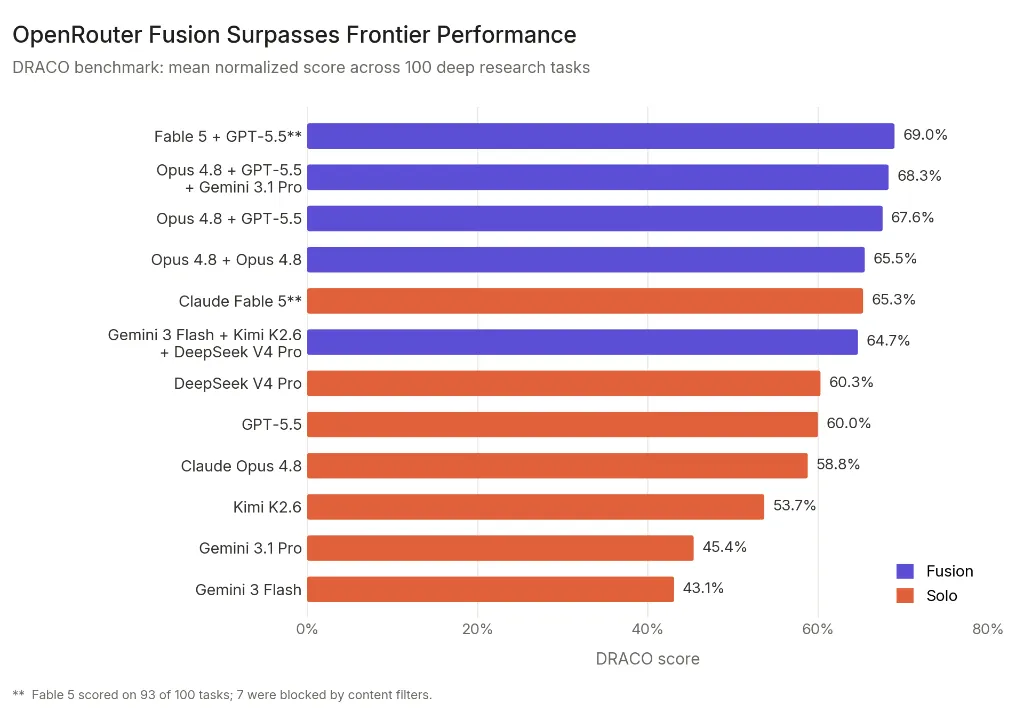
To validate this approach, OpenRouter subjected Fusion to the DRACO benchmark, a rigorous suite of real-world "deep research" requests curated by Perplexity.
The results were striking. When a panel consisting of Fable 5, OpenAI’s GPT-5.5, and a Claude Opus 4.8 synthesizer were deployed, the system achieved a 69% success rate. For comparison, a standalone Fable 5 model scored 65.3%. Perhaps most telling was that the solo Fable model failed to complete seven of the 100 tasks due to its own aggressive content filters.
More importantly for cost-conscious developers, OpenRouter highlighted a highly efficient, budget-friendly configuration: pairing Gemini 3 Flash with open-source Chinese models like Kimi K2.6 and DeepSeek V4 Pro, then synthesizing them with Opus 4.8. This combination hit a 64.7% score—outperforming the standalone GPT-5.5 (60%) and Opus 4.8 (58.8%)—all while delivering the results at approximately 50% of the cost of a premium model.
The data suggests that the "synthesis" step itself accounts for roughly 75% of the performance lift, with the remaining gain attributed to genuine model diversity. By forcing multiple architectures to "argue" and then reconcile, the system produces a higher-fidelity result than any single, isolated model.
Official Responses and Industry Reaction
The response to the launch has been as polarized as the AI community itself. On one side, industry observers like AI researcher Andrew Trask have hailed the development as "a way bigger deal than it seems." Trask argues that the era of frontier labs holding a total monopoly on high-end intelligence is effectively over, as modular, compound systems become easier to build and deploy.
However, skepticism remains. Critics have pointed to potential weaknesses in the system, particularly regarding complex coding tasks and tool-calling capabilities. Some developers have argued that the lack of transparency—especially now that Fable 5 is restricted—makes it difficult to accurately compare Fusion’s performance against a true "gold standard."
Furthermore, there is a technical concern regarding "benchmark contamination." During initial testing, providing the model panel with live web access allowed them to surface the DRACO grading rubric directly in search results. While OpenRouter quickly patched this by excluding the benchmark’s hosting domains from the search tools, the incident highlights the fragility of benchmarking in an era of live-web-connected AI.
Implications: The New Frontier of AI
The implications of Fusion extend far beyond simple cost-cutting. It represents a fundamental shift in how we conceive of "intelligence" in the machine age.
The Death of the "Black Box" Dependency
For years, the industry has trended toward larger, more opaque models. Fusion reverses this. It posits that intelligence is an emergent property of consensus. By building systems that rely on the interplay of multiple models, developers are less vulnerable to the "single point of failure" risks associated with companies like Anthropic or OpenAI.
The Role of Regulatory Compliance
It is important to note that Fusion does not solve the underlying issue of export controls. Because it runs on infrastructure routed through OpenRouter, users who are restricted by U.S. law remain restricted. However, for the international community, it creates a viable path forward. Instead of waiting for a specific, restricted model, users can build their own "Fusion" panels using available open-weight alternatives like GLM-5.2, which, while not perfect, offer "good enough" performance that effectively lowers the barrier to entry.
Is Fusion a Replacement for Frontier Models?
OpenRouter is transparent about the limitations: Fusion is not a wholesale replacement for the most advanced reasoning tasks. For long-horizon planning or complex, multi-stage agentic loops, a single frontier model often maintains the lead. Fusion is best utilized as an additive layer—a tool that catches the gaps that a primary model might miss.
As the industry moves forward, the "Fusion" model of development will likely become standard. We are entering a phase where the "smartest" output is not necessarily produced by the "smartest" model, but by the most effective committee. By decentralizing intelligence and prioritizing synthesis over sheer parameter count, OpenRouter has opened a door to a more modular, affordable, and resilient AI future.
For the developer, the message is clear: if you can’t get the best model, build the best team. The results, as the data shows, are surprisingly human.