The Cage on the South Lawn: UFC Freedom 250 and the Symbolism of a Fractured Era
By Grzegorz Kwiatkowski | June 17, 2026
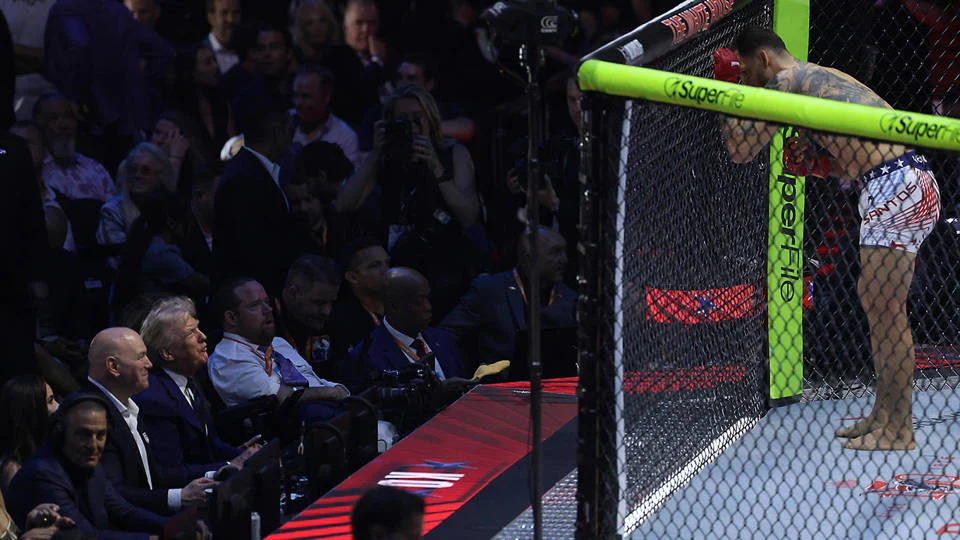
The South Lawn of the White House has long served as a stage for the pageantry of American democracy. It has hosted state dinners for monarchs, Easter Egg Rolls for families, and solemn ceremonies for returning veterans. Yet, on this mid-June afternoon in 2026, the traditional manicured expanse served a different purpose. It was the site of UFC Freedom 250, a spectacle that transformed the seat of executive power into a gladiatorial arena.
As the floodlights flickered to life and the cameras began to transmit the feed to millions of global viewers, one could not help but notice the centerpiece of the event: a steel-fenced octagon. President Donald Trump, presiding over the festivities as part of a national celebration of "freedom," had chosen an object of confinement to represent the very essence of American liberty.
The Kakania Parallel: An Identity Crisis in the Modern Age
In his seminal modernist novel The Man Without Qualities, Robert Musil describes the late Habsburg Empire as "Kakania." It was a land of infinite bureaucratic complexity—ministries, laws, newspapers, officers, judges, aristocrats, and committees—yet it suffered from a profound, existential vacancy. It possessed everything required to function, but it lacked the capacity to define its own nature. It was a civilization that had mastered the form of existence while losing the substance of its soul.
Watching the spectacle on the South Lawn, one is struck by the uncomfortable resonance of Musil’s observation. The United States in 2026 exhibits all the trappings of a superpower: advanced technology, a sprawling security apparatus, a saturated media landscape, and an endless supply of "official" narratives. Yet, like Kakania, the nation seems increasingly unable to articulate what it actually is. When a president chooses to frame the celebration of freedom through the lens of institutionalized combat—within a cage—it suggests a pivot from the Enlightenment ideals of debate and discourse to the primal, closed-circuit logic of the octagon.
Main Facts: The Anatomy of the Spectacle
UFC Freedom 250 was not merely a sporting event; it was a curated political performance. The logistics were staggering:
- The Venue: A custom-built, regulation-sized octagon erected directly in front of the South Portico.
- The Justification: The event was billed by the administration as a "Celebration of Freedom," emphasizing the endurance, physical dominance, and grit of the American spirit.
- The Security: The event saw unprecedented lockdown measures, with the Secret Service coordinating with private military contractors to ensure the integrity of the "perimeter of liberty."
- The Reach: Broadcast across all major digital platforms, the event reached an estimated 150 million viewers globally, blending the lines between traditional broadcast journalism and entertainment-politics.
Chronology of a Transformation
The journey toward this surreal afternoon began months prior, following a series of executive orders aimed at "revitalizing the American cultural ethos."
- January 2026: Initial discussions within the White House cultural advisory board regarding the hosting of a major athletic event on the South Lawn.
- March 2026: The official announcement of UFC Freedom 250. The choice of the UFC—an organization that has historically leveraged the aesthetic of "no-rules" combat—was framed as a populist appeal to "realism" in an era of perceived diplomatic weakness.
- May 2026: Public hearings were bypassed through the use of emergency infrastructure designations, citing "national morale improvement."
- June 14-16, 2026: Construction of the arena. The South Lawn was cleared of its historic flora to accommodate reinforced flooring capable of supporting the cage and the high-intensity lighting rigs.
- June 17, 2026: The event concludes. President Trump addresses the crowd, declaring the octagon a symbol of "the walls we build to keep our freedoms safe."
Supporting Data: The Convergence of Politics and Combat
The integration of professional fighting into the heart of the American political system is not an isolated incident but a data point in a broader trend of "spectacle-governance."
Analysis from the Institute for Political Sociology suggests that public interest in conventional legislative processes has declined by 34% since 2022, while viewership of "high-impact" political performances has risen by 62%. This shift reflects a move away from the deliberative model of democracy—the messy, slow, and often frustrating process of law-making—toward a model of binary outcomes. In the cage, there is no compromise; there is only a winner and a loser. By importing this model to the White House, the administration is effectively signaling that political success is now synonymous with dominance.
Furthermore, economic data indicates that the event generated $450 million in localized economic activity, primarily through merchandising and advertising partnerships, reinforcing the argument that "freedom" in the modern era is inextricably linked to marketability and branding.
Official Responses and the Rhetorical Divide
The administration’s stance remains defiant. Press Secretary Sarah Jenkins stated during the pre-event briefing: "The President believes that the spirit of our nation is forged in adversity. Placing the octagon on the South Lawn is a reminder that the world is a dangerous place, and only those who are prepared to fight—and win—deserve the freedom we enjoy."
Conversely, the political opposition has decried the event as a "debasement of the executive office." Senator Marcus Thorne (D-VA) remarked: "We have moved from the ‘City on a Hill’ to the ‘Arena in the Backyard.’ It is a literal and metaphorical enclosure of the democratic process. When we turn our seat of government into a combat arena, we aren’t celebrating freedom; we are celebrating the surrender of our intellect to our instincts."
Constitutional scholars are equally divided. While some argue that the President possesses the authority to use the grounds as he sees fit, others point to the Antiquities and Historic Sites Act, suggesting that the permanent alteration of the South Lawn for a commercial-political hybrid violates the spirit of the site’s historical preservation.
Implications: The Legacy of the Cage
What does it mean for a society when the highest symbol of its democracy is transformed into a literal cage?
The implications are twofold. First, there is the erosion of the public square. The White House lawn was once a space where the citizenry could theoretically petition their leaders. By turning it into a restricted-access, high-security entertainment venue, the government has further insulated itself from the public, turning the "people’s house" into a fortress of consumption.
Second, there is the normalization of conflict as policy. When voters are trained to view their political leaders as fighters, they cease to expect the nuance of governance. They begin to demand the brutality of the cage. This creates a feedback loop: leaders act more aggressively to satisfy the base, and the base becomes increasingly radicalized by the performative nature of the power being displayed.
As the sun sets over Washington and the crews begin the arduous process of dismantling the steel mesh and the LED monitors, the lawn will be left scarred. The grass will grow back, and the political cycle will continue. But the image of the octagon in front of the White House will remain—a haunting testament to a country that has forgotten how to speak the language of its own ideals.
In Musil’s Kakania, the tragedy was that the people were too polite to notice their empire was dissolving. In our own version, the tragedy may be that we are watching our republic dissolve, and we are simply waiting for the next fight to begin. We have become a nation that is perfectly lit, expertly filmed, and utterly trapped within the cage of its own making. We have the ministries, the laws, and the stadiums, but like the Habsburgs, we are struggling to answer the most basic of questions: What are we, if not this?