Decades of Doodles: Unearthing Wall Street’s Financial Follies Through Comic Art
Posted: June 16, 2026, by Ben Carlson
In an age increasingly dominated by real-time data feeds, algorithmic trading, and artificial intelligence-driven market analysis, the subtle art of financial commentary often finds its most potent expression not in complex econometric models, but in the deceptively simple lines of a political cartoon or a comic strip. A recent acquisition of a decades-spanning collection of Wall Street comics offers a unique, often humorous, and remarkably prescient lens into the human psychology that underpins market movements, particularly highlighting the frenzied optimism of the dot-com bubble and the subsequent, painful reckoning.
The genesis of this fascinating archive stems from the long-standing interaction between financial writers and their dedicated readership. For analysts like Ben Carlson, who regularly engages with his audience, the feedback loop is invaluable—a conduit for questions, insights, and sometimes, unexpected historical treasures. Such was the case when a reader, an avid collector of financial satire for decades, offered his entire trove of Wall Street comics, meticulously clipped from newspapers and financial publications, providing an unparalleled visual chronicle of market sentiment through the late 20th and early 21st centuries.
This collection, far from being mere amusement, serves as a poignant historical record, capturing the zeitgeist of specific market eras. It vividly illustrates the cyclical nature of investor emotions, the often-absurd narratives that drive asset prices, and the enduring challenge of navigating economic uncertainty. Sifting through this treasure trove reveals recurring themes, persistent anxieties, and an uncanny ability of cartoonists to distil complex economic phenomena into universally understood visual metaphors.
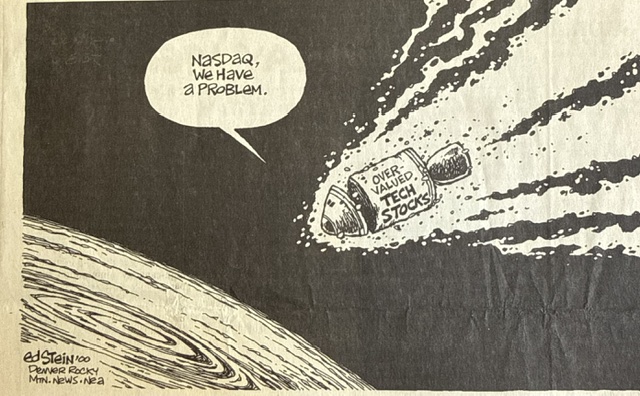
The Dot-Com Deluge: A Glimpse into 1990s Market Mania
The 1990s were an epoch of unprecedented technological optimism and burgeoning digital frontiers. The internet, once a niche academic tool, rapidly transformed into a commercial juggernaut, promising to revolutionize every facet of life and business. This revolutionary fervor fueled a speculative boom in technology stocks, often with little regard for traditional valuation metrics. As the comic collection vividly demonstrates, two central figures dominated the financial landscape and the satirical ink of cartoonists: the burgeoning tech sector itself and the towering presence of Federal Reserve Chairman Alan Greenspan.
The Era of Tech Hype and Unbridled Speculation
The comics from this period paint a picture of extraordinary market exuberance, bordering on irrationality. One particularly striking cartoon from the collection depicts investors literally "floating" on a cloud labeled "Internet Stocks," blissfully unaware of the precarious precipice below. The sheer disconnect between corporate fundamentals and skyrocketing stock prices became a recurring motif. Companies with minimal revenue or even viable business models were commanding stratizations, fueled by a narrative of "new economy" exceptionalism.
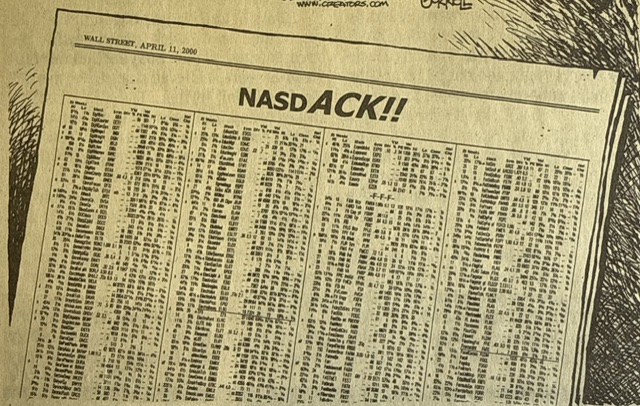
Comparing the speculative fervor of the 1990s dot-com era to contemporary trends, such as the excitement surrounding Artificial Intelligence (AI), might tempt some to draw direct parallels. However, the intensity and widespread nature of the dot-com bubble often felt "in a different stratosphere." The belief that "this time is different" permeated market psychology, leading to a profound underestimation of risk. The comics serve as a stark reminder of this historical hubris.
Alan Greenspan’s Shadow and the "Irrational Exuberance" Warning
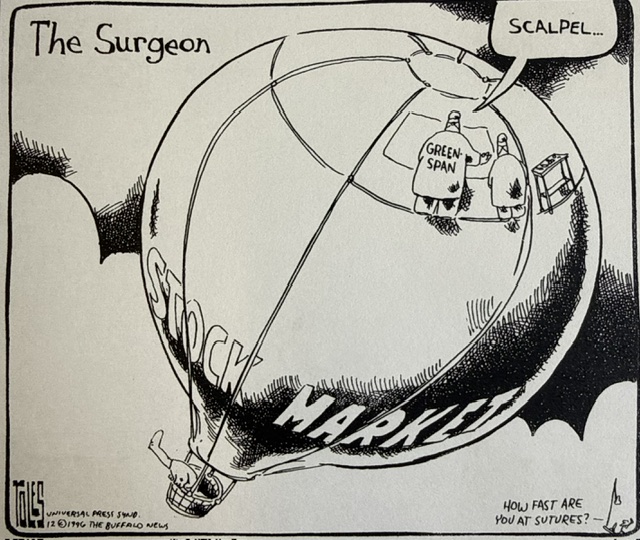
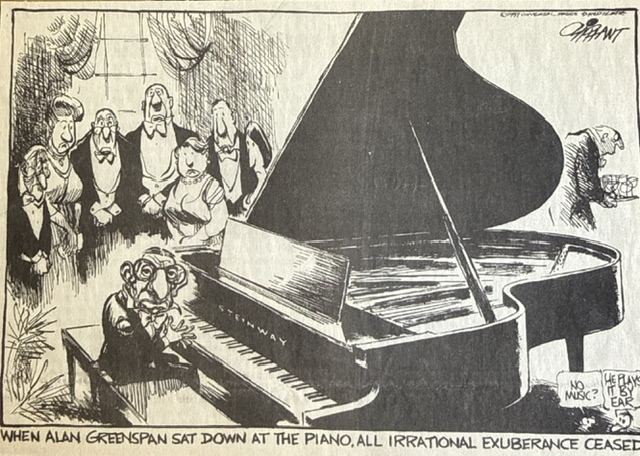
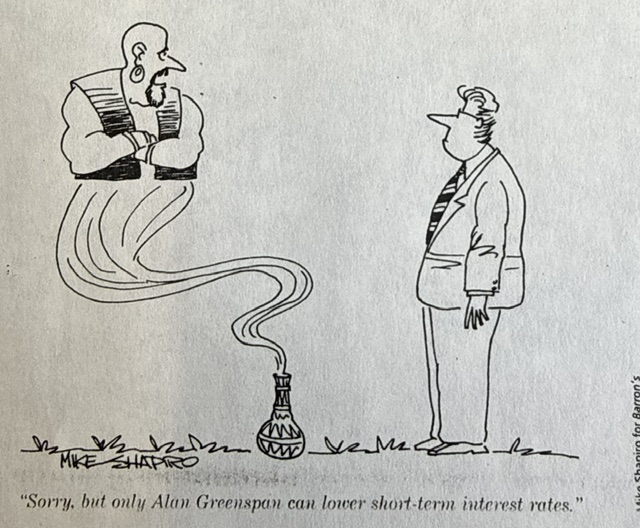
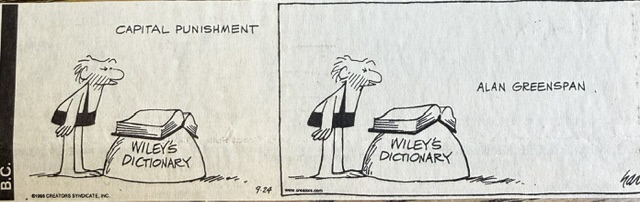
At the helm of the U.S. central bank, Alan Greenspan was a figure of immense influence, often seen as the oracle of the financial world. His pronouncements were scrutinized, his every gesture analyzed for clues about the Fed’s monetary policy direction. The comic collection features Greenspan prominently, reflecting his celebrity status in the financial media.
One of the most iconic moments of Greenspan’s tenure, captured in several cartoons, was his "irrational exuberance" speech delivered on December 5, 1996. In a cautious address to the American Enterprise Institute, Greenspan questioned whether "an irrational exuberance has unduly escalated asset values." While intended as a warning, the market, seemingly impervious to such caution, largely shrugged off his comments, continuing its upward trajectory for several more years. A comic from the collection perfectly encapsulates this, showing Greenspan delivering his warning to a crowd of investors whose heads are literally in the clouds, ignoring the ground beneath them. This illustrates not only Greenspan’s concerns but also the market’s initial defiance of them, highlighting the challenge of tempering speculative enthusiasm once it takes hold. His inability to halt the speculative tide, despite his immense prestige, became a theme cartoonists loved to explore, often depicting him as a frustrated conductor trying to control an out-of-control orchestra.
The Unfolding Crash: A Brutal Aftermath
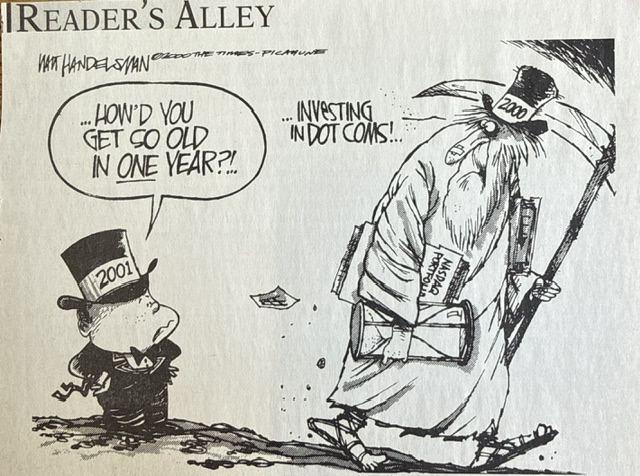
The euphoria, however, was unsustainable. The dot-com bubble spectacularly burst in March 2000, initiating one of the most severe market corrections in modern history, particularly for technology stocks. The comics from the early 2000s transition from depicting giddy investors to illustrating widespread despair and financial pain.
Great Depression-Like Declines in Tech
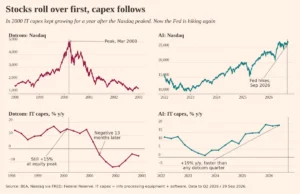
While many today might associate "Great Depression-like calamity" with the 1929 stock market crash and its ensuing economic devastation, the dot-com bust offered a contemporary echo of such pain, specifically within the tech sector. As the article notes, the Nasdaq Composite, heavily weighted towards technology and internet companies, plummeted by nearly 80% from its peak. The Nasdaq 100, an index of the largest non-financial companies listed on the Nasdaq, fared even worse, crashing more than 82%. This level of decline was, indeed, comparable to the catastrophic losses experienced during the Great Depression, albeit concentrated within a specific market segment.
One poignant comic from the collection visually represents this steep decline, showing a once-lofty "dot-com" balloon deflating rapidly, its former passengers now falling through the air. The captions often reflected the grim reality of lost fortunes and shattered dreams. For many investors who had piled into tech stocks, believing in a new paradigm where old rules no longer applied, the consequences were devastating.
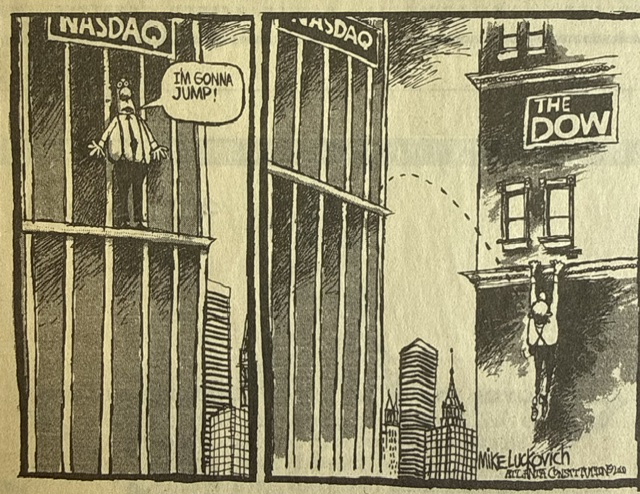
Divergent Paths: Nasdaq vs. Dow
The market pain, however, was not uniformly distributed. The comic collection subtly highlights this divergence. In 2000, while the Nasdaq plunged almost 40%, the Dow Jones Industrial Average, composed of more established, blue-chip companies, was down a comparatively modest 6%. The following year, 2001, saw the Nasdaq drop over 20%, while the Dow fell only 7%.
This stark contrast is visually articulated in cartoons that show investors abandoning speculative tech plays for the perceived safety of traditional industries. One such comic depicts a frantic scramble away from a burning "dot-com" sign towards a sturdy, old-fashioned "Dividend Stock" sign, emphasizing the flight to quality. This period underscored the importance of diversification and the potential for traditional, dividend-paying blue-chip stocks to offer a refuge during times of tech-driven volatility. These "boring" companies, often overlooked during the boom, provided a crucial ballast for portfolios when the speculative froth evaporated.
Echoes of the Past: Market Psychology in Caricature
Beyond the specific events of the dot-com bubble, the comic collection offers broader, timeless insights into human psychology in financial markets. Recurring themes include media bias, the futility of market prediction, and the differing dynamics of bull versus bear markets.
The Media’s Negativity Bias
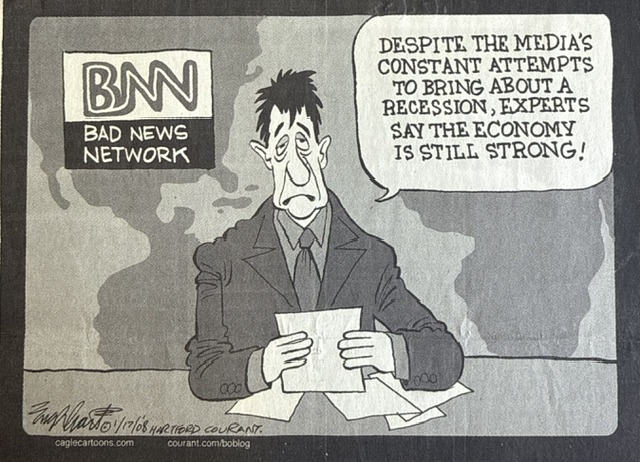
A powerful thread running through the comics is the pervasive negativity bias in financial media. One comic from the collection, dated 2008 but eerily relevant to any period of market stress, shows a television news anchor excitedly reporting on "panic," "gloom," and "disaster," while the general public looks on in fear. Another similar cartoon depicts a financial newspaper emblazoned with dire headlines, while a small, optimistic counter-headline is almost entirely obscured.
This phenomenon is well-documented in behavioral finance. Bad news tends to sell more newspapers and attract more eyeballs. Media outlets often amplify negative events, creating a feedback loop of anxiety and fear that can exacerbate market downturns. The comics satirize this tendency, reminding readers that while caution is warranted, sensationalism often distorts perception. They highlight how easily public sentiment can be swayed by the prevailing media narrative, often leading to suboptimal investment decisions driven by emotion rather than reasoned analysis.
The Elusive Market Predictor
The inherent difficulty in predicting market movements is another theme that cartoonists have consistently lampooned. One comic humorously depicts a financial guru making a confident prediction, only to be shown utterly wrong in the next panel, with the market moving in the opposite direction. Another, likely from a publication like Barron’s given its sophisticated tone, portrays a complex financial model being twisted into a pretzel, symbolizing how even the most elaborate analyses can fail to grasp the market’s unpredictable nature.
These cartoons serve as a perpetual reminder that market forecasting is an exercise fraught with peril. The sheer number of variables, coupled with the irrationality of human behavior, makes precise predictions virtually impossible. Investors who chase predictions often find themselves whipsawed by volatility, emphasizing the wisdom of long-term strategies over short-term speculation. The market’s ability to "twist your brain into a pretzel" is a timeless observation, reflecting its capacity to confound even the most seasoned professionals.
Bear Market Humor vs. Bull Market Silence
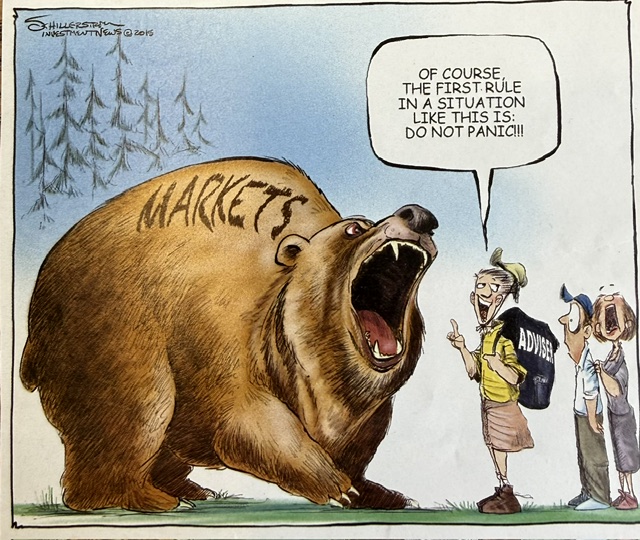
It’s a curious observation that "there are not many bull market cartoons. There are a lot of good bear market comics." This imbalance speaks volumes about market psychology. During bull markets, investors are generally happy, perhaps complacent, and less inclined to critical self-reflection or satire. The prevailing mood is one of optimism and wealth accumulation, which offers less fodder for comedic critique.
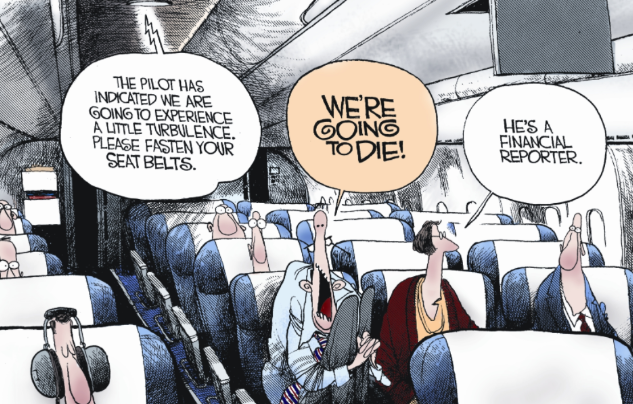
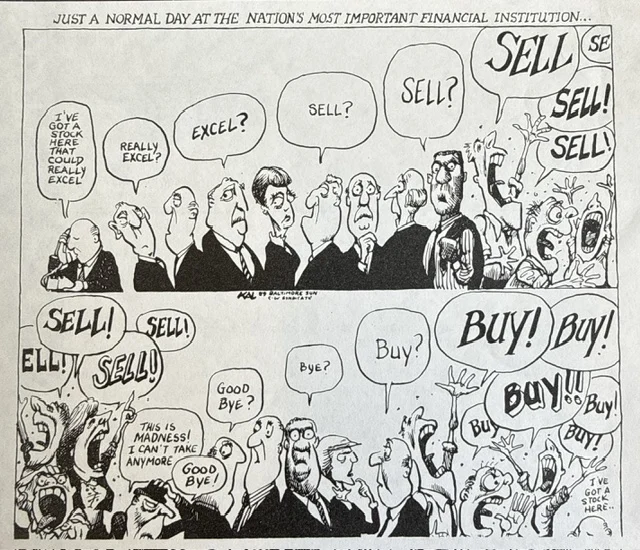
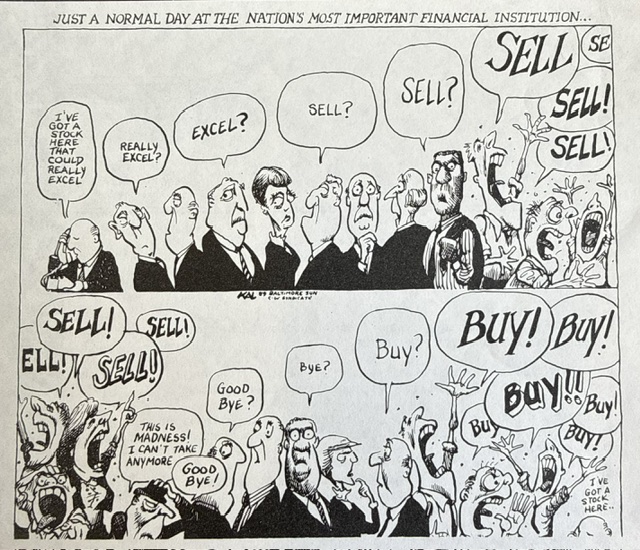
Bear markets, however, are fertile ground for humor. They expose absurdities, highlight human folly, and offer a shared experience of pain that can be cathartic when satirized. Comics from downturns often feature investors in various states of distress, financial advisors offering comically bad advice, or market indices depicted as falling off cliffs. One particular comic, deemed the "greatest Wall Street comic of all-time" by the author, perfectly captures this sentiment with a punchline so universally true it needs "no notes." These cartoons provide an outlet for frustration and a sense of camaraderie among those enduring losses, turning shared misery into shared laughter.
Timeless Truths: What Wall Street Comics Reveal
The collection of Wall Street comics, spanning decades, transcends mere historical anecdote. It serves as a powerful testament to the enduring principles of market behavior and human psychology.
Human Nature and Financial Cycles
Ultimately, these cartoons are not just about stocks and interest rates; they are about people. They illustrate the perpetual tug-of-war between greed and fear, the susceptibility to herd mentality, and the often-futile quest for easy riches. From the "get rich quick" schemes depicted during the dot-com boom to the despair of the subsequent crash, the comics remind us that while the technological landscape evolves, human nature in financial markets remains remarkably consistent. The cycles of boom and bust are, in many ways, cycles of collective human emotion. The universal truths they uncover about irrationality, overconfidence, and panic are as relevant today as they were when first drawn.
Relevance for Today
In an era where discussions around the potential for an "AI bubble" frequently arise, revisiting the dot-com bust through these satirical lenses offers invaluable perspective. While AI’s foundational technology is undeniably transformative, the historical parallels serve as a caution against unchecked speculation and the belief that "this time is different." The lessons from Alan Greenspan’s unheeded warnings and the brutal aftermath of the Nasdaq crash resonate strongly.
The comics also highlight the ongoing challenge of discerning genuine innovation from speculative hype, the importance of independent thinking amidst market frenzies, and the critical role of emotional discipline in investing. They underscore that sound financial principles—diversification, long-term perspective, and a healthy skepticism towards breathless predictions—are not fads but fundamental pillars of prudent investing.
Conclusion
This unique collection of Wall Street comics, far from being a quaint historical curiosity, offers a profound and accessible education in financial history and market psychology. It proves that sometimes, the most insightful commentary on complex economic phenomena can be found not in dense academic papers or intricate financial reports, but in the sharp wit and visual storytelling of a cartoonist. They serve as a vital reminder that while the tools and technologies of finance may change, the underlying human elements—the hopes, fears, and follies that drive markets—remain timeless. The enduring power of these simple drawings lies in their ability to capture the essence of financial events and human reactions with a clarity and humor that transcends generations, offering lessons that are as pertinent today as they were decades ago.