The Trillion-Dollar Shift: How SpaceX’s Historic IPO is Redefining Public Markets
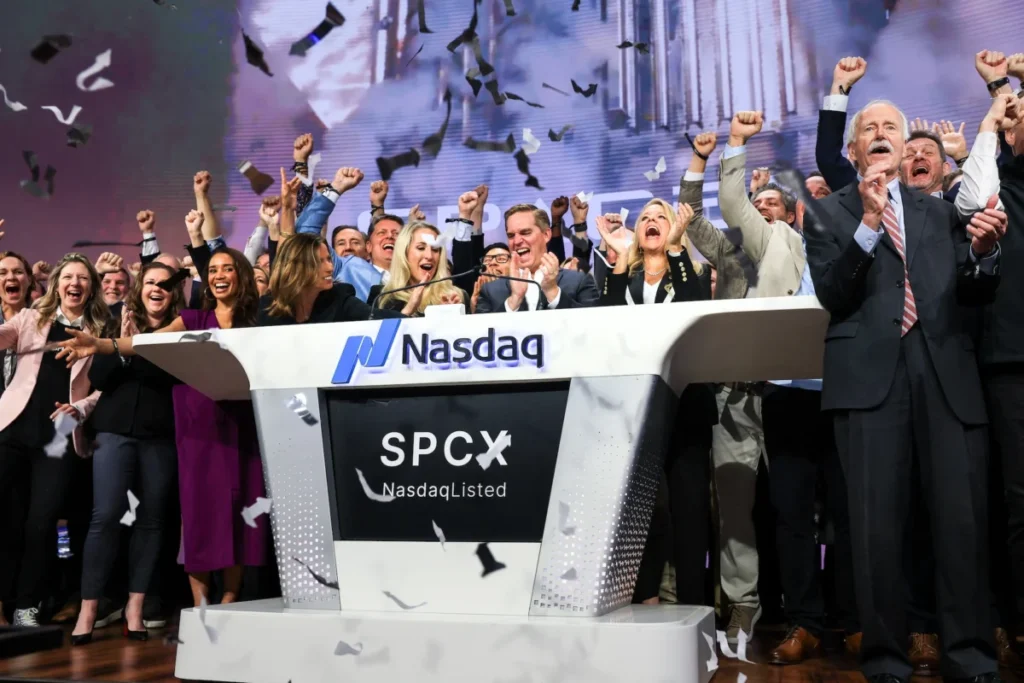
In a financial milestone that has fundamentally altered the landscape of modern capitalism, SpaceX officially entered the public markets this week. With its shares priced at $135, the aerospace giant secured its place in history by executing the largest Initial Public Offering (IPO) ever recorded. The immediate effect of this market debut was the elevation of CEO Elon Musk to the status of the world’s first trillionaire, a title that underscores the unprecedented concentration of wealth and influence currently orbiting the tech sector.
However, beyond the dizzying valuation and the personal fortune of its founder, the SpaceX IPO serves as a catalyst for a broader, more profound transformation in how investors, startups, and legacy corporations approach the future of deep tech and artificial intelligence.
Chronology of a Market Seismic Shift
The lead-up to this moment was characterized by a period of intense speculation regarding the maturity of the private market. For years, observers watched as startups ballooned into multi-billion-dollar entities while remaining insulated from the rigorous scrutiny of public shareholders.
- Early 2026: As the IPO market began to thaw, rumors swirled that the "Series Whatever" fundraising cycle was finally hitting a wall of diminishing returns.
- May 2026: SpaceX filed its initial paperwork, revealing a strategic pivot in its narrative: while the company remains an aerospace powerhouse, it is increasingly positioning itself as a leader in high-cost AI infrastructure and orbital data processing.
- Early June 2026: As SpaceX prepared to ring the opening bell, competitors followed suit. Both Anthropic and OpenAI filed confidentially for their own IPOs, signaling a rush to tap into the finite pool of capital currently flowing toward AI-driven enterprises.
- Mid-June 2026: SpaceX officially priced its shares at $135, marking the largest IPO in history and formally ushering in what market analysts are calling a "Hot IPO Summer."
The Rise of "MANGOS" and the Death of FAANG
The market is no longer defined by the consumer-centric giants of the previous decade. Journalists and analysts are discarding the outdated "FAANG" acronym (Facebook/Meta, Amazon, Apple, Netflix, Google/Alphabet) in favor of a new paradigm: MANGOS. This new cohort—consisting of Meta, Anthropic, NVIDIA, Google, OpenAI, and SpaceX—reflects a pivot away from social media and streaming toward the core of modern innovation: deep tech, generative AI, and advanced infrastructure.
This shift represents a fundamental change in capital allocation. Institutional investors are moving away from the ad-supported consumer web and toward "AI labs" and hardware-intensive deep tech companies. As Kirsten Korosec noted on TechCrunch’s Equity podcast, the removal of Netflix from the top-tier tech index in favor of AI-focused labs demonstrates that the public market is placing its highest bets on the companies building the intelligence layer of the future economy.
The SpaceX Stress Test: Governance and Control
The sheer size of the SpaceX IPO is not just a financial event; it is a governance experiment. Sean O’Kane of TechCrunch observes that SpaceX is currently "stress testing the limits of what a public company can be and how much it can be controlled by one single person."
By successfully taking a company public while maintaining a structure that mirrors the extreme consolidation seen in the early days of Google and Meta, Musk has provided a blueprint for future tech founders. The question now occupying the minds of industry analysts is whether Anthropic and OpenAI will attempt to mirror this model. Will these companies structure themselves to protect founder control, or will they succumb to the traditional pressures of a public board and broad shareholder influence?
Furthermore, SpaceX is blending the "lose money to gain scale" growth model famously pioneered by Amazon with the intense capital demands of deep space exploration. The market is currently rewarding this high-risk, high-reward posture, but analysts warn that this could lead to extreme volatility as these AI labs navigate the realities of quarterly reporting.
The Ripple Effect: SPACs and the "Data Center Gold Rush"
The impact of the SpaceX IPO extends far beyond the company itself. Startups across the sector are scrambling to capitalize on the investor enthusiasm surrounding the Musk-led entity. A prime example is the recent SPAC (Special Purpose Acquisition Company) move by Quantum Space, which is transparently attempting to ride the wave of interest generated by the SpaceX offering.
This "ripple effect" is manifesting in the infrastructure space as well. SpaceX’s exploration of orbital data centers has sparked a secondary market for innovative, if experimental, infrastructure businesses. Startups that have no intention of going public themselves are leveraging the industry buzz around SpaceX’s business model to secure private funding, pitching their own versions of space-based or deep-tech infrastructure.
Implications for Legacy Industry: The Ford and GM Pivot
Perhaps the most fascinating consequence of this market shift is how legacy companies are attempting to adapt. General Motors and Ford, traditional stalwarts of the automotive industry, are increasingly pivoting their assets toward energy storage and grid management to support the massive infrastructure requirements of AI data centers.
While these moves have triggered positive reactions from Wall Street—with Ford’s stock price seeing a bump after its pivot into battery-powered energy storage—analysts remain skeptical. There is a recurring pattern of "Tesla-envy" among legacy CEOs who, for years, have attempted to launch "Tesla-killers." The current trend involves automakers trying to recreate the business models of Musk-led companies, often without the underlying technical or operational infrastructure to support it.
As Korosec warned during recent industry discussions, the desire to mimic the successes of SpaceX or Tesla is not always a viable long-term strategy for traditional manufacturing firms. The risk is that these companies are diverting resources toward "modest-looking" energy businesses in a desperate attempt to stay relevant in an AI-dominated economy, rather than focusing on their core competencies.
Looking Ahead: The Race for Capital
As the summer progresses, the central drama will be the race between OpenAI and Anthropic to reach the public markets. Analysts suggest that there is only a finite amount of investor appetite for high-valuation, high-burn AI companies. If one entity goes public and underperforms, it could dampen the enthusiasm for the entire sector, leading to a correction in valuations.
OpenAI’s recent efforts to slash operational costs are viewed by many as a calculated move to present a more attractive, "disciplined" profile to public market investors ahead of their IPO. However, the long-term viability of these companies rests on their ability to move beyond the current hype cycle and prove that their AI models can generate sustainable revenue, rather than just absorbing massive amounts of venture and public capital.
Conclusion
The SpaceX IPO is more than just a headline-grabbing wealth transfer to Elon Musk. It is a defining moment for 21st-century finance. The transition from the FAANG era to the MANGOS era signifies that the market has fully embraced the AI and deep-tech revolution. Whether this results in a durable, innovation-led economy or a bubble fueled by the promise of infinite AI potential remains to be seen.
For now, the public markets are serving as the ultimate arbiter, stress-testing the governance models of the world’s most powerful tech companies. As investors prepare to digest hundreds of pages of SEC filings in the coming months, one thing is clear: the rules of the game have changed, and the entire market is now moving to the rhythm of the new AI-centric world order.