The Great Transformation: How AI and Change Management are Redefining the Accounting Profession
The accounting landscape is undergoing a tectonic shift, moving away from traditional, manual compliance tasks toward a future defined by technological integration and strategic advisory services. According to the latest CPA Firm Top Issues Survey conducted by the AICPA’s Private Companies Practice Section (PCPS), change management—specifically regarding the rapid proliferation of artificial intelligence—has surged to the forefront of the profession. For the first time in recent history, the challenge of adapting to these technological advancements is not merely a peripheral concern; it is the dominant issue expected to shape the trajectory of CPA firms over the next five years.
This realization marks a stark departure from the industry’s status quo only two years ago. While previous surveys highlighted talent acquisition as the singular "pain point," the current data suggests that while human capital remains critical, the way that capital interacts with technology has become the defining variable for success in the modern accounting firm.
A Chronology of Change: From Niche Concern to Industry Imperative
To understand the current urgency, one must look at the recent evolution of firm priorities. In the 2024 Top Issues Survey, technology-related challenges were largely relegated to the fringes, appearing primarily among the smallest and largest firms, where they ranked fourth or fifth. At that time, the discourse was focused heavily on "digital transformation" as a distant goal rather than an immediate necessity.
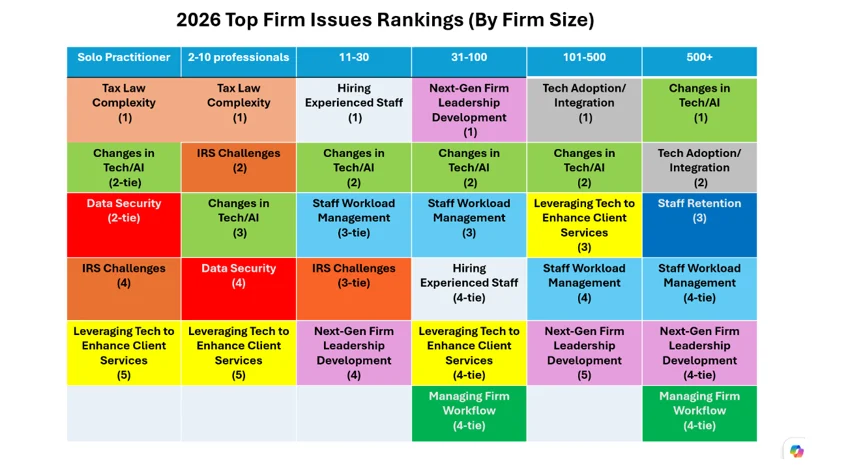
However, the narrative has shifted rapidly. Between April 20 and May 22 of this year, 629 accounting professionals participated in the latest survey, revealing a landscape where AI is no longer a buzzword but an operational reality. The survey results show that in five out of six firm-size categories, changes in technology and the adoption of AI now rank in the top two most impactful issues. Even among firms with two to 10 employees—the group most insulated from the rapid-fire tech mandates of the enterprise world—the issue holds the third spot, proving that no segment of the profession remains untouched.
For larger organizations, the shift is even more pronounced. Firms with more than 500 employees now list tech adoption, integration, and AI changes as their top two priorities, reflecting the massive infrastructure challenges involved in retrofitting legacy accounting systems with modern, AI-driven capabilities.
Supporting Data: Disparities Across Firm Sizes
The PCPS survey is notable for its granular segmentation of the industry, dividing firms into six categories based on employee count. This segmentation recognizes a fundamental truth: a solo practitioner’s challenges differ significantly from those of a midsize regional firm or a national powerhouse.
The Divergent Priorities
- Solo Practitioners and Small Firms (Up to 10 employees): For these firms, the "boots on the ground" reality of tax law complexity remains the primary hurdle. With limited administrative bandwidth, the constant churn of tax legislation and IRS compliance challenges occupies the top spot. Data security also remains a top-four concern, reflecting the heightened risk profile of smaller firms handling sensitive client information with limited cybersecurity budgets.
- Midsize Firms (11–30 and 31–100 employees): As firms grow, the focus shifts toward structural sustainability. Firms with 11–30 employees identify hiring experienced staff as their most pressing issue, highlighting the ongoing "war for talent" that continues to plague the sector. Meanwhile, firms with 31–100 employees are hyper-focused on the next generation of leadership development. They are looking to bridge the gap between retiring partners and the incoming digital-native workforce.
- Large Firms (101–500 and 500+ employees): These organizations are in the throes of full-scale digital integration. For firms with 101–500 employees, the priority is the actual integration of new tech, followed closely by the AI revolution. In firms with over 500 employees, the order is flipped, with AI strategy leading the way. Across all four of these larger segments, staff workload management has emerged as a top-four issue, suggesting that while technology is meant to create efficiencies, the current transition period is causing significant friction for existing employees.
Official Perspectives: The Human Element of Technology
Lisa Simpson, CPA, CGMA, and vice president of Firm Services at the AICPA, characterizes this era as a fundamental "transformation" of the profession. Her insights underscore that while AI is the catalyst, the ultimate goal is a reimagining of the firm’s operating model.
"The top issues for firms tie into the transformation we’re seeing in technology, people skills, and operating models," Simpson stated following the survey’s release. "We know keeping up with rapid developments in AI and technology capabilities can be a challenge, but the survey also revealed that there are challenges with integrating technology and leveraging it to enhance service offerings."
Simpson emphasizes that the profession must avoid the trap of viewing technology as a total replacement for the CPA. "On the people side, we’re seeing more focus on reframing job skills, managing staff workload, developing leaders, and evolving services to meet client expectations. Regardless of technology capabilities, accounting is still a people business."
This perspective suggests that the most successful firms will be those that manage the "change" aspect of change management—upskilling staff to work alongside AI rather than competing with it.
The Long-Term Implications for the Profession
The survey results point toward several long-term shifts in how CPA firms will function, compete, and survive through 2030 and beyond.
1. The Death of Commodity Compliance
The fact that AI is now a primary issue suggests that firms are no longer comfortable with the status quo. As AI becomes increasingly capable of handling routine data entry, reconciliation, and basic tax computation, the value of the CPA will shift entirely toward interpretation, strategy, and high-level advisory. Firms that fail to pivot from "commodity compliance" to "advisory services" will likely find themselves squeezed out by both tech-native competitors and the AI tools themselves.
2. The Talent Paradigm Shift
The presence of "staff retention" and "job skill shifts" in the top five priorities across nearly all firm sizes indicates a profession in transition. Accountants are no longer just looking for technical tax knowledge; they are looking for professionals who possess data literacy, emotional intelligence, and the ability to leverage technological tools. This implies a future where accounting curricula and firm training programs must be fundamentally redesigned to prioritize "tech-fluency" alongside GAAP knowledge.
3. Scaling Through Systems
The challenge of "integrating technology" suggests that many firms currently suffer from fragmented tech stacks. The firms of the future will be defined by their ability to create cohesive, end-to-end digital ecosystems. Managing this integration is not just an IT project; it is a cultural one. It requires leadership to convince teams that new tools are not just "more work," but are instead the essential levers for reclaiming time and increasing capacity.
4. Quality Management (QM) as a Competitive Advantage
With four of the six firm-size groups identifying the bolstering of Quality Management (QM) systems as a key priority, it is clear that the industry is bracing for a higher standard of scrutiny. As AI takes on more of the workload, the firm’s ability to prove the accuracy and integrity of its outputs will become a primary marketing and risk-mitigation tool.
Conclusion: Adapting for the Future
The 2024–2025 survey serves as a clarion call for the accounting profession. The era of passive technological adoption is over. Whether it is the solo practitioner struggling to keep up with IRS mandates or the large firm managing a workforce of hundreds, the common thread is the need for agility.
The data confirms that the "people business" of accounting is not disappearing, but it is undergoing a metamorphosis. Those who view the AI-driven transformation not as a threat, but as a mechanism for elevating the accountant from a processor of data to a strategic partner, will be the leaders of the next decade. As the AICPA’s survey makes clear, the challenge lies not in the technology itself, but in the human-centric management of the change that technology necessitates.