The Ghost Seat: How Russia’s Unlawful Succession at the UN Security Council Undermines Global Security
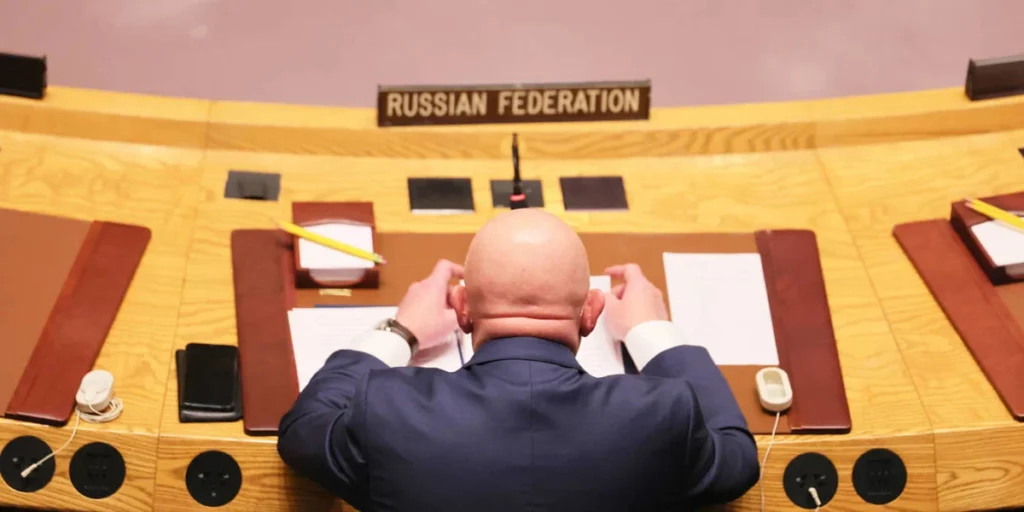
KYIV — "We the peoples of the United Nations determined to save succeeding generations from the scourge of war."
So begins the preamble of the United Nations Charter, drafted in the ashes of the most devastating conflict in human history to ensure that no single state could ever again trample international law with impunity. Yet, as Russia’s brutal war of aggression against Ukraine grinds well into its fourth year, these foundational words ring increasingly hollow. The ongoing carnage on European soil has laid bare a systemic failure at the heart of the international system—one rooted not merely in political deadlock, but in a foundational illegality.
When the Soviet Union collapsed in December 1991, the Russian Federation assumed the USSR’s permanent seat on the United Nations Security Council. For over three decades, this transition has been treated as a bureaucratic formality. However, a rigorous examination of the historical record reveals a stark reality: Russia did not follow the constitutional process outlined in the UN Charter to attain its seat. Now, with Moscow leveraging its veto power to shield its imperial ambitions and paralyze the world body, international legal scholars, diplomats, and policymakers are demanding that the dubious legal status of Russia’s membership be revisited once and for all.
Main Facts: The Anatomy of a Procedural Heist
To understand the crisis currently paralyzing the UN Security Council, one must examine Article 23 of the UN Charter. The Charter explicitly enumerates the five permanent members of the Security Council: the Republic of China, France, the Union of Soviet Socialist Republics, the United Kingdom of Great Britain and Northern Ireland, and the United States of America.
Crucially, the "Russian Federation" is nowhere to be found in the text.
When the USSR dissolved, international law dictated that the vacant seat should have either remained empty pending a formal Charter amendment, or the successor states would have been required to apply for new membership under Article 4 of the Charter. Article 4 mandates that admission to the UN "is open to all other peace-loving states," requiring a recommendation from the Security Council and a two-thirds majority vote in the General Assembly.
Instead, on December 24, 1991, following a letter from Russian President Boris Yeltsin, the UN Secretariat simply altered the name plates. Without a single vote in the General Assembly, without a formal amendment to the UN Charter, and without the vetting process required of every other member state, the Russian Federation slid into the Soviet Union’s chair.
This maneuver bypassed the checks and balances designed to prevent rogue or aggressive states from wielding veto power. Today, that procedural shortcut has manifested as a catastrophic security liability. Armed with a permanent seat and veto power it never legitimately earned under the rule of law, Moscow has systematically neutralized the Security Council’s ability to uphold international peace, rendering the UN virtually impotent in the face of Europe’s largest armed conflict since World War II.
Chronology: From Soviet Collapse to Imperial Aggression
The trajectory leading to the current geopolitical paralysis spans more than three decades of diplomatic complacency, marked by key historical milestones:
- December 8, 1991: The leaders of Russia, Ukraine, and Belarus sign the Belavezha Accords, declaring the Soviet Union dissolved and establishing the Commonwealth of Independent States (CIS).
- December 21, 1991: At an Alma-Ata summit, leaders of the former Soviet republics sign a declaration stating that "the member states of the CIS support Russia in taking over the USSR membership in the UN, including the Security Council." However, this regional political agreement possessed zero binding authority over the international body of the United Nations.
- December 24, 1991: Russian President Boris Yeltsin dispatches a letter to UN Secretary-General Javier Pérez de Cuéllar, announcing that the Russian Federation is continuing the membership of the USSR in the UN and all its organs. The UN Secretariat accepts the transition administratively, circumventing the General Assembly.
- 1993–1999: Russia leverages its disputed Security Council status to intervene in regional conflicts in the post-Soviet space, including Transnistria, Abkhazia, and Chechnya, setting a precedent of unchecked impunity.
- February–March 2014: Russia violates the UN Charter by illegally annexing Crimea and instigating a proxy war in the Donbas region of eastern Ukraine. Despite clear violations of international law, Russia uses its veto power to block Security Council resolutions condemning its actions.
- February 24, 2022: Russia launches a full-scale, unprovoked invasion of Ukraine. In an emergency session of the Security Council, Russia brazenly vetoes a resolution demanding an immediate cessation of its offensive and the withdrawal of its troops.
- 2024–2026: As the war enters its fourth year, the cost in human lives mounts into the hundreds of thousands. Russia weaponizes global food and energy supplies, while continuing to occupy its disputed seat, using procedural obstruction to shield itself from accountability.
Supporting Data: The Cost of Impunity
The institutional paralysis caused by Russia’s presence on the Security Council is quantifiable in both diplomatic deadlock and human suffering.
According to data compiled by UN Watch and international legal analysts, Russia has cast dozens of vital vetoes since 1991 to block accountability measures, with the vast majority concentrated on shielding its own actions or those of its strategic allies (such as the Assad regime in Syria). Since the 2022 full-scale invasion of Ukraine, Russia has systematically blocked:
- Resolutions condemning its territorial annexations.
- Proposals establishing international tribunals for war crimes committed in Ukraine.
- Mandates extending humanitarian aid corridors and independent monitoring missions in conflict zones.
Furthermore, economic and humanitarian metrics underscore the broader collateral damage of this diplomatic blockage. The UN Refugee Agency (UNHCR) reports that the war has displaced over 14 million Ukrainians, triggering the largest refugee crisis in Europe since 1945. Meanwhile, global food insecurity spiked dramatically in 2022 and 2023 as Russia blockaded Ukrainian grain exports—actions that directly violated the spirit of international humanitarian law, yet went unaddressed by the Security Council due to Moscow’s self-serving veto.
Official Responses: Diplomatic Standpoint and Resistance
The legal fiction surrounding Russia’s UN seat has not gone unchallenged. Over the past four years, Ukrainian diplomats, international jurists, and a growing coalition of global south and western nations have begun pushing back against what they term "the usurpation of the Soviet seat."
Kyiv’s Stance
The Ministry of Foreign Affairs of Ukraine has repeatedly raised the issue at the General Assembly, arguing that Russia’s occupancy is legally null and void. In official statements, Ukrainian representatives have emphasized:
"Russia never underwent the admission process mandated by Article 4 of the UN Charter. Its occupation of the USSR’s permanent seat is an administrative anomaly that has enabled a regime guilty of war crimes to sit in judgment of international peace."
Western and Allied Responses
While Western capitals initially accepted Russia’s succession in 1991 as a pragmatic measure to ensure the security of the Soviet nuclear arsenal, the calculus has shifted drastically. Legal scholars in the United States and the European Union have published extensive briefs arguing that the precedent of 1991 violated international constitutional law.
However, cautious diplomats in Washington, London, and Paris have historically hesitated to challenge Russia’s seat directly, fearing it could trigger a total institutional collapse of the UN or provoke unpredictable retaliatory measures from Moscow. Nonetheless, momentum is growing for broader UN reforms, including proposals to restrict or eliminate the veto power in cases involving mass atrocities and acts of aggression by permanent members.
Implications: The Future of the Rules-Based Order
The question of Russia’s UN seat extends far beyond legal technicalities or bureaucratic pedantry; it strikes at the very core of whether the international community can maintain a rules-based global order.
- The Crisis of Multilateralism: If a state can simply declare itself the successor to a defunct superpower, ignore the explicit text of the UN Charter, and subsequently launch aggressive wars while shielded by its own illegally acquired veto, the credibility of the United Nations collapses. Smaller nations are left to conclude that international law applies only to the weak.
- Pathways to Reform: Legal experts argue that correcting the 1991 error does not require an impossible consensus from the Security Council (where Russia holds a veto). Instead, the UN General Assembly holds the ultimate authority to accredit member delegations under Rule 27 of the Rules of Procedure. A majority vote in the General Assembly could theoretically challenge the credentials of the Russian delegation, demanding that Moscow submit to the formal Article 4 admission process.
- A Defining Test for Global Leadership: As the war in Ukraine persists into its fourth year, the international community faces a stark choice. It can continue to normalize a legal absurdity that enables aggression, or it can summon the political courage to restore the integrity of the UN Charter.
Until the international community addresses the ghost seat at the UN Security Council, the foundational promise of the United Nations—to save succeeding generations from the scourge of war—will remain severely compromised.