Navigating the Future: A Comprehensive Guide to Selecting the Best Retirement Planning Software
Retirement planning is arguably the most significant financial project an individual will undertake in their lifetime. Whether you are decades away from leaving the workforce or hovering on the cusp of your golden years, the transition requires more than just a gut feeling; it requires data-driven precision. Today’s digital landscape offers a robust suite of retirement calculators and planning software designed to demystify the process. However, not all tools are created equal, and choosing the wrong one could lead to a fundamental misunderstanding of your long-term financial security.
The Reality of Algorithmic Variance
When planning for a period that could span three decades or more, minor variations in input assumptions—such as inflation rates, market volatility, and tax projections—can result in vastly different outcomes. A notable industry study recently examined five popular retirement planning software packages and identified stark discrepancies in their final results.
The study’s core takeaway is a warning against over-reliance on a single platform. It suggests that individuals should test their financial variables across multiple programs before finalizing an action plan. By triangulating results from different engines, users can identify outliers and build a more resilient strategy.
The Evolution of Planning Tools: A Chronology
The history of retirement planning has evolved from simple paper-based worksheets and rudimentary spreadsheets to sophisticated, cloud-based financial engines.
- The Early Years (Pre-2010): Most retirement planning was done via basic calculators that utilized simple compound interest formulas. These tools rarely accounted for taxes, Social Security claiming strategies, or fluctuating market returns.
- The Rise of Aggregation (2010–2018): As fintech matured, platforms like Empower (formerly Personal Capital) introduced account aggregation, allowing users to sync their real-time net worth with their planning projections. This shifted the focus from "estimation" to "execution."
- The Sophistication Era (2019–Present): Modern software now includes Monte Carlo simulations, complex tax-bracket modeling, and "what-if" scenario analysis. Tools like Boldin and ProjectionLab have pushed the boundary further, allowing users to model everything from Roth conversions to long-term care costs.
Evaluating the Top Tier: My Personal Selection
Having spent years testing various platforms, I have identified three standout solutions that cater to different needs, ranging from the casual saver to the detail-oriented strategist.
1. Empower: The Best Free All-In-One Solution
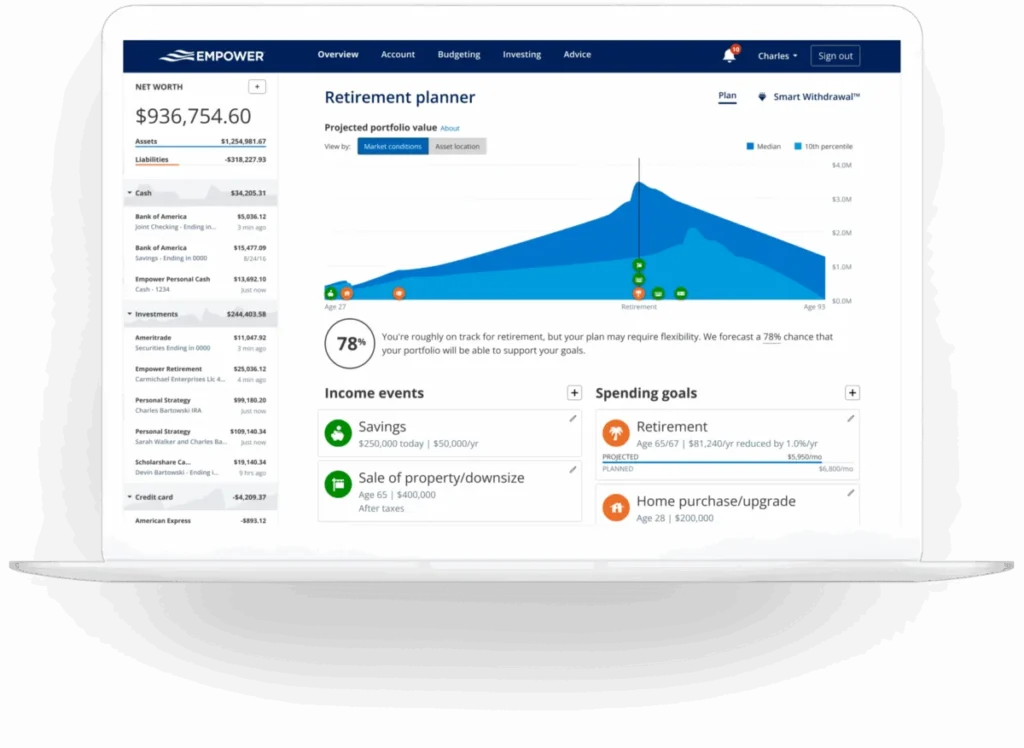
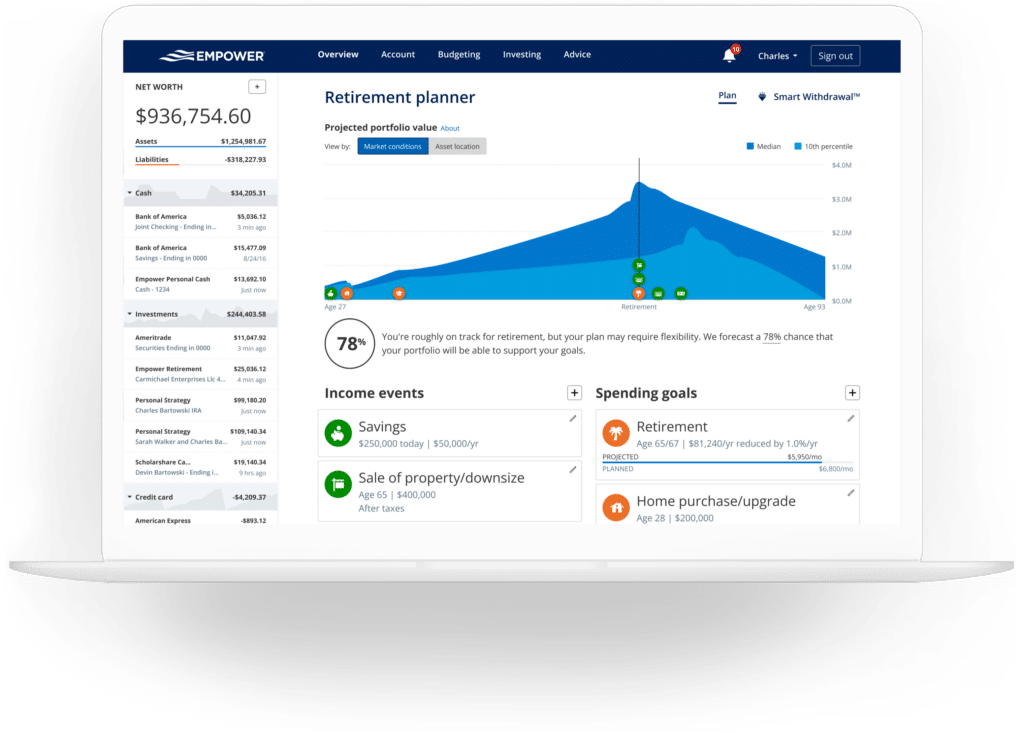
Empower’s Retirement Planner remains the gold standard for those seeking a balance between accessibility and power. It is entirely free and utilizes an intuitive interface that makes it an ideal starting point.
How it works:
Once you securely link your 401(k), IRA, and taxable brokerage accounts, Empower pulls your actual balance data into its engine. It then runs a Monte Carlo simulation—a mathematical technique that predicts the probability of different outcomes by running thousands of variations of market performance.
Why it stands out:
The ability to model "what-if" scenarios is unparalleled for a free tool. You can adjust your retirement age, test the impact of a sudden expense, or see how delaying Social Security affects your success probability. It is particularly effective for those who are five or more years away from retirement, as it provides a high-level view of whether your current trajectory is sustainable.
2. Boldin: The Professional’s Choice
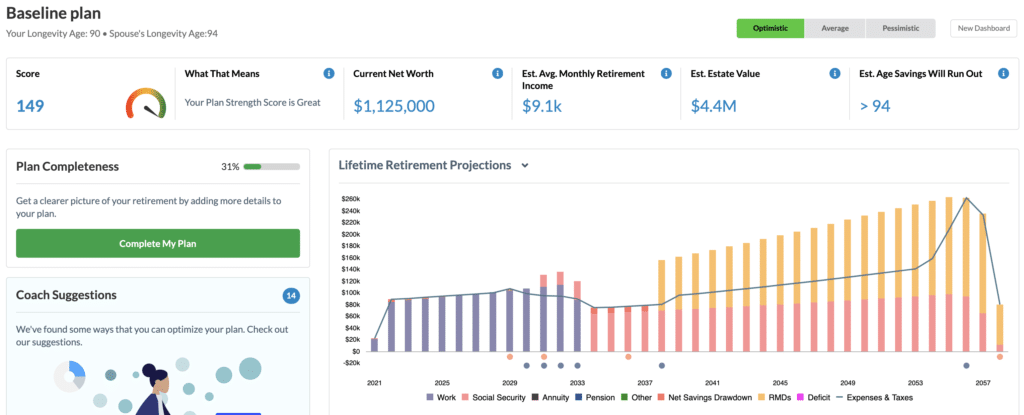
For those who want granular control, Boldin (formerly New Retirement) is arguably the most comprehensive tool on the market. It is designed for users who want to dive deep into the mechanics of their financial life.
Key Capabilities:
- Social Security & Pensions: It excels at modeling specific government benefits and private pensions.
- Tax Strategy: It includes a dedicated Roth IRA conversion calculator, which is essential for retirees looking to minimize their lifetime tax burden.
- Flexibility: Whether you want to model monthly, yearly, or one-time cash flows, Boldin accommodates almost any scenario.
While it offers a free version, the PlannerPlus subscription (approximately $12/month) unlocks advanced features like tax optimization and custom scenario comparisons. As someone currently in the semi-retirement phase, I rely on Boldin for its depth; it allows me to see the direct impact of every dollar moved between accounts.
3. ProjectionLab: The Best for Visualization
ProjectionLab, founded by Kyle Nolan, represents the next generation of financial planning software. It is perhaps the most visually engaging platform, turning complex financial data into digestible charts and graphs.
Why it deserves your attention:
ProjectionLab is built for those who find traditional spreadsheets tedious. It handles complex account structures—including HSAs, Roth 401(k)s, and traditional IRAs—with ease. Its "what-if" analysis is industry-leading, allowing users to test multiple withdrawal strategies, such as the 4% Rule or Variable Percentage Withdrawal (VPW), to see how they impact portfolio longevity.
With a Premium subscription at $129 per year, it is a professional-grade tool offered at a consumer-friendly price point. It is ideal for users who enjoy refining their plan and seeing the immediate, visual feedback of their decisions.
Supporting Data: Why "Consumption Smoothing" Matters
While the aforementioned tools focus on portfolio success rates, there is a separate school of thought known as "consumption smoothing." This is the foundation of the Maxifi planner.
The economic model of consumption smoothing posits that individuals aim to maintain a consistent standard of living throughout their retirement, regardless of age. While critics argue that spending patterns naturally decrease in later years, the methodology behind Maxifi is mathematically rigorous. It forces the user to look at the other side of the coin: instead of asking "Will I have enough money?", it asks "Based on my current assets, how much can I safely spend each year?"
Understanding both perspectives—the "success rate" model used by Empower/Boldin and the "consumption" model used by Maxifi—will make you a much more informed planner.
Implications for Your Financial Future
The availability of these tools has profound implications for the average investor.
- Democratization of Advice: You no longer need to pay a high-fee financial advisor thousands of dollars just to run a basic retirement projection. These tools provide institutional-grade modeling at a fraction of the cost.
- Increased Accountability: When you see a "failure" projection on a Monte Carlo simulation, it serves as a powerful motivator to increase your savings rate or adjust your asset allocation.
- The "Multiple Source" Strategy: As the study mentioned earlier noted, you should never rely on one source of truth. Use Empower for a quick, automated health check. Use Boldin for your deep-dive tax and pension modeling. Use ProjectionLab to stress-test your withdrawal strategies.
Frequently Asked Questions
Are these tools actually secure?
Yes. Reputable planning software uses bank-level encryption and read-only access to your financial accounts. They cannot move your money; they only "read" the data to perform the analysis.
What is the difference between a "calculator" and "software"?
A calculator is typically a one-page tool that provides a snapshot based on three or four variables. Software is a comprehensive ecosystem that accounts for taxes, inflation, life expectancy, Social Security, healthcare premiums, and asset location.
Does the "best" tool depend on my age?
Partially. If you are 25, you need a tool that encourages consistent saving and simple projections. If you are 55, you need a tool that handles complex tax strategies, Medicare costs, and withdrawal sequencing. Empower is excellent for the former; Boldin and ProjectionLab are superior for the latter.
Final Thoughts
Retirement planning is not a "set it and forget it" task. It is a dynamic process that should be revisited annually. By leveraging these digital tools, you are moving from a position of uncertainty to one of agency. Choose the platform that best matches your appetite for detail, and remember: the most important variable in your retirement plan isn’t the software—it’s the action you take based on the data it provides.