Bridging the Gap: A Financial Roadmap for Mid-Life Security and Ownership

In the heart of Connecticut, Brian and Michael—a professional couple both aged 34—stand at a pivotal juncture in their lives. Together since 2013, the couple shares a household with two cats, a deep passion for community advocacy, and a shared set of ambitious life goals. Brian serves as a quality assurance manager for a state-run hospital, while Michael balances a role as a project coordinator for a state behavioral health agency with a side career in disability advocacy.
Despite their professional stability, the couple reports a pervasive sense of anxiety regarding their financial trajectory. They are currently grappling with consumer debt, a lack of home equity, and an urgent desire to solidify their long-term security. As they approach their 10-year anniversary, they have turned to the Frugalwoods community to help navigate the transition from "surviving" to "thriving."

The Chronology of a Financial Crossroads
The past 12 months have been defined by significant volatility for the couple. In 2022, they were forced to vacate a cozy 600-square-foot studio apartment, which they had occupied for eight years at a modest $945 per month. The subsequent search for a new home during the 2022/2023 rental market surge proved to be a grueling, three-and-a-half-month ordeal.
This transition, coupled with unexpected veterinary expenses for their two new kittens, derailed their initial plan to enter the housing market in late 2023. While the couple has settled into a luxurious two-bedroom industrial-style apartment, the shift has left them feeling exposed. They characterize their current financial state as a "cycle of debt," where they oscillate between periods of relative stability and bouts of unplanned, high-stress spending.

Supporting Data: An Analysis of the Ledger
To provide context for their request, Brian and Michael shared a detailed breakdown of their finances. Their household, with a combined annual gross income of approximately $167,544, results in a net annual income of roughly $109,455.
Debt Profile
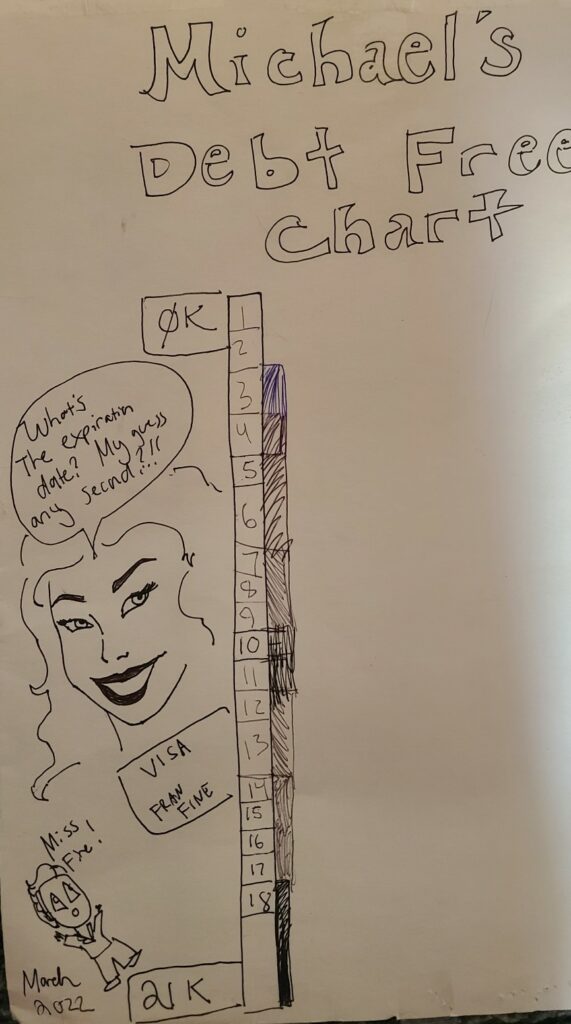
The couple currently carries $28,259 in consumer debt across three credit card accounts. While some of these debts have temporary 0% interest rates, these periods are set to expire in late 2023, at which point interest rates will jump to between 17% and 18%.

Expense Snapshot
Monthly expenditures currently total approximately $8,035. A significant portion of this is tied to fixed costs, including $2,000 for rent and $2,000 specifically allocated toward debt repayment. However, discretionary spending—including dining out, gifts, and home goods—remains a source of concern for the couple, who feel these habits are preventing them from achieving their ultimate goal of homeownership.
Asset Allocation
The couple’s total assets, including retirement accounts (401k, 403b, 457b, and a pension), cash savings, and vehicle equity, hover around $91,250. While Brian’s government-sector benefits—including a pension and healthcare for life—provide a strong safety net, the couple feels their liquid savings are underfunded for their age.

Official Recommendations: A Strategic Shift
Financial experts, including those in the Frugalwoods network, emphasize that Brian and Michael’s situation is far from dire. Many of their anxieties stem from "comparison bias"—the belief that peers are further ahead—rather than a mathematical failure.
1. The Power of Expense Tracking
The most immediate recommendation is the implementation of a rigorous, automated expense-tracking system. By utilizing tools like Empower (formerly Personal Capital) or manual spreadsheet accounting, the couple can visualize exactly where their "missing" $13,000 in potential annual surplus is going.
2. The "Short-Term Famine" Strategy
To break the cycle of debt, the recommendation is a temporary, aggressive spending detox. By categorizing expenses into "Fixed," "Reducible," and "Discretionary," the couple can identify non-essential spending. By eliminating discretionary outflows (such as dining out and subscriptions) for a six-month window, the couple could potentially increase their debt-repayment capacity to over $4,400 per month, effectively clearing their consumer debt within half a year.
3. Redefining the Priority List
The expert consensus for the couple’s ten-year plan is as follows:

- Eliminate Consumer Debt: High-interest debt is an anchor that must be cut before any other investment or purchase.
- Emergency Fund: Once debt is gone, the focus must shift to building a liquid buffer that covers 3–6 months of essential expenses.
- Retirement Contributions: Before saving for a down payment, the couple should maximize their tax-advantaged accounts. With access to a 403b, 457b, and 401k, they have a "triple crown" of retirement options that should be utilized to their full potential.
- Homeownership: Real estate should be viewed as the final goal, to be pursued only once the financial foundation (debt-free status, emergency fund, and retirement trajectory) is secure.
Implications: The Psychology of Money
Beyond the spreadsheets, the couple’s case highlights a critical psychological element: the shame associated with financial "adulting." Michael and Brian express deep-seated disappointment in themselves for not having "arrived" at a more traditional milestone of success.
The core lesson for the couple is that money is a tool, not a report card. The "famine" period recommended by advisors is not meant to be a permanent lifestyle of deprivation, but a reset button to allow for intentional spending.

Addressing the Master’s Degree Question
Regarding Brian’s desire to pursue a graduate degree, the advice is cautionary. Unless the degree carries an "iron-clad, documented, and guaranteed" salary increase, it is viewed as an unnecessary distraction from their immediate goal of becoming debt-free and owning property. Pursuing education for intellectual growth is valid, but the couple must acknowledge that it will delay their other financial goals by years.
The Path Forward
The political and economic climate—specifically the instability of Social Security and the volatility of the housing market—is valid cause for concern, but it should not dictate the couple’s day-to-day decisions. By focusing on what they can control—their spending habits, their debt load, and their tax-advantaged savings—Brian and Michael can effectively insulate themselves against external economic shifts.

The couple is currently at a "comfortable middle" where they can transition from reacting to life’s expenses to proactively building the life they desire. With a clear, disciplined path to debt elimination and a renewed focus on long-term retirement planning, they are well-positioned to achieve their goals within the decade.