Beyond the Frontlines: Russia’s Escalating War on Ukraine’s Infrastructure and the Geopolitical Brinkmanship at NATO’s Doorstep
By Anna Husarska
October 1, 2026
Politics & World Affairs
Main Facts
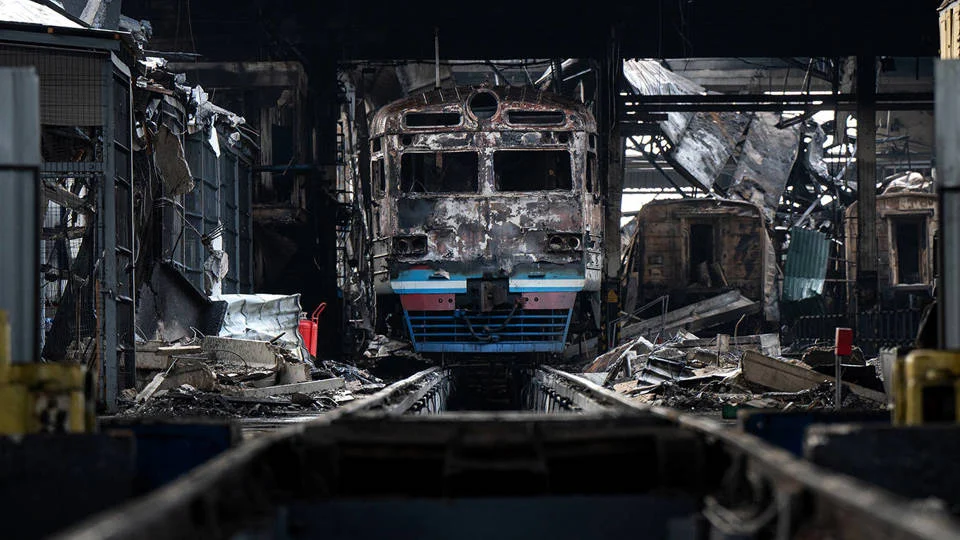
The Kremlin has systematically expanded the scope of its war against Ukraine, shifting from traditional battlefield engagements to a broad strategy of national isolation. Beyond wearing down the political will of Kyiv’s international allies, Russia is actively attempting to sever Ukraine’s physical lifelines to the outside world. This multifaceted campaign relies on relentless airstrikes and drone attacks targeting merchant shipping lanes in the Black Sea, critical port facilities along the Danube and Odesa, vital border crossings, and—increasingly—the country’s railway grid.
The severity of this strategy was brought into sharp, alarming focus near the city of Lviv, a mere mile from the Polish border and, by extension, the threshold of the North Atlantic Treaty Organization (NATO). In a deliberate escalation, jet-powered Russian drones struck a Ukrainian passenger and logistical train operating dangerously close to a vital European transit corridor.
The timing and coordinates of the strike have ignited intense debate among intelligence analysts and diplomats. The attack occurred just after high-profile international dignitaries—including former British Prime Minister Boris Johnson, former Swedish Prime Minister Carl Bildt, former CIA Director David Petraeus, and former Polish President Aleksander Kwaśniewski—had departed Kyiv. These leaders had gathered in the Ukrainian capital for the prestigious Yalta European Strategy (YES) Annual Meeting, often described as "Ukraine’s Davos."
While the targeted train did not carry these specific high-profile figures, the proximity of the strike to their known travel routes has raised a chilling question: Was the incident a deliberate warning shot by Moscow, or a terrifying near-miss born of calculated recklessness? Regardless of intent, military strategists agree that such brazen attacks on transport arteries near NATO’s perimeter represent a dangerous evolution in the conflict, designed to test the limits of Western deterrence and isolate a nation fighting for its survival.
Chronology
To understand how the conflict reached the threshold of NATO territory, it is necessary to examine the systematic escalation of Russia’s infrastructure warfare over the course of the war, culminating in the recent Lviv drone strike.
- February – July 2022: Following its initial full-scale invasion, Russia imposes a near-total naval blockade on Ukraine’s Black Sea ports, trapping millions of tons of grain and halting critical maritime commerce. Kyiv’s land and rail routes become the sole economic and diplomatic lifelines to Europe.
- Late 2022 – 2023: Moscow shifts its air campaign toward Ukraine’s energy grid, attempting to freeze the civilian population into submission. Simultaneously, cyberattacks and localized sabotage target rail switching yards and electrical transformers along primary western transit routes.
- July 2023: Russia unilaterally withdraws from the Black Sea Grain Initiative, subsequently launching sustained, systematic missile and drone campaigns against Ukrainian grain silos, port terminals on the Danube River (such as Reni and Izmail), and coastal infrastructure designed to starve the Ukrainian economy.
- Spring 2024: The Kremlin accelerates its targeting of railway hubs. Understanding that Western aid, ammunition, and visiting dignitaries depend almost exclusively on Ukraine’s resilient rail network—often referred to as "Iron Ukrzaliznytsia"—Russian command attempts to systematically paralyze freight and passenger logistics.
- September 2026 (The YES Annual Meeting): Political leaders, military analysts, and global executives gather in Kyiv for the Yalta European Strategy conference. Security protocols are exceptionally tight, reflecting the constant threat of aerial bombardment during high-level diplomatic visits.
- Late September 2026: Immediately following the conclusion of the summit, as trains carrying international delegations and regular civilian passengers navigate the western corridors toward Poland, jet-powered Russian drones strike a railway target just one mile from the Polish border near Lviv, underscoring the extreme vulnerability of Ukraine’s western transport arteries.
Supporting Data
The physical and economic data surrounding Russia’s war on infrastructure paint a grim picture of systematic destruction, countered only by the remarkable resilience of Ukrainian logistics.
- Geographic Proximity: The strike near Lviv occurred approximately 1.6 kilometers (one mile) from the Ukrainian-Polish border—effectively placing Russian munitions within direct line-of-sight of NATO airspace.
- The Lifeline Railway: Since February 2022, Ukrainian railways have evacuated more than 4 million civilians from active combat zones and transported millions of tons of humanitarian and military aid. Despite suffering thousands of direct missile and artillery hits on tracks, bridges, and stations, the state-run railway system has maintained an operational punctuality rate exceeding 80%.
- Maritime Impact: Prior to the establishment of Ukraine’s unilateral humanitarian corridor in the western Black Sea, Russian strikes destroyed over 30 port facilities and damaged dozens of civilian merchant vessels flying the flags of various nations, causing global insurance rates to skyrocket and threatening food security across the Global South.
- Diplomatic Footprint: The YES Annual Meeting regularly convenes hundreds of global decision-makers. The 2026 summit hosted representatives from over 30 countries, making the subsequent targeting of the transport network an explicit messaging campaign directed at Western political capitals.
Official Responses
The strike near the Polish border and the broader strategy of isolating Ukraine have provoked sharp reactions from international leaders, Ukrainian officials, and military analysts.
Speaking on condition of anonymity, a senior European diplomat noted the psychological dimensions of the attack:
"When you launch jet-powered drones within shouting distance of a NATO member state, you are no longer just fighting Ukraine. You are probing the alliance’s threshold, measuring response times, and testing our collective nerve."
Ukrainian infrastructure authorities have emphasized the civilian cost of these transport attacks. In a statement released following the Lviv incident, the Ministry of Communities, Territories and Infrastructure Development of Ukraine declared:
"Russia’s targeting of railway lines used by both international partners and ordinary citizens proves that the Kremlin recognizes no humanitarian norms or diplomatic boundaries. Every strike on our transport network is an attack on the physical connection between Ukraine and the democratic world."
Western intelligence agencies have expressed mounting concern over the integration of advanced jet-powered propulsion in reconnaissance and strike drones used near the western border. Analysts point out that these systems possess enhanced speed and electronic-warfare resistance, making them significantly harder for regional air defense systems to intercept before they reach sensitive border zones.
While formal NATO communiqués continue to reiterate unwavering support for Ukraine’s territorial integrity, military planners in Brussels are reportedly reviewing air-defense configurations along the eastern flank to account for the increasing frequency of stray or targeted munitions drifting close to alliance territory.
Implications
The escalation of attacks on Ukraine’s western borderlands carries profound long-term implications for European security, global supply chains, and the future posture of Western deterrence.
1. The Erosion of Deterrence and the "Salami-Slicing" Strategy
By striking transport links near the Polish border, Moscow is engaging in a classic "salami-slicing" tactic—incremental escalations designed to cross established red lines gradually without triggering a direct military response from NATO. If these attacks on western supply routes and diplomatic corridors are met with silence or hesitation, Russian President Vladimir Putin will be emboldened to push further, assuming that Western fatigue will ultimately outweigh collective security commitments.
2. The Vulnerability of Diplomatic and Humanitarian Corridors
The safety of foreign leaders, diplomats, and humanitarian workers visiting Kyiv has long relied on the predictability and relative security of the rail link through Lviv. If Russia demonstrates both the capability and the willingness to strike these specific arteries, international engagement with Ukraine will face severe logistical constraints. High-level diplomacy could be forced underground or restricted entirely, reducing face-to-face solidarity between Western leaders and the Ukrainian government.
3. Economic Isolation as a Weapon of Attrition
Physical isolation is the logical extension of military attrition. By targeting ports, merchant shipping, and rail networks simultaneously, the Kremlin aims to render Ukraine economically unviable. Even if the frontlines freeze, a permanently landlocked or logistically crippled Ukraine would struggle to rebuild, attract foreign investment, or export the agricultural and industrial goods upon which its economy depends.
4. The Imperative for a Decisive Western Response
As Anna Husarska observes, these assaults cannot go unanswered. A failure to reinforce Ukraine’s western air defenses—particularly around critical logistics and transit hubs—sends a dangerous signal of weakness. Strengthening anti-drone and anti-missile shields near the EU and NATO borders is no longer merely an act of solidarity with Kyiv; it is an urgent necessity for the defense of European stability itself.
The drone strike near Lviv should serve as a wake-up call in Western capitals: the war cannot be neatly contained on the eastern steppes of Ukraine. As long as Moscow believes it can sever Ukraine’s ties to the free world with impunity, the shadow of conflict will continue to lengthen across the entire European continent.