A Watershed Moment in Thematic Investing: Dan Ives Departs Wedbush, Casting Uncertainty Over AI-Focused ETFs

The landscape of thematic investing experienced a significant tremor on Wednesday, July 1, as Wedbush Securities officially announced that Dan Ives, the firm’s prominent Global Head of Technology Research, has resigned from his position. Ives, a fixture in the financial media and a central architect of Wedbush’s aggressive expansion into artificial intelligence-themed exchange-traded funds (ETFs), is set to embark on an undisclosed new venture.
This departure is not merely a change in personnel; it represents a fundamental shift for Wedbush’s asset management arm. Ives was not just an analyst; he was the face of the firm’s specialized AI investment products. With billions of dollars in assets under management (AUM) tied directly to his personal brand, the industry is now bracing for a period of transition, potential volatility, and a necessary reassessment of "key person risk" in the era of high-profile investment analysts.
The Core Facts: A Departure of Significant Magnitude
For nearly a decade, Dan Ives has been synonymous with Wedbush’s tech research division. His analysis of the software and hardware sectors, particularly his bullish stance on the "AI Revolution," helped define the firm’s market positioning.
The announcement, released mid-week, confirmed that Ives would be stepping down to pursue entrepreneurial interests. While the exact nature of his next project remains under wraps, the industry is already speculating on whether he will launch an independent research boutique, a private equity vehicle, or a new investment management firm.
For Wedbush, the immediate challenge is stabilizing the funds that bear his name. The Dan Ives Wedbush AI Revolution ETF (IVES) and the Dan Ives Wedbush AI Power & Infrastructure ETF (IVEP) were explicitly designed to leverage his reputation. When a fund’s ticker symbol is the manager’s own name, the brand equity is inseparable from the individual. As of July 2, 2026, the IVES fund managed over $1.1 billion in assets, making its future performance and management stability a matter of significant interest for institutional and retail investors alike.
Chronology of a High-Profile Partnership
To understand the weight of this departure, one must look at the timeline of the "Ives-Wedbush" era:
- 2018–2022: The Build-Up: Over these years, Dan Ives established himself as one of the most cited analysts on Wall Street regarding the "cloud computing" and early "generative AI" booms. His consistent presence on major financial news networks solidified his status as a key influencer in tech investment circles.
- 2023: The ETF Launch: Recognizing the demand for thematic exposure, Wedbush capitalized on Ives’s popularity by launching the IVES ETF. It was an unconventional move—placing an analyst’s name on a product—but one that paid off in massive inflows as investors sought a "name-brand" guide to the complex AI sector.
- 2024–2025: Expansion: Following the success of IVES, the firm expanded its thematic suite with IVEP, focusing on the infrastructure layer of AI, such as data centers and grid electrification.
- July 1, 2026: The Pivot: The announcement of his departure marks the end of an eight-year tenure. The speed with which this transition is occurring suggests a deliberate exit strategy rather than a sudden resignation, though the market impact remains immediate.
Official Responses and Corporate Strategy
The transition has been handled with standard corporate diplomacy. Gary Wedbush, President and CEO of Wedbush, issued a statement praising the departing executive. "Dan has been an exceptional team member of Wedbush, helping bring our firm valuable prominence and expertise in the technology equity markets," the CEO noted.

Crucially, the firm is attempting to signal continuity. By emphasizing that the firm remains "committed to its global technology banking and research platform," Wedbush is trying to prevent a run on its assets. The official rhetoric focuses on the "natural step" of entrepreneurial growth, framing the departure as a win-win scenario that could lead to future "partnerships" between the two parties.
However, behind the scenes, asset managers are likely scrambling to reassure stakeholders that the institutional research process—rather than one individual’s intuition—will continue to drive the firm’s investment decisions.
Implications: The "Key Person Risk" Paradigm
The departure of Dan Ives is a textbook case of "key person risk," a concept often discussed in wealth management but rarely seen with such high-profile exposure.
"Ives’s departure is a poster child example of key person risk that can happen with certain ETFs," explains Todd Rosenbluth, Head of Research at VettaFi. "The ETFs were built and marketed around Mr. Ives’s name and expertise. His departure from Wedbush is likely to cause investors to consider other AI-related ETFs."
When a product is built on a "star manager" model, the firm faces two primary risks:
- Brand Dilution: If the public perceives that the "genius" behind the fund has left, the perceived value of the product drops, regardless of the underlying assets.
- Asset Outflows: Investors who entered the fund based on Ives’s specific investment philosophy may feel that the "promise" of the fund has been broken, leading to mass redemptions.
The Competitive Landscape: Where Do Investors Go?
The AI thematic space is far more crowded today than it was when the IVES ETF first launched. For investors feeling trepidation about the future of the Wedbush funds, the market offers a variety of alternatives, many of which have demonstrated strong performance metrics.
The Rise of Alternatives
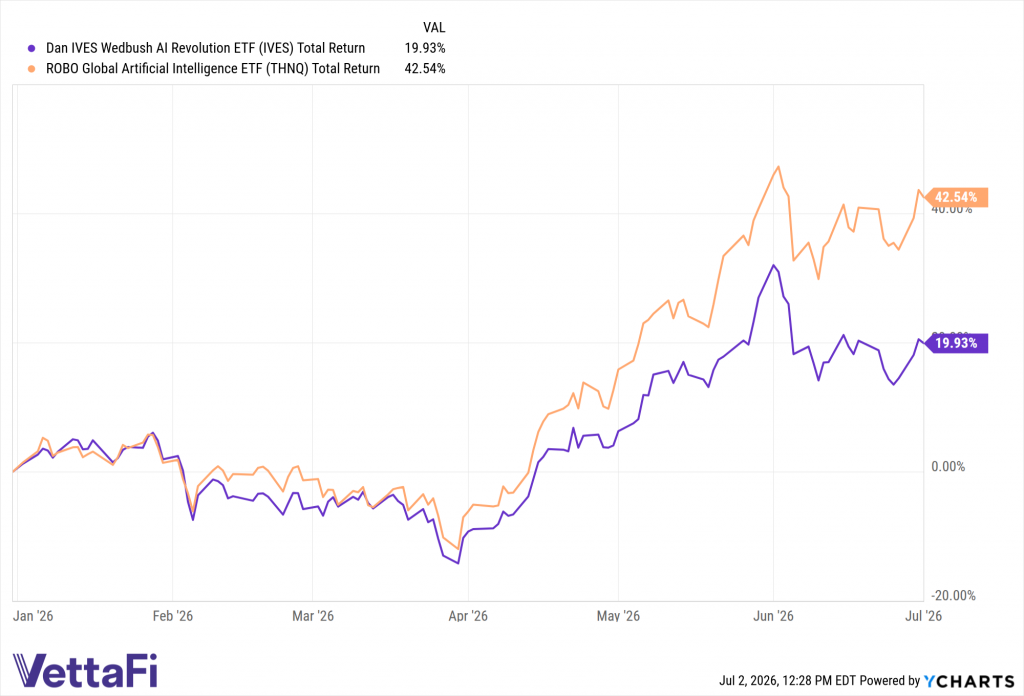
Investors are increasingly looking toward funds like the ROBO Global Artificial Intelligence ETF (THNQ). Notably, THNQ has shown distinct year-to-date outperformance compared to IVES, suggesting that investors may be rotating capital into strategies that rely on broader, quantitative, or index-based methodologies rather than single-manager expertise.
Other prominent players in the space include:
- Roundhill Generative AI & Technology ETF (CHAT): This fund has gained traction by focusing on the pure-play generative AI software and hardware ecosystem.
- Global X Artificial Intelligence & Technology ETF (AIQ): A broader, more established fund that captures the full spectrum of AI development, from semiconductor manufacturers to cloud providers.
The Future of the AI Investment Theme
Despite the shock of this leadership change, the underlying thesis for AI remains robust. The "AI Opportunity Set" is not tied to one person or one firm. Tech giants continue to invest billions into data centers, GPU infrastructure, and energy modernization. Companies across all sectors—from healthcare to manufacturing—are in the middle of a multi-year integration phase for AI tools.
The departure of Dan Ives serves as a reminder to investors that in the world of thematic ETFs, the "theme" is often more resilient than the "messenger." While Ives was instrumental in identifying the trend, the structural demand for AI infrastructure and innovation remains a permanent fixture of the modern economy.
Conclusion: A Turning Point for Retail Investors
For investors currently holding IVES or IVEP, the coming months will be critical. It is a time for due diligence. Investors must ask: Does the current fund management team have the capacity to replicate the strategy without the lead analyst? Or, has the fund’s competitive advantage left the building?
The departure of a high-profile analyst is a catalyst for portfolio review. As the thematic ETF space continues to mature, the transition of the Wedbush funds will likely influence how firms market their products in the future. We may see a move away from "personal brand" ETFs and toward "institutional methodology" ETFs, which offer more stability in the face of inevitable personnel turnover.
As the dust settles, the competition in the AI ETF space will only intensify. Whether through the established, index-based giants or newer, more agile thematic funds, the path forward for AI investors remains clear, even if the road map has lost one of its most recognizable signposts.
Disclaimer: VettaFi is the index provider for THNQ, for which it receives an index licensing fee. THNQ is not issued, sponsored, endorsed, or sold by VettaFi. VettaFi and its affiliates have no obligation or liability in connection with the issuance, administration, marketing, or trading of THNQ.