A Brutal Bond Market – A Wealth of Common Sense
Main Facts: The Anatomy of a Historic Fixed Income Collapse
For the better part of half a century, the Bloomberg Aggregate Bond Index—colloquially known across Wall Street simply as "The Agg"—has served as the undisputed North Star for fixed income investors. Created in the early 1980s by Lehman Brothers (and subsequently rebranded through various corporate acquisitions, much like a major sports stadium changing its naming rights sponsor), the index was designed to provide a comprehensive benchmark for the investment-grade, taxable bond market. Comprising more than 10,000 individual fixed-income securities, the Agg is dominated by U.S. Treasuries, high-grade corporate bonds, mortgage-backed securities (MBS), and asset-backed securities (ABS). It acts as the primary performance yardstick for active institutional managers and the foundational proxy for the vast majority of total bond market index funds.
Yet, despite its historical role as a stabilizing ballast in diversified portfolios, the Agg has just endured the most punishing and relentless bear market in modern financial history.
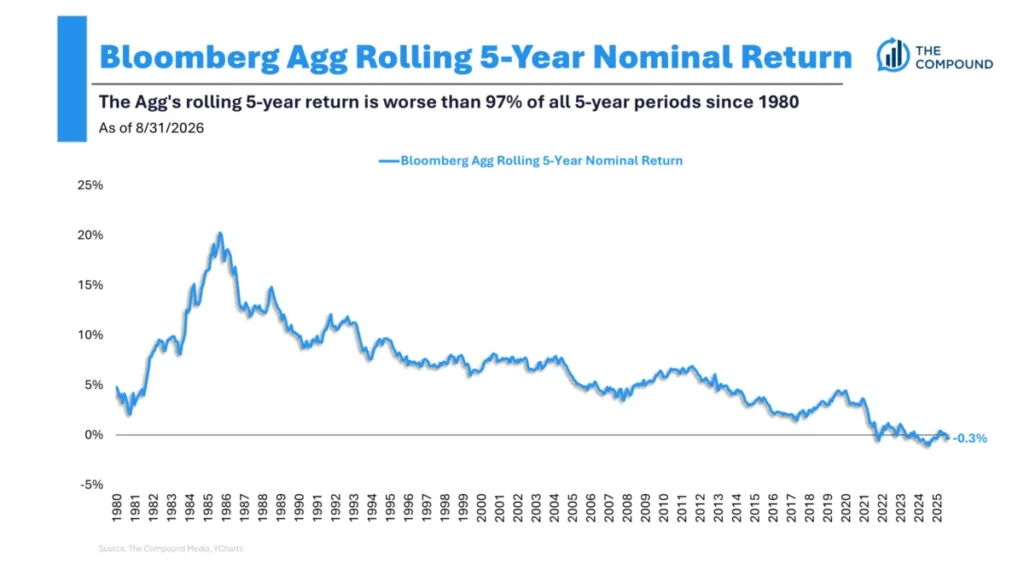
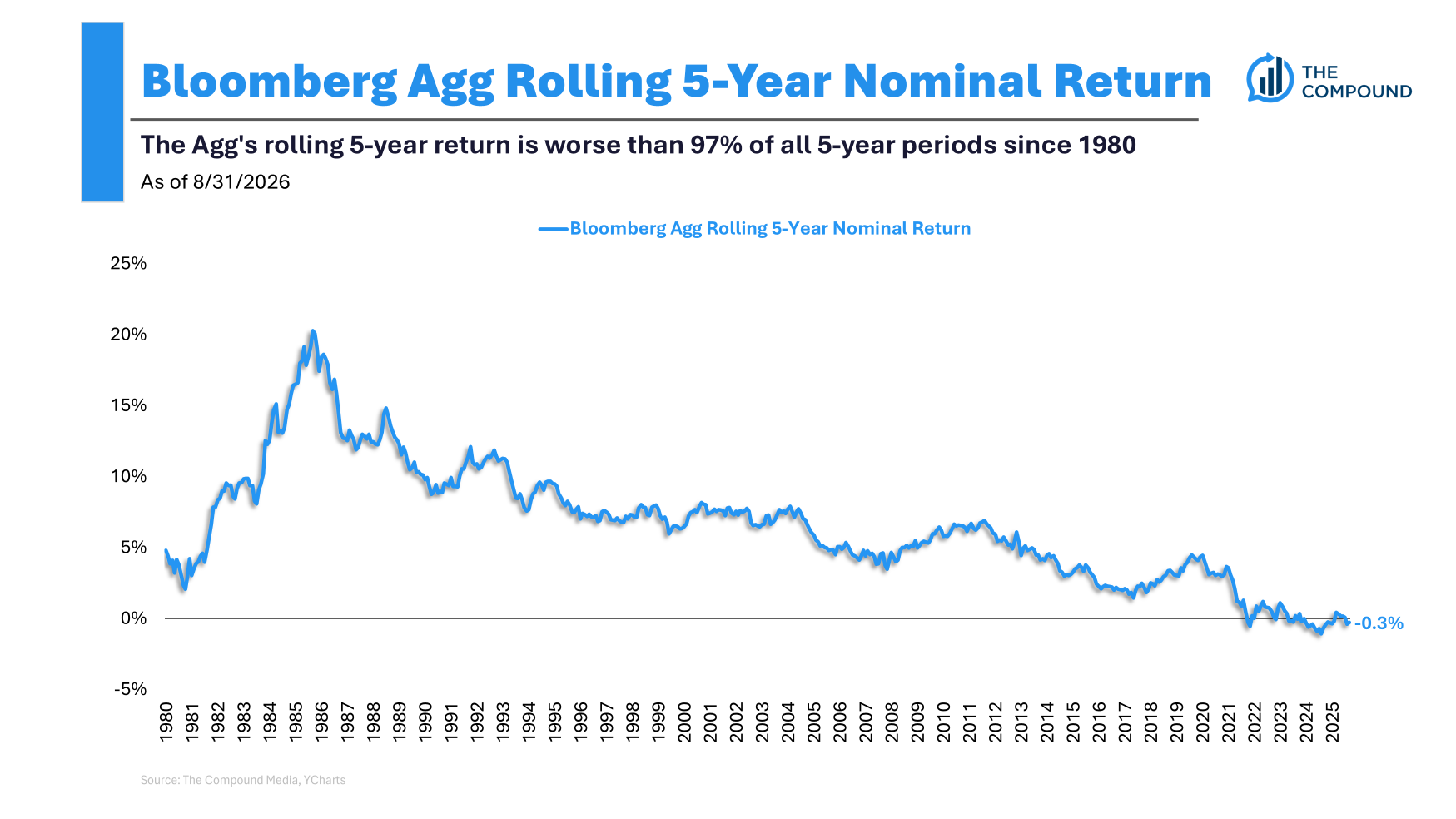
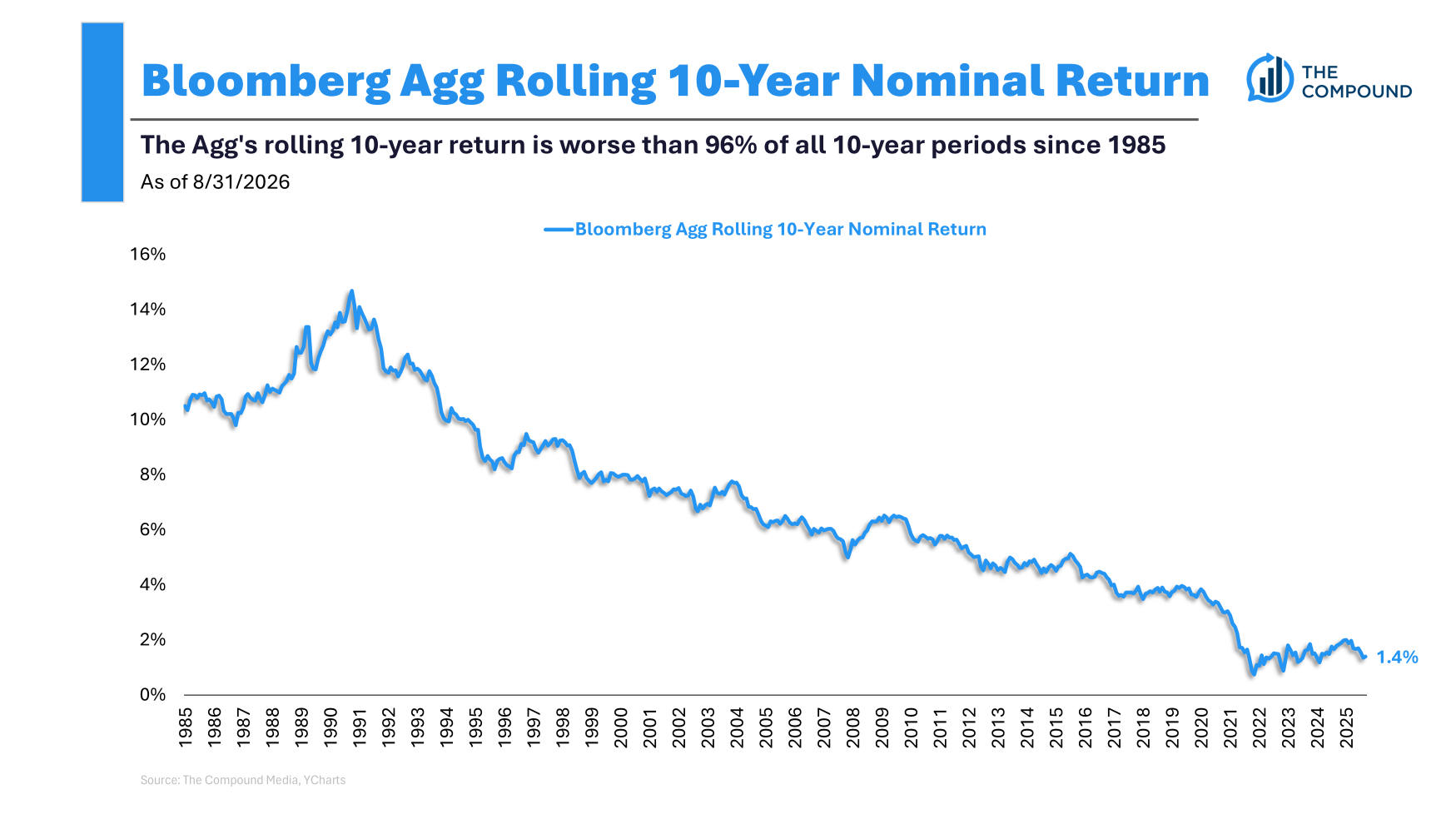
Over the past five- and ten-year rolling periods, total returns for the index have fallen to levels as abysmal as any seen since its backfilled inception date of 1976. Most astonishingly, the current investment cycle marks the first time in the recorded history of the index that rolling five-year returns have dipped into negative territory. While rolling ten-year returns have technically remained positive, bond investors came perilously close to experiencing a "lost decade" during the historic market rout of 2022.
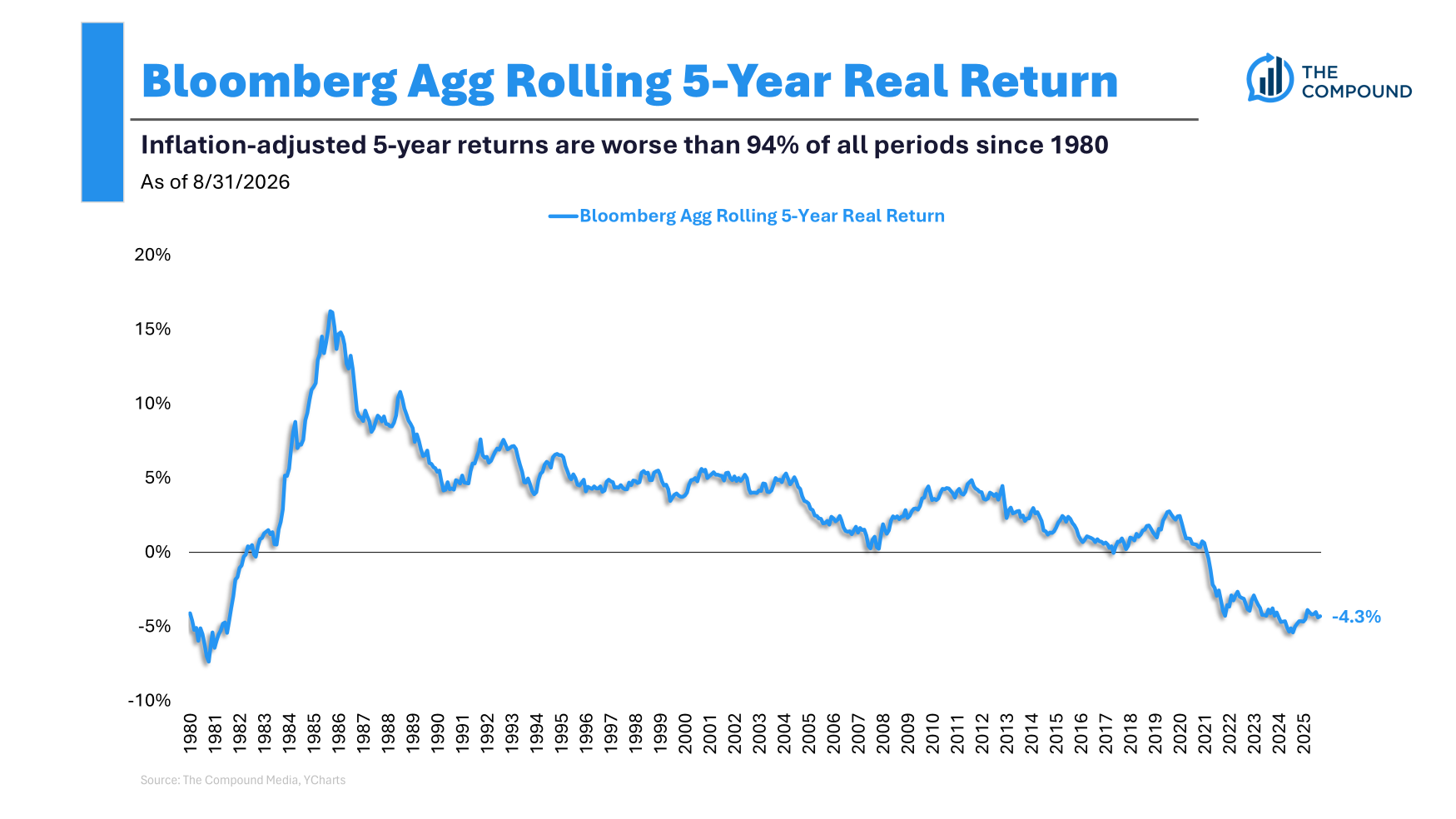
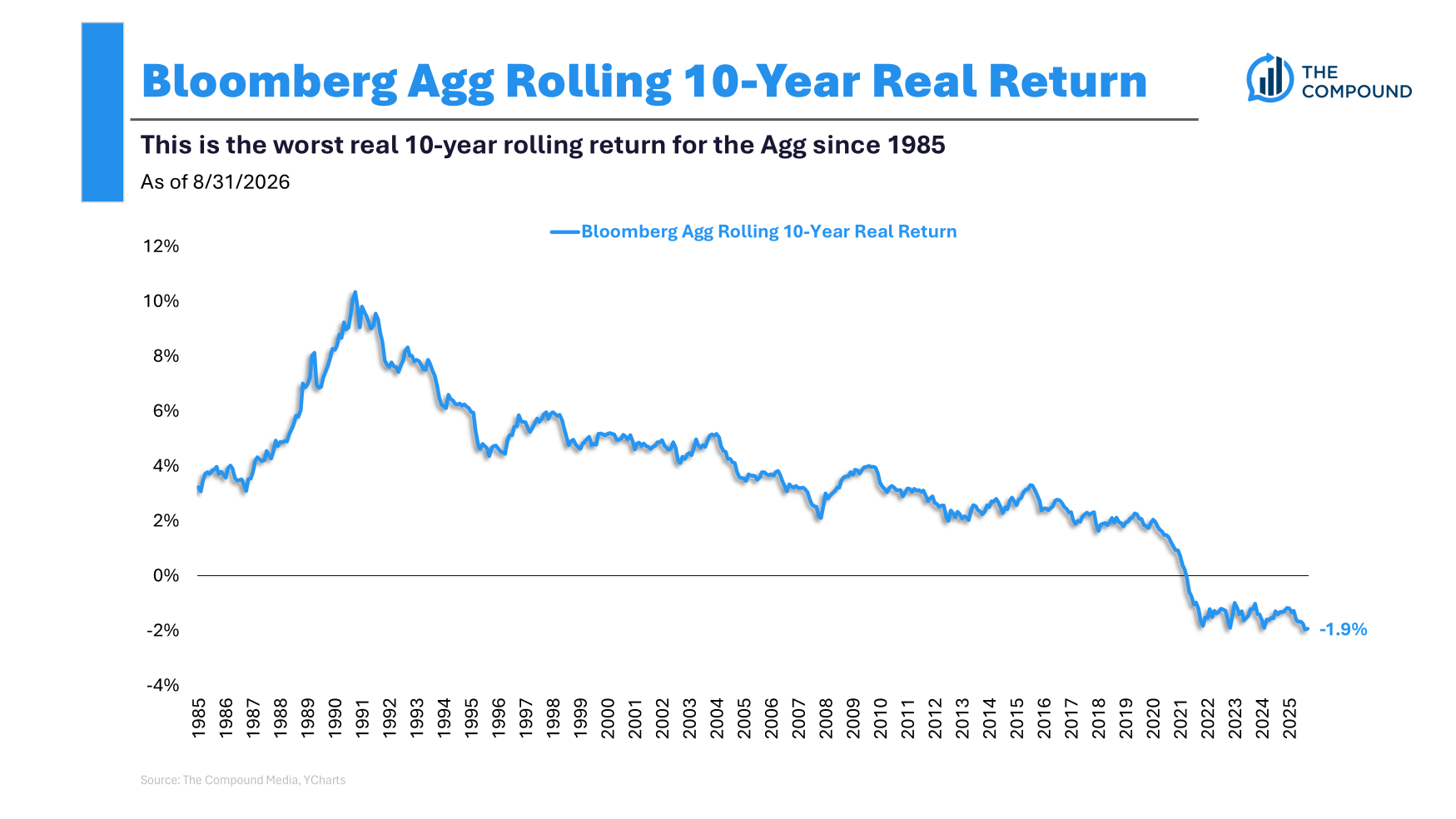
When adjusted for inflation, the picture becomes even grimmer. Real five-year returns during this cycle rivaled the stagflationary shocks of the early 1980s, when consumer prices were compounding at double-digit rates. More alarmingly, current ten-year real returns are sitting at historic lows. After accounting for the corrosive effects of inflation, fixed-income investors have effectively endured a true lost decade—cementing the Agg’s status as arguably the most hated asset class in the global financial landscape.
Chronology: From the Safe Harbors of the 1970s to the Perfect Storm of 2022
To fully comprehend the trauma inflicted upon bondholders over the last several years, it is necessary to examine the historical trajectory of the index. Ironically, the late 1970s and early 1980s—an era universally remembered for runaway inflation and painful economic stagnation—did not witness the same structural destruction in the Agg that investors experienced recently.
The Early Years: Stability Amid Inflation
From 1976 through 1981, despite double-digit inflation prints, the Agg did not register a single negative calendar year. The worst annual return recorded during that tumultuous late-1970s window occurred in 1978, when the index eked out a nominal gain of 1.4%. While real returns suffered, nominal bond prices held their ground because starting yields were substantially elevated, providing a thick financial cushion against rising interest rates.
In fact, the first negative calendar year in the history of the Agg did not materialize until 1994, when aggressive Federal Reserve monetary tightening pushed the index down by a modest 3%. For decades, the structural playbook for bonds remained consistent: steady yields combined with low inflation created a reliable, low-volatility asset class.
The 2020–2022 Watershed Moment
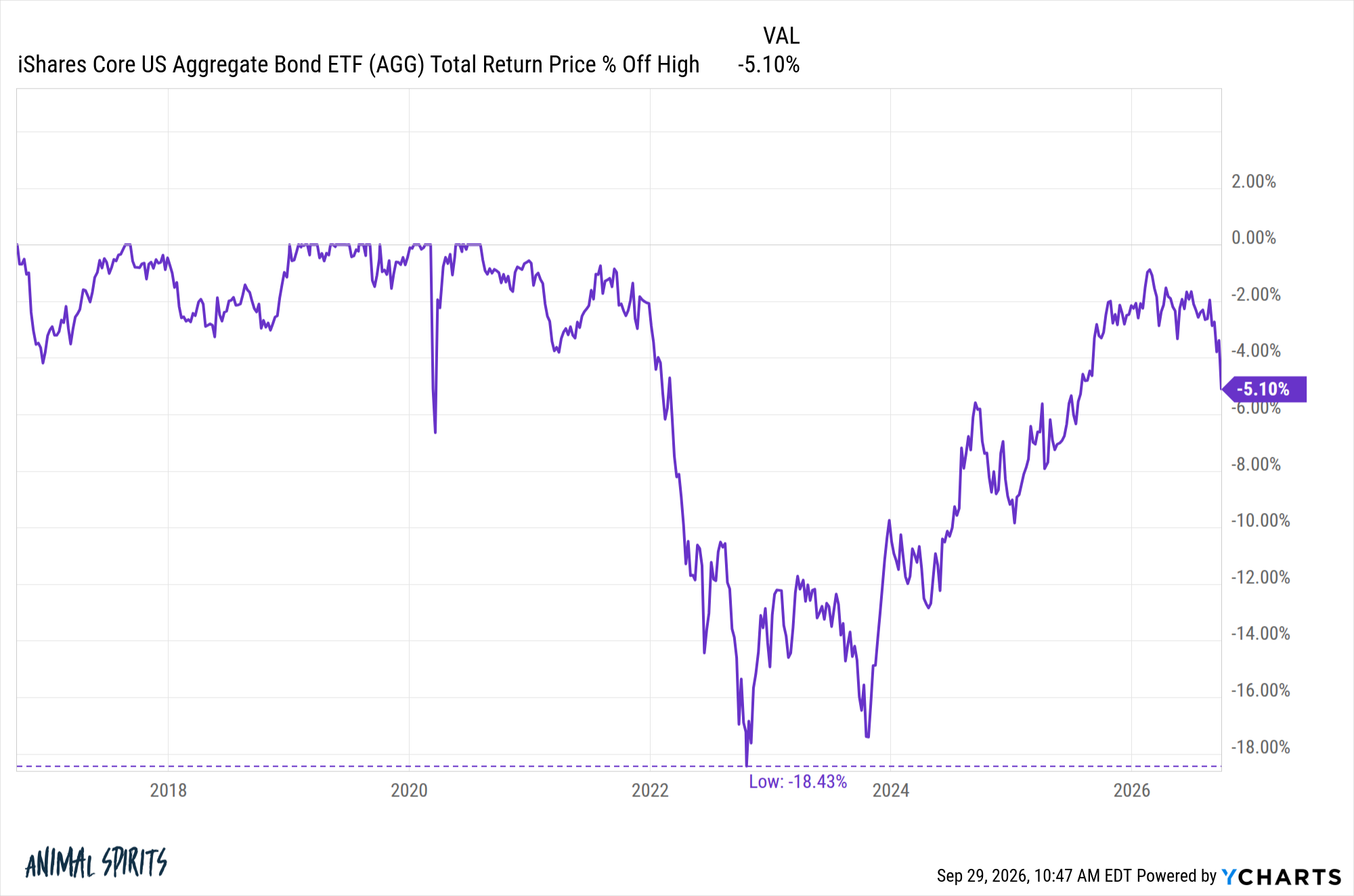
The complacency built over decades of falling interest rates came to a screeching halt as the world emerged from the pandemic-era monetary policies of 2020. As central banks pinned interest rates near zero to combat economic lockdowns, bond yields touched historic floors. When inflation surged back with a vengeance in 2021 and 2022, the Federal Reserve was forced into an aggressive, rapid hiking cycle.
This dynamic triggered a sequence of unprecedented market events:
- 2021: The Agg dropped 1.5%.
- 2022: The index suffered a catastrophic 13% decline—the first double-digit annual loss in its history.
- Back-to-Back Losses: For the first time ever, the Agg posted consecutive negative calendar years in 2021 and 2022.
- The Ultimate Drawdown: Driven from a baseline of microscopic starting yields, the bond bear market that began in 2020 culminated in a peak-to-trough drawdown of nearly 20% for intermediate investment-grade debt—a magnitude of loss virtually unheard of for this asset class.
This compounded disaster was driven by a textbook "triple threat": starting yields that were entirely too low to absorb shocks, an unprecedented velocity of interest rate hikes by global central banks, and stubbornly persistent inflation.
Supporting Data: The Numbers Behind the Rout
The quantitative evidence of the recent fixed-income depression is stark. When analyzing rolling five-year nominal returns through the end of August, the historical distribution curves show a clear structural break. Never before in the nearly fifty-year history of the benchmark has a five-year rolling window ended below the zero line.
Furthermore, the relationship between starting Yield to Maturity (YTM) and forward returns—a historically reliable econometric relationship utilized by portfolio managers for generations—experienced a significant fracture during this decade. Because interest rates rose so far, so fast, and from such an historically depressed starting point, forward returns actually underperformed even the pessimistic baseline expectations implied by low starting yields.
The primary metrics underlying the modern bond market environment include:
- Peak Drawdown: ~20% decline in intermediate investment-grade bonds.
- 2022 Annual Return: -13.0%, the worst single-year performance in the index’s history.
- Average YTM (Current): ~5.5% across the Agg.
- Cash Yields: Stabilized around 4.0%.
- U.S. Government Debt: Yielding in excess of 5.0%.
- Investment-Grade Corporate Bonds: Yielding north of 6.0%.
Despite these grim historical data points, the silver lining embedded within the current data is that forward-looking return expectations have reset dramatically higher.
Official Responses and Market Perspectives: The Futility of Rate Forecasting
As financial markets grapple with this structural reset, commentary from central bankers, institutional strategists, and independent analysts highlights a unifying theme: macroeconomic forecasting remains an exercise in humility.
Federal Reserve officials, whose forward guidance and policy rate projections repeatedly underestimated the persistence of post-pandemic inflation and the necessary velocity of rate hikes, have increasingly emphasized data-dependency over rigid long-term forecasting. Institutional fixed-income managers echo this sentiment, openly acknowledging that predicting the exact trajectory, timing, and magnitude of future interest rate movements is nearly impossible.
Market veterans stress that investors should avoid trying to time interest rate cuts, economic growth cycles, or geopolitical shocks when constructing fixed-income allocations. Instead, expert consensus advises focusing on structural fundamentals: evaluating risk-reward profiles based on current yields, credit quality, duration, and maturity rather than attempting to outguess macroeconomic developments or central bank maneuvers.
Implications: The Silver Lining and the Path Forward for Investors
The brutal lessons of the past decade have left fixed income deeply unpopular among retail and institutional investors alike. Yet, financial history suggests that the asset classes generating the most intense investor fatigue often sow the seeds for the most attractive forward-looking opportunities.
A Return to Meaningful Yields
The most significant implication of the recent bond bear market is the wholesale resetting of global yield curves. After spending more than a decade in a ZIRP (Zero Interest Rate Policy) environment that starved income-seeking investors, the market has undergone a generational regime change.
With the average yield to maturity for the Bloomberg Aggregate Bond Index hovering around 5.5%—and high-grade corporate offerings clearing 6% or higher—fixed-income investors are finally being paid to take risk. Cash equivalents offer approximately 4%, while U.S. government debt provides over 5%.
Navigating Future Volatility
While the prospect of structurally higher or volatile interest rates could trigger additional short-term price adjustments for existing bond portfolios, those potential price drawdowns are now heavily cushioned by substantially higher starting cash flows. In essence, the math of fixed income has flipped back in favor of the investor: every time interest rates tick higher, the baseline expectation for long-term forward returns rises in tandem.
For investors who survived the lost decade of the 2010s and early 2020s, the current landscape offers a rare paradox. The recent past has been undeniably painful, featuring drawdowns and inflation-adjusted losses previously thought unimaginable for aggregate bond indices. However, the future has rarely looked more attractive for those willing to look past recent headline trauma and embrace yields not seen in nearly two decades.