The Crucible of French Education: Inside the Student Protests, the Parcoursup Crisis, and the Automated Divide

By Gabriela Ramos
Published: October 20, 2026
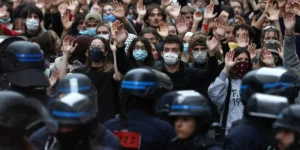
PARIS — Across France, the autumn air has grown thick with the acrid smoke of burning barricades, the thunderous chants of mass demonstrations, and the unmistakable urgency of a generation demanding a fundamental reckoning. For weeks, hundreds of thousands of high school and university students have flooded the streets of Paris, Marseille, Lyon, and dozens of other cities.
While isolated scenes of violence and clashes with riot police—most notably on October 17—have dominated evening newscasts, they tell only a fraction of the story. Beneath the unrest lies a profound and legitimate systemic crisis. French youth are mobilizing against what they view as a crumbling educational infrastructure, chronic underinvestment, and a technological gatekeeper that has come to symbolize their disenfranchisement: Parcoursup, the centralized national university-admissions platform.
As experts note, while automated decision-making algorithms do not inherently invent social and educational inequalities, they act as high-speed catalysts, magnifying pre-existing systemic flaws under the guise of mathematical neutrality.
1. Main Facts: The Anatomy of the French Student Uprising
The current wave of student mobilization is not a sudden, unprovoked flashpoint; it is the culmination of years of mounting frustration with the state of French public education.
The protesters’ grievances are multi-layered, focusing on physical infrastructure, human resources, and digital gatekeeping:
- Infrastructure Collapse: Many public schools and universities across France are suffering from severe structural neglect. Reports of leaking roofs, broken heating systems, mold, and outdated facilities are commonplace, contrasting sharply with the government’s stated commitment to modernization.
- The Teacher Shortage: France faces an acute, persistent shortage of educators. Classrooms are frequently left without permanent teachers for months, leading to cancelled hours, unreplaced leaves of absence, and an over-reliance on unstable, underpaid contract workers.
- Overcrowded Classrooms and Exhausting Schedules: Students describe learning environments where lecture halls are packed far beyond capacity, making personalized attention impossible. Compounding this are grueling, archaic daily schedules that stretch young people to their psychological and physical limits.
- The Parcoursup Lightning Rod: At the center of the student rage is Parcoursup. Replaces the older Admission Post-Bac (APB) system, Parcoursup was designed to streamline the transition from secondary to higher education. Instead, it has become a notorious source of anxiety, widely denounced as an opaque, unpredictable, and profoundly unfair algorithm that reduces human potential to cold, unfeeling data points.
2. Chronology: How the October 2026 Protests Escalated
To understand how a series of localized grievances transformed into a nationwide movement, it is essential to trace the timeline of escalation leading up to the mid-October clashes.
- Early September 2026 (The Return to Class): As millions of students return to school for the autumn term, discontent immediately surfaces. Syndicates and student unions—including the Union Nationale des Lycéens (UNL) and the Unef (National Union of Students of France)—report immediate issues with teacher shortages and deteriorating campus facilities.
- Late September 2026 (Pre-Parcoursup Anxieties): Even months before the next application cycle officially opens, graduating high school seniors voice intense apprehension about university access. Debates flare up regarding the criteria used by higher education institutions to vet candidates through the national portal.
- October 2, 2026 (The First Fires): The first major coordinated demonstrations take place. Videos circulate globally of fires burning near Parisian high schools as students stage walkouts. The core demands center on immediate investments in educational infrastructure and a review of higher education access.
- October 10, 2026 (The Boiling Point over Parcoursup): Investigative reports and student forums heavily scrutinize the mechanics of Parcoursup. Public anger swells as students realize that thousands of applicants in high-demand fields were relegated to waiting lists or forced into undesirable academic tracks during previous cycles due to algorithmic sorting.
- October 17, 2026 (Clashes and Escalation): Demonstrations turn volatile. While the vast majority of protesters march peacefully, pockets of radicalized youth clash with riot police (Compagnies Républicaines de Sécurité, or CRS) in major urban centers. Tear gas, projectiles, and property damage make international headlines, threatening to overshadow the political message of the youth.
- October 20, 2026 (The Stand-Off): Despite government calls for calm and promises of dialogue, student unions vow to maintain pressure. The movement expands beyond immediate logistical demands, morphing into a broader philosophical debate about the future of the French republican model of education.
3. Supporting Data: The Digital Divide and Institutional Strain
To contextualize why Parcoursup has provoked such intense backlash, one must examine the intersection of algorithmic administration and socioeconomic disparity in France.
The Illusion of Algorithmic Meritocracy
Parcoursup evaluates hundreds of thousands of applicants using a combination of high school transcripts (bulletins scolaires), the baccalauréat track records, teachers’ evaluations (fiches avenir), and a mandatory motivation letter (projet de formation motivé).
However, critics and academic researchers point out systemic flaws in how these metrics are processed:
- Subjectivity in Grading: High school grading standards vary wildly across France. A grade of 14/20 in an elite Parisian lycée does not carry the same weight as the same grade in a rural, underfunded institution in the banlieues or overseas territories. While algorithms attempt to account for this via statistical normalization, the adjustments are often viewed as opaque.
- The Black Box Problem: The exact weighting assigned to specific criteria by individual university departments remains largely proprietary and hidden from students. This opacity breeds profound mistrust. Applicants denied entry to their preferred majors are left wondering whether they were rejected due to academic shortcomings or algorithmic bias.
- Socioeconomic Self-Censorship: Studies indicate that students from lower-income backgrounds are significantly more likely to engage in "self-censorship"—avoiding elite preparatory classes (classes préparatoires) or competitive university programs because they assume the automated system will reject them anyway.
The Numbers Behind the Crisis
- Volume: Parcoursup processes applications for over 900,000 candidates annually, sorting them across more than 23,000 distinct higher education formations.
- The Waiting List Anxiety: Historically, tens of thousands of students remain stranded on agonizingly slow waiting lists well into the summer months, throwing their housing, employment, and personal lives into prolonged limbo.
- Investment Gap: According to recent OECD education reports, France’s investment per tertiary student has struggled to keep pace with rising enrollment numbers, resulting in a widening gap between institutional capacity and student demand.
4. Official Responses: Government Stance and Institutional Defense
The French government, caught between the demands of restless youth and the necessity of maintaining administrative order, has adopted a dual strategy of measured conciliation and firm law-and-order rhetoric.
The Ministry of Education’s Defense
Representatives from the Ministry of Higher Education and Research have consistently defended Parcoursup as a necessary modernization tool. Officials argue that:
- Transparency Has Improved: Over successive iterations, the platform has integrated features designed to show applicants the general profile of accepted students in previous years, helping them make more realistic choices.
- Eliminating Human Bottlenecks: Without an automated preprocessing system, the sheer volume of nearly one million applications would completely paralyze university administrative boards, rendering admissions physically impossible within the academic calendar.
- Fairness Through Criteria: The platform’s defenders argue that by standardizing the evaluation process, Parcoursup reduces the potential for human nepotism and institutional bias that characterized older, decentralized admissions models.
Condemnation of Violence
Concurrently, government ministers have drawn a sharp line between legitimate social protest and property destruction. Interior Ministry officials condemned the violence of October 17, emphasizing that while the right to demonstrate is constitutionally protected, vandalism, arson, and attacks on law enforcement will be met with swift judicial consequences.
Presidential spokespersons have signaled a willingness to open regional dialogues with student representatives, focusing specifically on facility modernization budgets and teacher recruitment drives, while firmly refusing to scrap the admissions platform outright.
5. Implications: What the Protests Mean for the Future of France
The October 2026 protests transcend the immediate grievances of school repairs and university sorting algorithms. They touch upon fundamental questions regarding the social contract in France, the future of the republican model of education, and the ethics of digital governance.
1. The Crisis of the Republican Ideal
For generations, the French educational system was viewed as the ultimate engine of social mobility—the great equalizer where background mattered less than intellect and hard work. When students feel that crumbling classrooms and opaque algorithms are locking them into predetermined socioeconomic tracks, the foundational myth of the Republic fractures. The anger on the streets is, at its core, a desperate defense of the promise of equal opportunity.
2. The Ethics of Automated Governance
The Parcoursup controversy serves as a cautionary tale for modern democracies attempting to digitize public services. Efficiency must not come at the expense of human dignity and comprehensibility. As algorithmic decision-making expands into welfare distribution, healthcare, and education across Europe and the globe, the demand for "explainable AI" is no longer just a technical preference—it is a political necessity. If citizens cannot understand why a decision affecting their life path was made, trust in democratic institutions collapses.
3. Political Fallout for the Administration
For the ruling government, the handling of the student crisis represents a severe political test. Failing to address the material conditions of schools risks entrenching a permanent youth opposition movement. Conversely, capitulating entirely to demands to dismantle modern administrative tools without a viable alternative could lead to bureaucratic gridlock.
As the autumn leaves fall over Paris and the demonstrations continue to reverberate, one reality remains starkly clear: France’s youth are no longer willing to quietly accept a system they perceive as broken. Whether the state can adapt quickly enough to restore their trust will define the trajectory of the nation’s educational and political landscape for years to come.