The Great Fixed Income Reappraisal: Why Investors Are Finally Falling Back in Love with Bonds
Main Facts: The Return of Yield in a Changing Market
For the better part of two decades, fixed-income investing was largely treated as an afterthought. Following the tumultuous years of the 2008 Global Financial Crisis, central banks around the globe drove interest rates to historic lows, culminating in an era of near-zero and, in some international markets, negative yields. For younger investors who entered the markets after 2009, bonds appeared to be a relic of a bygone financial era—assets that offered "return-free risk" rather than a safe haven.
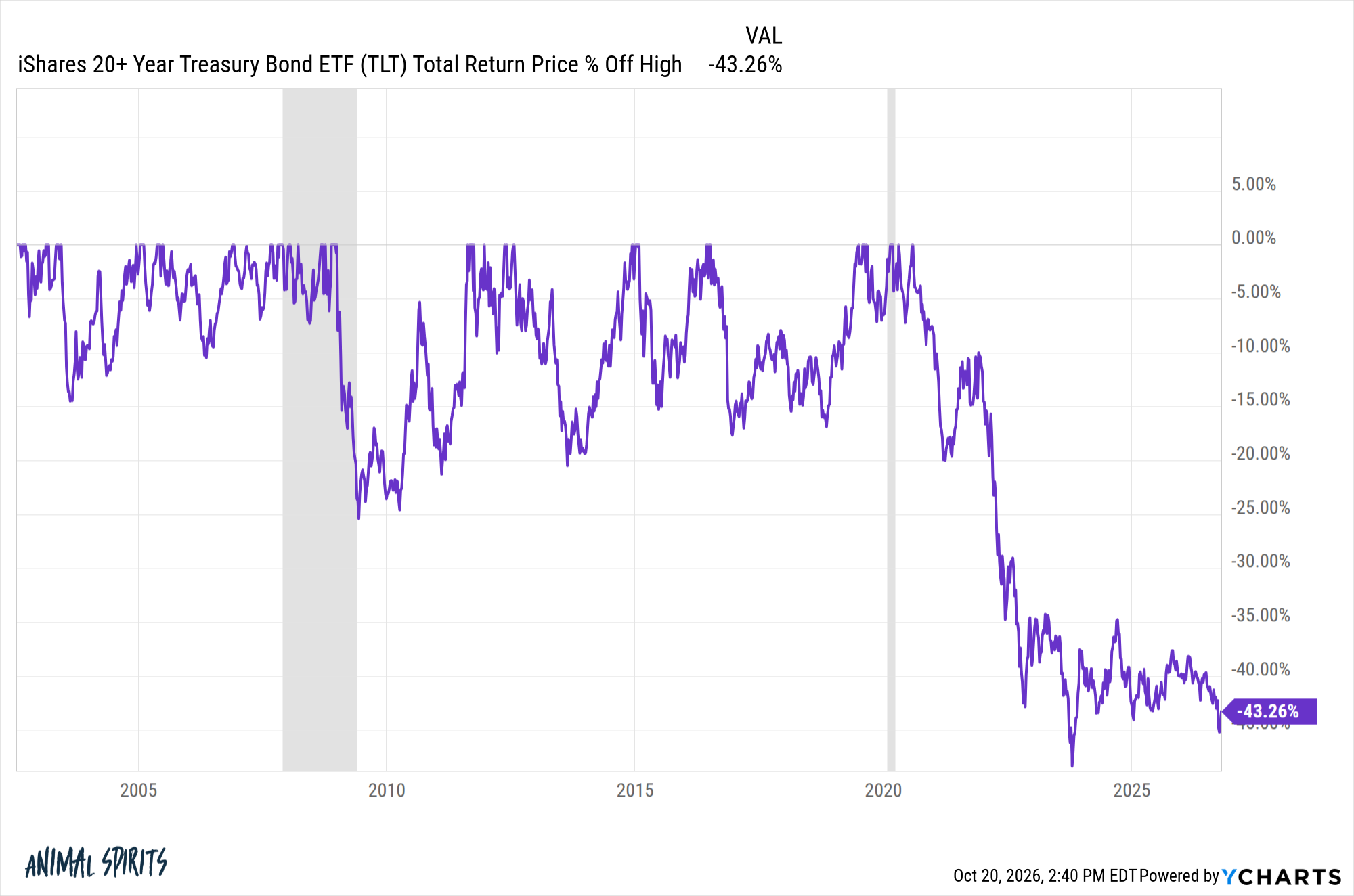
However, the macroeconomic landscape has experienced a seismic shift. Driven by unprecedented government spending, massive post-pandemic supply chain shocks, sticky multi-decade-high inflation figures, and an aggressive federal funds rate-hiking campaign by the Federal Reserve, the bond market suffered the worst bear market in modern financial history.
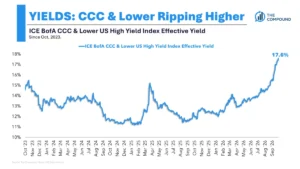
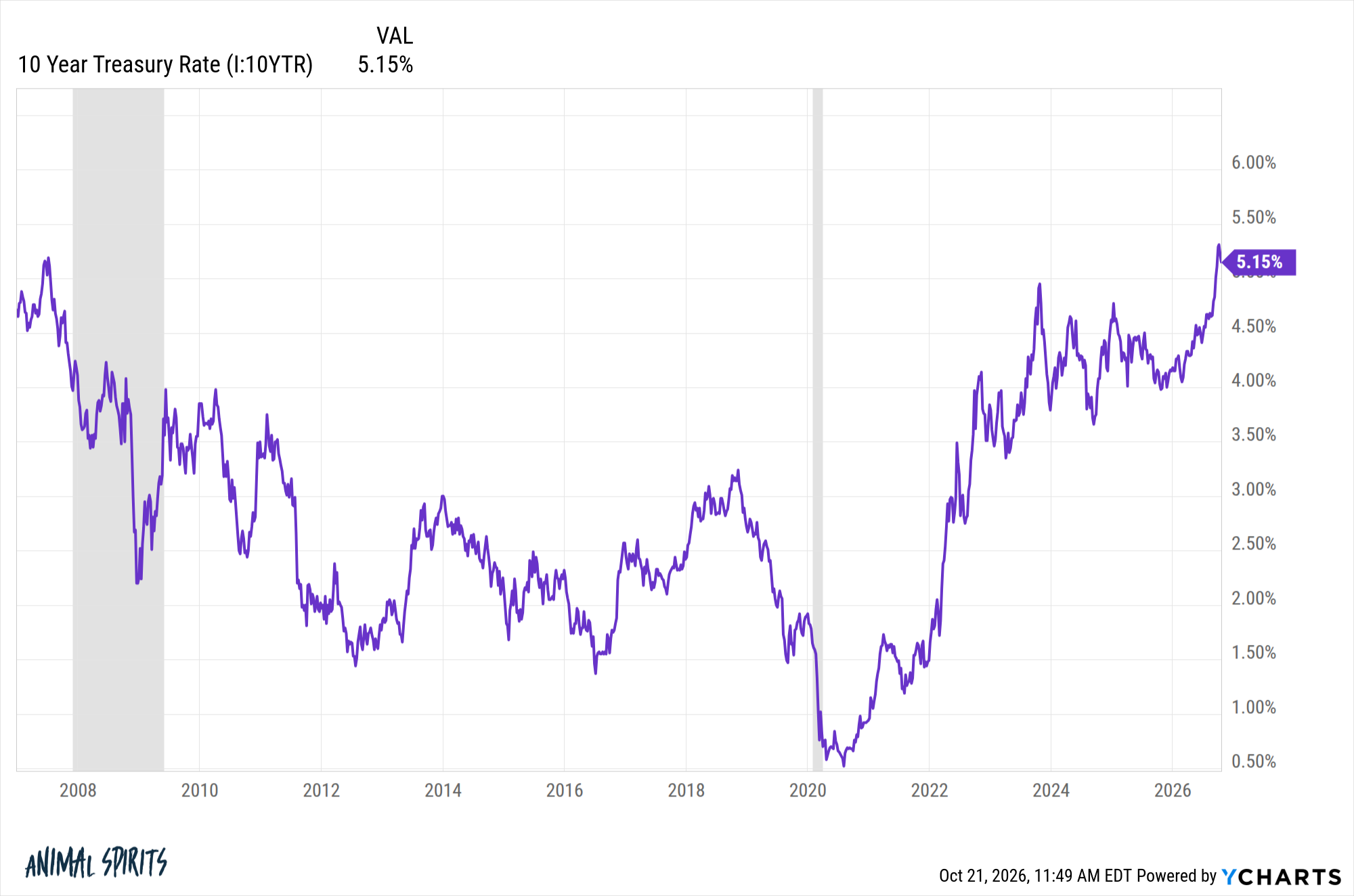
Yet out of the ashes of this historic fixed-income rout, a compelling new reality has emerged: bond yields have climbed to levels not seen since 2007. For the first time in nearly twenty years, investors are looking at a market where bonds actually pay meaningful income. This environment has sparked a broader cultural and strategic conversation across the financial community—exemplified by seasoned market commentators publicly admitting to purchasing bonds for the first time in their careers—prompting everyday investors to rethink portfolios traditionally dominated entirely by equities.
Chronology: From the 40-Year Bull Market to the Modern Fixed-Income Abyss
To understand how the fixed-income market arrived at this psychological and economic turning point, it is vital to trace the historical timeline of interest rates and investor sentiment over the past half-century.
1. The Era of Disinflation and the 40-Year Bond Bull Market (Early 1980s–2007)
The story of modern bonds truly begins in the early 1980s. Under Federal Reserve Chair Paul Volcker, interest rates skyrocketed to combat runaway inflation, with the 10-year Treasury yield peaking well into double digits. This high starting point kicked off a legendary 40-year bull market for bonds. As global inflation steadily decelerated over the decades, interest rates marched downward. Because bond prices move inversely to interest rates, falling yields generated tremendous capital appreciation for fixed-income investors, making bonds a stellar and reliable asset class.
2. The Post-Crisis Zero-Rate Experiment (2008–2019)
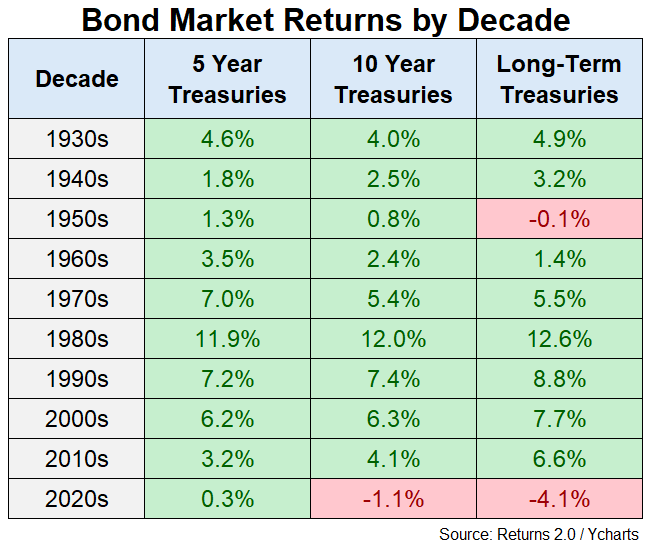
The 2008 financial crisis shattered traditional economic frameworks. Central banks slashed benchmark interest rates to zero and deployed quantitative easing (QE) on a massive scale. While long-term bonds provided a brief, glittering hedge during the initial 2008 equity crash, the subsequent decade locked yields near zero. For millennial and younger investors building wealth during the 2010s, allocating capital to bonds made virtually no mathematical sense when broad stock market indices could be bought at lower and lower prices during dips, followed by an epic, uninterrupted equity bull run.
3. The Pandemic Shock and the Worst Bond Bear Market in History (2020–2023)
The COVID-19 pandemic triggered an extraordinary fiscal and monetary response. Trillions of dollars injected directly into the economy, combined with severe supply chain disruptions, ignited an inflation wave that peaked near 9%. To combat this, the Federal Reserve executed one of the fastest rate-hiking cycles in its history. Because starting yields were practically at zero, the sudden spike in interest rates inflicted catastrophic losses on fixed-income portfolios. Long-term bonds, in particular, were decimated, handing investors the worst drawdown profiles since the inception of modern financial tracking.
4. The Yield Renaissance (2024–Present)
Today, the paradigm has flipped. With the Fed maintaining a higher-for-longer stance to anchor inflation, base yields on short- to intermediate-term paper sit comfortably in the 4% to 5.5% range. For an entire generation of investors, these figures represent unchartered territory—turning fixed income from a yield desert into a viable cornerstone of asset allocation.
Supporting Data: Understanding Duration, Volatility, and Expected Returns
Evaluating whether to allocate capital to bonds requires an analytical look at the mechanics of fixed income, specifically concerning duration risk and historical yields.
The Dangers of Duration Risk
Not all bonds are created equal, and financial professionals draw a sharp line between short-, intermediate-, and long-term debt instruments. The primary metric governing this distinction is duration—a financial term measuring a bond’s sensitivity to interest rate changes.
Duration acts as a rough prognosticator of price volatility. For instance, a bond fund with a duration of 5 years will theoretically see its price drop by roughly 5% if interest rates rise by 1%. Conversely, long-term Treasury funds (such as the iShares 20+ Year Treasury Bond ETF, ticker TLT) frequently carry durations extending past 15 years. This means a 1% upward bump in interest rates can trigger a gut-wrenching 15% drop in principal value.
Because of this extreme volatility, many conservative and intermediate-term investors steer clear of long-term bonds. As financial analysts note, investors should only take on volatility when they are explicitly being paid a risk premium to do so. In recent years, the risk-reward profile of long-term bonds failed to justify the wild price swings, driving capital toward intermediate options maturing in five years or less.
The Power of Starting Yields
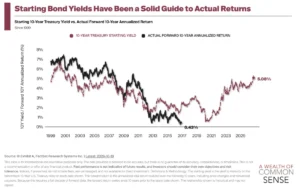
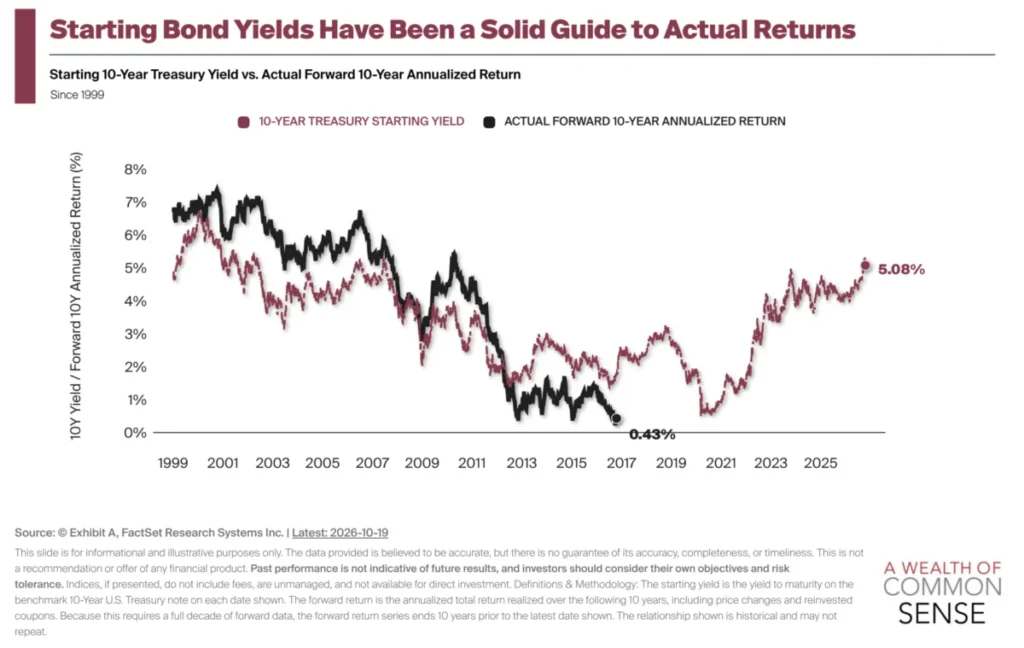
Empirical data demonstrates that future bond returns track starting yields with remarkable accuracy. Because current yields sit at multi-decade highs not witnessed since the era before Apple launched the iPhone, expected forward returns for fixed income are exceptionally robust.
Furthermore, data tracking rolling 10-year annualized Treasury returns highlights that the modern fixed-income landscape has finally emerged from the trough of the 2010s. This provides a natural cushion—or margin of safety—that protects portfolios against future macroeconomic turbulence.
Official Responses and Expert Perspectives: Rebalancing the Modern Portfolio
Financial advisors, wealth managers, and everyday retail investors are increasingly grappling with how to adjust portfolios that have relied entirely on broad-based equity index funds for the last fifteen years.
The Shift in Middle-Aged Wealth Management
For a 38-year-old investor with 100% of their net worth tied up in equity index funds, the question of whether to buy bonds is rarely about abandoning stocks; it is about portfolio evolution. Wealth management consensus highlights that life stages dictate strategy. While a young professional in their twenties can safely ignore fixed income in pursuit of maximum equity compounding, reaching middle age often brings shifting financial goals—ranging from intermediate savings targets (such as funding home renovations, college tuition, or real estate down payments) to the fundamental need for risk mitigation.
Strategic Diversification vs. Market Timing
Leading financial commentators emphasize that introducing bonds into a portfolio should not be driven by an attempt to time the stock market or predict interest rate movements.
- The Bear Case for Prediction: No one can reliably predict whether the equity bull market will continue unabated, nor can anyone forecast whether persistent government spending, artificial intelligence capital expenditure, and sticky inflation might push bond yields even higher.
- The Case for Risk Management: Responsible risk management does not rely on foresight; it exists precisely because the future is unknowable. Buying intermediate, tax-efficient bonds yielding 5.5% in a brokerage account provides "dry powder" for future market downturns, produces reliable income, and dampens overall portfolio volatility without requiring investors to abandon their equity growth engines in retirement accounts.
Implications: What Higher Yields Mean for the Next Decade of Investing
The resurgence of the bond market carries profound implications for individual financial planning, institutional asset allocation, and broader macroeconomic stability.
1. The Death of "TINA" (There Is No Alternative)
For over a decade, TINA ruled the markets. Because cash and bonds yielded virtually nothing, investors poured every available dollar into equities, driving valuations to historic highs. The return of attractive bond yields changes this calculus entirely. Investors now have a viable, low-risk alternative to stocks, which could temper speculative excesses in equity markets and restore traditional balance to multi-asset portfolios.
2. Redefining Retirement Readiness
For retirement planners, the return of 5% yields makes building predictable income streams vastly easier. Savers no longer need to take on hazardous equity-like risks in their late-stage accumulation years just to generate enough cash flow to beat inflation.
3. A Return to Balanced Portfolios
The 60/40 portfolio (60% stocks, 40% bonds) took a severe PR beating during the dual stock-and-bond crash of 2022. Critics loudly proclaimed the traditional balanced portfolio dead. However, with bond yields normalized, the foundational premise of the 60/40 model—uncorrelated assets providing a cushion during equity drawdowns while generating steady income—has been forcefully revitalized.
Ultimately, whether an investor decides to rebalance depends on personal risk tolerance and financial timelines. But for an entire generation that grew up believing bonds were financially obsolete, the current market offers a rare opportunity: fixed income that actually fixes income.