The Silent Sentinel: Why Financial Institutions Must Evolve Their Cybersecurity Architecture in the Age of AI
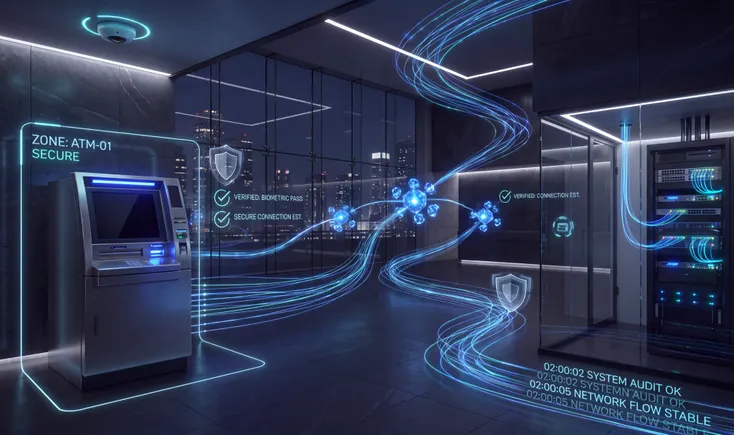
It is 2 a.m. The bank branch is dark, save for the rhythmic, low-frequency hum of a lobby ATM and the faint, blinking red eye of a security camera in the corner. Miles away, in a virtual server cluster, an autonomous AI agent is silently processing a massive batch of overnight fraud scores.
While these entities are technically within the bank’s "trust boundary," they exist in a state of operational isolation. They are managed as separate security problems, governed by disparate policies, and monitored through fragmented tools. In an era where the velocity of financial transactions is measured in milliseconds and the sophistication of cyber-adversaries is reaching unprecedented levels, this fragmentation is no longer just a technical hurdle—it is a systemic risk. As banks increasingly rely on AI-driven automation and sprawling Internet of Things (IoT) ecosystems, the "bolt-on" approach to cybersecurity has reached its expiration date.
Main Facts: The New Reality of the Financial Attack Surface
The modern banking environment has shifted from a human-centric model to one dominated by machine-to-machine interactions. However, the security infrastructure has lagged behind this transformation.
The core challenge lies in the "unmanaged attack surface." Devices like ATMs, badge readers, and IoT sensors are essential to branch operations, yet they are fundamentally incapable of running traditional, memory-intensive security features such as endpoint detection and response (EDR) or host-based firewalls. These devices lack the processing power and modern OS overhead required for standard endpoint protection, leaving them as permanent, quiet vulnerabilities in the network fabric.
Compounding this is the rise of autonomous AI agents. These agents operate without human intervention, accessing sensitive financial systems and executing API calls at machine speed. Because they do not fit the traditional mold of a "user" or a "device," they create "unlisted" entry points—blind spots that attackers are already beginning to exploit. Financial institutions are realizing that simply piling more security controls onto a legacy network architecture is akin to adding deadbolts to a house with a rotting foundation: it provides a false sense of security while ignoring the fundamental structural failure.
Chronology of a Cybersecurity Shift
To understand why the current approach is failing, one must look at the evolution of the banking perimeter:
- The Era of the Hard Shell (1990s–2010): Banks operated on a "castle-and-moat" strategy. Everything inside the branch network was considered trusted. Security was focused on the perimeter, with heavy reliance on firewalls at the edge.
- The Proliferation Phase (2010–2020): The rapid adoption of IoT and mobile banking expanded the perimeter. Banks responded by adding specialized security tools for every new category of technology. This created "silos of visibility" where the ATM team, the network team, and the AI/Cloud team rarely spoke the same security language.
- The AI and Hyper-Connectivity Era (2020–Present): The introduction of AI agents and hyper-scale automation has rendered manual, siloed management impossible. The sheer volume of traffic and the autonomous nature of AI agents mean that human-led oversight is no longer fast enough to stop a breach in progress.
Today, the industry is transitioning toward Network-Fused Security. This shift marks a move away from secondary security appliances toward a model where the network infrastructure itself acts as the primary security enforcement point.
Supporting Data: The Cost of Complexity
The financial services sector is currently grappling with a crisis of confidence in its own architecture. According to industry research, 79% of financial services professionals acknowledge that AI has significantly expanded their network’s attack surface. Furthermore, 85% of institutions have already implemented new security controls specifically tailored for AI workloads.
While these numbers indicate an awareness of the problem, they also highlight a dangerous trend of "control bloat." Adding layers of middleware and inspection appliances creates significant technical debt. Specifically:
- Latency Penalties: Routing traffic through centralized inspection appliances introduces millisecond delays. In high-frequency trading or real-time fraud detection, these milliseconds are the difference between a successful block and a fraudulent transfer.
- Complexity as a Liability: Each new security appliance adds a potential point of failure. When an update to an AI agent conflicts with an update to a legacy firewall, the result is often system downtime, which is as damaging to a bank’s reputation as a security breach.
Official Responses and Strategic Implications
Industry leaders and security architects are now calling for a fundamental redesign. The consensus is shifting toward the concept of "Fused Security," where security is baked into the switches and routers themselves rather than being bolted on as an afterthought.
Action Control vs. Access Control
Historically, Zero Trust was defined by "who can access the network." In the new banking paradigm, it must be redefined as "what an entity is allowed to do."
This requires microsegmentation for physical devices—ensuring that a security camera, for instance, is physically unable to communicate with anything other than its designated recorder. For AI agents, this must be even more granular. It requires governing individual API calls and tool requests. If an AI agent is designed to summarize transaction history, the network must be intelligent enough to detect and block that same agent if it attempts to execute a fund transfer—even if the agent’s credentials have been compromised by an attacker.
The Compliance Mandate
Regulatory bodies (such as the SEC, GDPR, and various global banking authorities) are increasingly demanding continuous, real-time proof of resilience. Traditional monitoring is failing here because it cannot track what it cannot see.
Because IoT devices cannot run endpoint agents and AI agents operate without traditional asset tags, they are essentially invisible to auditors. By integrating network telemetry directly into the security operations center (SOC), banks can create a unified, immutable audit trail. Every action—human or machine—is logged against specific policies in real-time. This provides the "defensible, continuous audit trail" that regulators now require, moving compliance from a quarterly "fire drill" to a perpetual state of readiness.
The Network as the New Trust Officer
The final implication of this architectural shift is the elevation of the network to the role of "Trust Officer." While data scientists will always be required to validate AI models and compliance officers will continue to oversee governance, the network provides the necessary secure execution environment.
By utilizing an AI-ready, secure network architecture, banks can turn their infrastructure into a "unified witness." This visibility allows for:
- Uniformity: The same security policy is enforced whether the request originates from a teller’s terminal, a lobby ATM, or an autonomous AI script.
- Resilience: By eliminating single points of failure (like centralized inspection appliances), the network remains operational even under high stress.
- Competitive Advantage: Banks that can securely innovate faster than their competitors—by safely deploying AI agents and IoT infrastructure—will inevitably capture more market share.
In the final analysis, the goal is to transform the branch from a collection of isolated risks into an extension of the bank’s digital business. As AI agents and IoT devices multiply, the network is the only control point that possesses the necessary visibility to govern this new, complex reality. By fusing security into the fabric of the network, financial institutions can stop playing a game of catch-up with attackers and instead build an environment where security and innovation exist in perfect equilibrium.
The branch may be empty at 2 a.m., but the network is working—and for the modern bank, that network is the most important employee on the payroll.