Mid-Air Terror: How Heroic Passengers Averted a Catastrophic Pilot-Led Hijacking Over Saudi Arabia
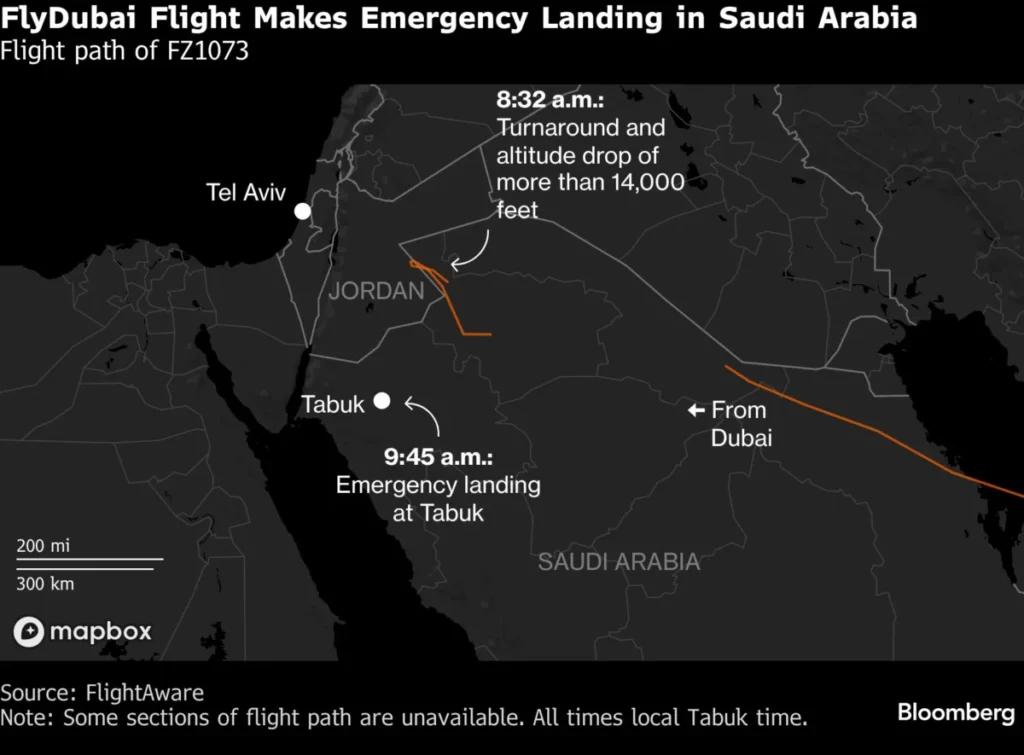
In a harrowing incident that has sent shockwaves through the global aviation community and Middle Eastern political circles, a Flydubai flight bound for Tel Aviv became the scene of an attempted mass-casualty event when a pilot allegedly attacked his colleague and attempted to force the aircraft into a terminal dive. The Boeing 737 MAX 8, carrying more than 170 passengers, narrowly avoided disaster only after a frantic, last-ditch effort by passengers and crew members to storm the cockpit and regain control of the plummeting jet.
The incident, which took place approximately two hours into the flight from Dubai, resulted in an emergency landing in Tabuk, Saudi Arabia. While the physical safety of the passengers has been largely secured, the event has sparked an intense international investigation and raised profound questions regarding cockpit security and the mental health protocols governing commercial aviation.
A Chronology of Terror: 30 Seconds of Chaos
The flight, which had departed Dubai without incident, was cruising at a standard altitude when the cabin environment shifted from routine travel to sheer terror. According to flight data retrieved from Flightradar24, the aircraft experienced a sudden and violent departure from its flight path. In less than 30 seconds, the jet plunged more than 14,000 feet (4,300 meters), descending at a rate that brought the aircraft perilously close to the speed of sound.
The aerodynamic stress of this maneuver was so severe that unverified imagery of the aircraft, taken after it eventually touched down in Tabuk, appears to show the rudder on the vertical stabilizer missing—a structural failure consistent with the airframe being pushed beyond its design limits during the aggressive descent.
"They prevented a huge disaster," Israeli Prime Minister Benjamin Netanyahu stated during a briefing on Wednesday. "Those who intervened displayed exceptional resourcefulness and courage. They saved many lives."
The chronology of the crisis indicates that as the plane began its rapid descent, the cockpit was locked in a life-or-death struggle. The attacker, whose identity remains withheld by authorities, reportedly stabbed his fellow pilot, leaving the flight controls vulnerable. As the aircraft entered a terrifying dive, a combination of passengers and crew members managed to breach the cockpit door. Their intervention allowed them to stabilize the jet just moments before it would have likely impacted the desert floor.
Following the stabilization of the aircraft, the crew transmitted a general emergency distress signal, followed immediately by an "unlawful interference" code—the universal aviation signal for a hijacking. The flight, which had briefly entered Jordanian airspace, executed a sharp 180-degree turn, heading southwest toward Tabuk, where it made a successful, albeit high-tension, emergency landing.
Aviation Safety and the Shadow of Pilot Suicide
The incident has reignited a somber debate regarding the "insider threat" in aviation. While aircraft security has been significantly hardened since the September 11, 2001, terrorist attacks, the focus has largely been on preventing external actors from gaining entry to the flight deck. The prospect of a pilot—a trusted professional—turning against his own aircraft remains one of the industry’s most difficult vulnerabilities to mitigate.
Aviation historians and safety experts have pointed to a disturbing, albeit rare, pattern of "murder-suicide" events in the sky. The 2015 Germanwings Flight 9525 tragedy, where a pilot locked his colleague out of the cockpit and intentionally flew an Airbus A320 into the French Alps, remains the most infamous modern example. All 150 people on board perished in that incident.
Similarly, the mystery surrounding Malaysia Airlines Flight 370 in 2014, while never officially concluded, is widely viewed by investigators as a potential pilot-initiated event. Furthermore, the memory of the 2025 Air India crash—which claimed 241 lives in the air and 19 on the ground—remains fresh, with preliminary reports still investigating the possibility of pilot tampering as a contributing factor.
The Flydubai incident adds a new, terrifying dimension to these discussions. If a pilot is determined to destroy the aircraft, the current "two-person rule" in the cockpit—often intended to prevent exactly this scenario—can be subverted if the second pilot is incapacitated or caught off-guard by a surprise attack.
Official Responses and Diplomatic Cooperation
The aftermath of the landing in Tabuk saw a swift, if complex, diplomatic response. Saudi authorities immediately detained the attacker, who is currently being questioned. Because the flight originated in Dubai and was destined for Tel Aviv, the incident necessitated high-level coordination between the UAE, Israel, and Saudi Arabia—a diplomatic challenge in a region where geopolitical tensions remain high.

"The underlying reasons and motives behind this event are unknown and remain subject to a formal investigation," Flydubai said in an official statement. The airline has confirmed that it is working closely with relevant Saudi and Emirati authorities to assist in the investigation.
Israel’s Transportation Ministry and the Prime Minister’s office have been working around the clock to ensure the safety and return of the passengers. A repatriation flight was dispatched to Saudi Arabia to collect the stranded travelers, who were finally flown to Tel Aviv after a harrowing ordeal.
"All measures are currently being deployed in order to return the Israeli passengers safely to Israel," the Prime Minister’s office confirmed. The rapid resolution of the repatriation effort is seen as a sign of the evolving normalization of ties between Israel and regional neighbors, though the incident has certainly tested these delicate relationships.
Implications for the Israeli Election and Beyond
The timing of the hijacking attempt could not be more significant for Israeli domestic politics. With Prime Minister Benjamin Netanyahu currently campaigning for reelection on a platform centered on "tough security," the incident provides a vivid, real-time example of the dangers he claims to be combating.
Netanyahu’s political rivals, however, are also emphasizing safety as their primary mandate, specifically focusing on the continued threat posed by Iran and its network of proxy militias. Analysts suggest that while the attempted hijacking may help solidify Netanyahu’s image as a leader capable of handling high-stakes security crises, it also places the focus of the election squarely on the vulnerabilities of the Israeli public.
Beyond politics, the aviation industry faces a reckoning. The fact that an aircraft could be pushed into a near-terminal dive by a single individual has triggered calls for a re-evaluation of cockpit access systems and psychological screening processes for commercial pilots.
The Future of Air Travel Security
Since the 1970s, when high-profile hijackings were more frequent, the aviation industry has developed a robust system of international protocols. Israel, having experienced its own share of aviation security crises in the 20th century, has long maintained some of the strictest airport security measures in the world.
The success of the Flydubai-Tel Aviv route, which began in 2020 following the Abraham Accords, has been a symbol of the "new Middle East," with the UAE becoming a premier destination for Israeli tourists. With 70 weekly flights currently operating, the sheer volume of air traffic makes the threat of a rogue pilot or a security breach even more concerning.
As the investigation in Saudi Arabia continues, the global aviation community waits for answers. What drove a commercial pilot to betray his oath and risk the lives of 170 people? Was this an act of political extremism, a sudden mental health crisis, or something more sinister?
For the passengers who survived, the memory of those 30 seconds—the violent descent, the sudden silence of a plummeting plane, and the frantic battle for the controls—will undoubtedly last a lifetime. For the rest of the world, the event serves as a stark reminder that even in an era of advanced technology and rigorous safety protocols, the human element remains the most unpredictable variable in the sky.
The investigation is ongoing, and as details emerge, regulators worldwide will likely be pressured to implement new safeguards to ensure that the cockpit remains a place of safety, not a potential theater of war.