The Precision of Planning: Navigating the Top Retirement Calculators for Financial Security

Retirement planning is arguably the most significant financial project an individual will undertake in their lifetime. Whether you are decades away from leaving the workforce or hovering on the precipice of your golden years, the difference between a comfortable retirement and financial instability often comes down to the quality of your projections. Online retirement calculators and planning software serve as the modern compass for this journey, helping users determine critical savings targets and sustainable withdrawal rates.
However, not all calculators are created equal. Because these tools rely on complex, proprietary algorithms and varying economic assumptions, they can produce vastly different outcomes for the same user. A recent study examining five popular retirement planning software packages revealed stark discrepancies in results, leading experts to recommend a "triangulation" approach: using multiple platforms to stress-test your financial plan before committing to a final strategy.
Drawing on years of personal experience testing these platforms and direct correspondence with their developers, this article evaluates the current landscape of retirement planning software to help you determine which tool best aligns with your financial goals.
The Core Objective: Why Projections Matter
At its heart, retirement planning is an exercise in balancing variables. When you are years away from retirement, the primary goal of these calculators is to help you determine your "savings rate"—the amount you need to put away monthly to reach a target nest egg. As you approach retirement, the goal shifts toward "consumption management"—determining how much you can safely withdraw each year to maintain your lifestyle without exhausting your assets prematurely.
The challenge lies in the "assumptions gap." One tool might assume a 7% market return with a 3% inflation rate, while another might incorporate a more conservative Monte Carlo simulation that accounts for historical market volatility. Understanding these underlying methodologies is essential for any serious investor.
1. Boldin (Formerly New Retirement)
The Comprehensive Powerhouse
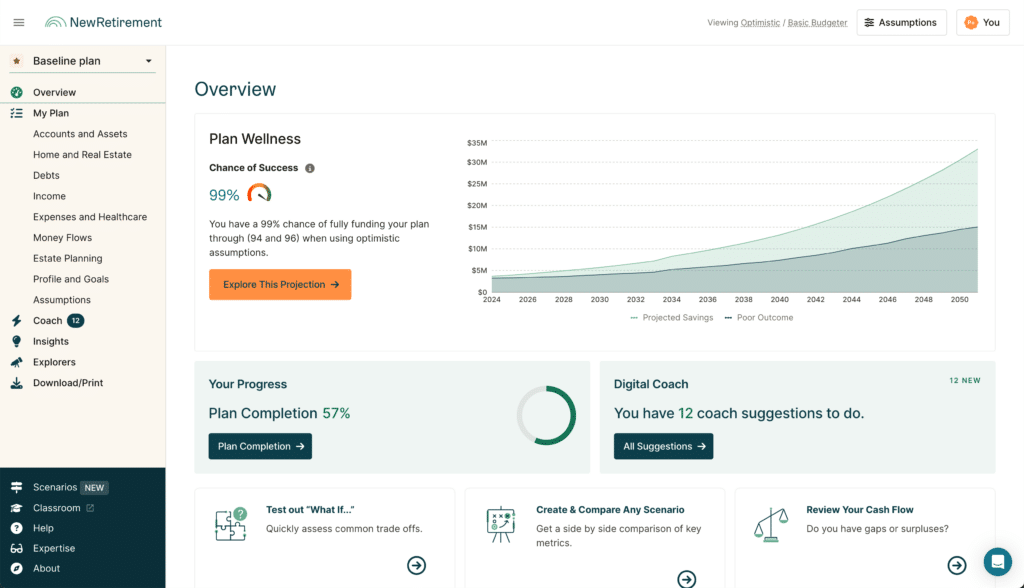
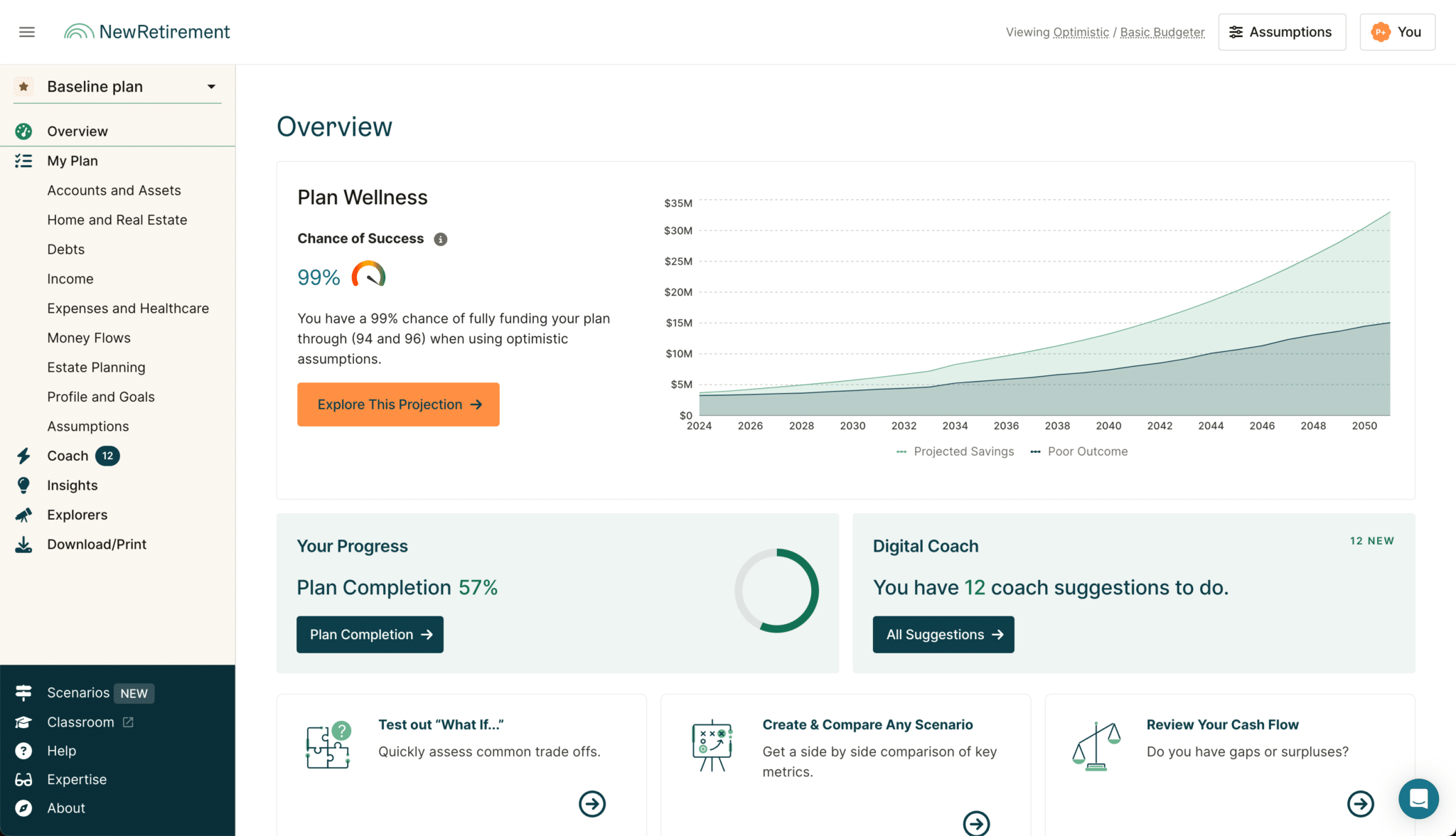
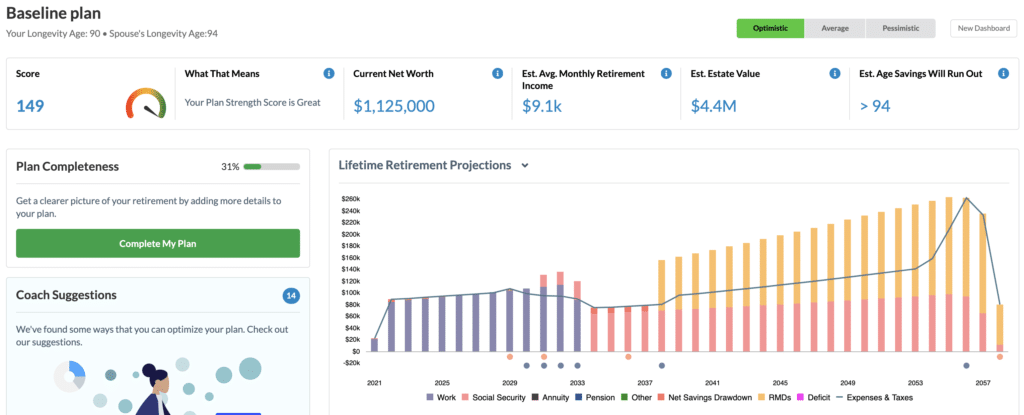
Boldin has established itself as the gold standard for users who require granular control over their financial data. It is the tool I personally rely on to model my own family’s retirement.
Functionality and Scope
Boldin is not merely a calculator; it is a comprehensive modeling engine. It allows users to project future income, expenses, and net worth with surgical precision. Whether you are trying to calculate the long-term impact of a Roth IRA conversion, planning the optimal age to claim Social Security, or budgeting for future healthcare costs, Boldin handles it with ease.
The User Experience
For those intimidated by complexity, Boldin offers a "Quick Start" guide that generates a snapshot of your retirement readiness in under five minutes. For the power user, the interface allows for deep dives into monthly, yearly, or one-off financial events. The ability to link your investment accounts directly, or manually input complex assets like pensions and annuities, makes it an exceptionally robust platform.
- Pros: Combines professional-grade depth with a user-friendly dashboard; excellent for tax planning and Roth conversions.
- Cons: The sheer number of options can be overwhelming for beginners; no native historical data simulation.
- Cost: Offers a free version; PlannerPlus is $144/year (billed annually).
2. ProjectionLab
Best-in-Class Visualization and "What-If" Scenarios
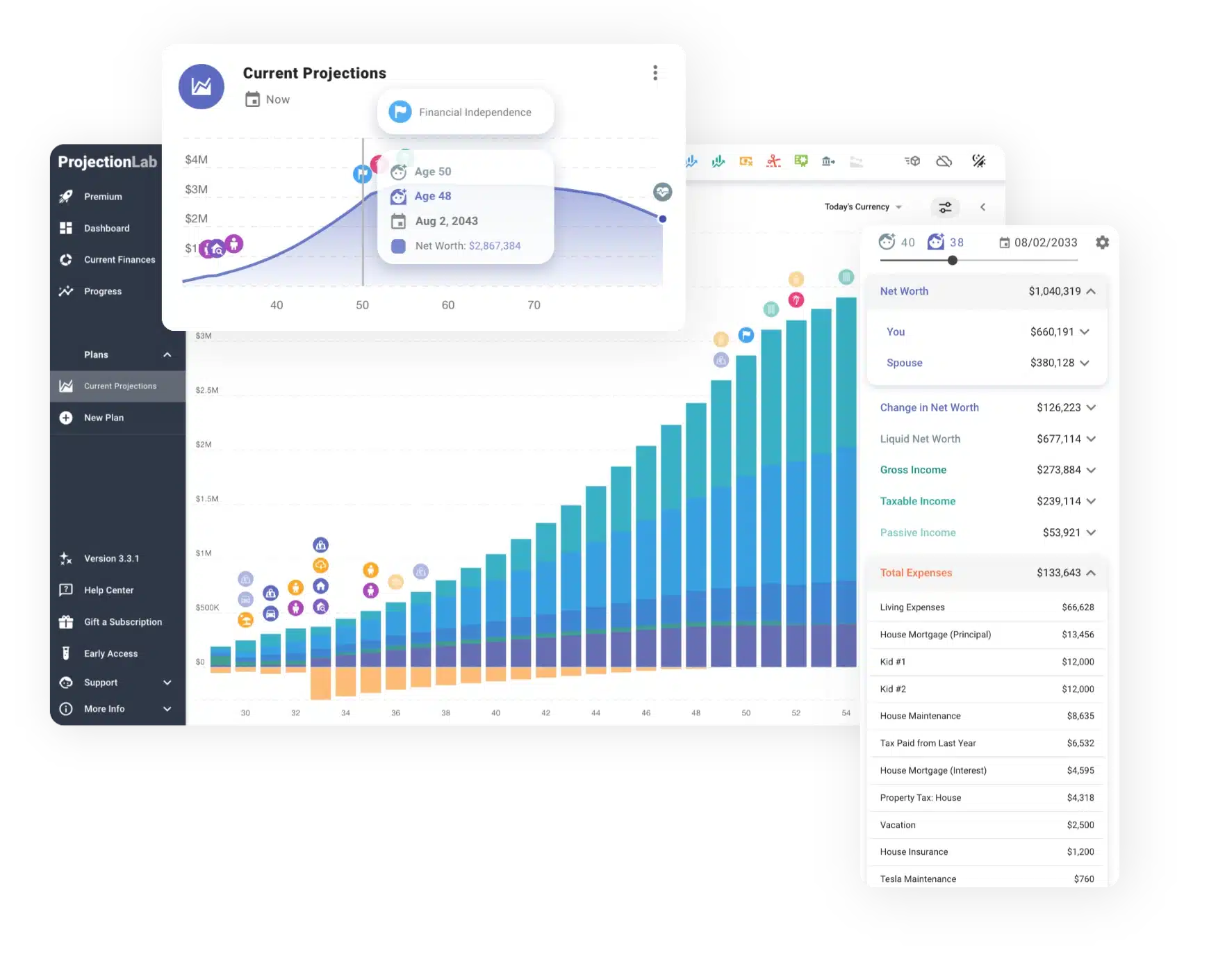
Since its inception, ProjectionLab has stood out for its exceptional user interface and its ability to turn complex financial data into intuitive, actionable visuals.
Advanced Modeling Capabilities
ProjectionLab shines in its tax analysis and scenario planning. Its "What-If" engine is arguably the best in the industry, allowing users to toggle different variables—such as retiring two years early, downsizing a home, or changing asset allocations—to see the immediate ripple effect on their success probability.
Key Features
While it excels at standard retirement planning, ProjectionLab also offers unique withdrawal strategies, including the Guyton-Klinger method and Variable Percentage Withdrawal (VPW). These strategies are vital for retirees who want to be more dynamic with their spending rather than relying solely on the rigid "4% Rule."
- Pros: Superior UI/UX, excellent Monte Carlo and historical simulations, and highly responsive to user feedback.
- Cons: Currently lacks dedicated tools for complex Social Security or specific Roth conversion simulations.
- Cost: Free version available; Premium is $129/year.
3. Empower
The Best Free Retirement Calculator
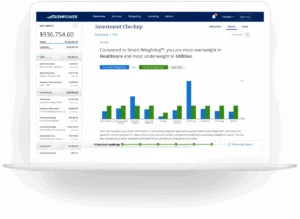
For those who want a powerful tool without a subscription fee, Empower (formerly Personal Capital) remains the undisputed leader. Its integration with your existing financial accounts provides an unparalleled view of your real-time net worth.
Seamless Data Integration
Empower excels at pulling data directly from your 401(k)s, IRAs, and brokerage accounts. Once your accounts are linked, the Retirement Planner automatically populates your current assets, providing an instant baseline for your projections.
Strategic Flexibility
The platform allows users to create multiple "scenarios." You can compare, for example, a "base case" scenario against a "what if I retire at 60 instead of 65" scenario. The software runs a Monte Carlo simulation on each, assigning a percentage of success to your plan. It is a powerful way to visualize risk without spending a cent.
- Pros: Completely free; automated data syncing; user-friendly interface.
- Cons: Less granular control over tax modeling compared to paid competitors.
- Cost: Free.
4. MaxiFi
The Economist’s Choice: Consumption Smoothing
MaxiFi takes a fundamentally different approach to retirement planning. Developed by economists, it is built on the theory of "consumption smoothing"—the idea that an individual’s goal should be to maintain the same level of spending (adjusted for inflation) throughout their entire life.
Methodological Differences
While most calculators ask, "How much can I spend based on my savings?", MaxiFi asks, "How much can I spend to maintain my current lifestyle given my total lifetime resources?" It is a sophisticated, albeit more rigid, framework. It is less concerned with "success probability" and more concerned with "living standards."
Complexity and Usage
MaxiFi is the most intellectually rigorous tool on this list. It requires a significant time investment to set up, often taking 10 to 15 minutes to run a single complex scenario. For users who value academic-grade financial modeling over simple "success/fail" dashboards, this is the premier choice.
- Pros: Deep, academically sound methodology; excellent for tax-efficient planning.
- Cons: Steep learning curve; the "consumption smoothing" approach can feel restrictive to some users.
- Cost: Paid tiers available.
Implications: Building Your Financial Action Plan
The existence of these diverse tools underscores a vital truth: there is no "correct" answer to retirement planning, only a range of probabilities. Because each calculator uses different assumptions regarding market returns, tax laws, and life expectancy, relying on a single source is a recipe for potential error.
Recommendations for Implementation:
- Triangulate Your Data: Input your numbers into at least two different tools—for example, use Empower for a high-level view and Boldin for a deep-dive analysis. If both tools point to the same outcome, your confidence in that plan should be high.
- Run Sensitivity Tests: Always test for the "worst-case scenario." What happens to your plan if the market stays flat for a decade? What if your healthcare costs are 20% higher than expected? A good tool will allow you to adjust these variables.
- Update Annually: Retirement planning is not a "set it and forget it" task. As tax laws change, your salary fluctuates, or your family needs evolve, your model must be updated. I recommend revisiting your plan at least once a year, ideally when you are preparing your tax returns.
Final Thoughts
Retirement planning is not just about the numbers; it is about the peace of mind that comes from knowing you have considered all the variables. Whether you choose the automated, free convenience of Empower, the analytical rigor of MaxiFi, the visualization strengths of ProjectionLab, or the total control offered by Boldin, the most important step is simply to start. By leveraging these tools, you move from guessing your financial future to actively designing it.