Decoding the Quant: Can Trend-Following and Momentum Strategies Actually Work for Everyday Retail Investors?
Main Facts: The Eternal Debate Between Indexing and Momentum
For decades, the dominant religion of the everyday retail investor has been passive indexing. Rooted deeply in the Efficient Market Hypothesis (EMH)—the financial theory positing that asset prices fully reflect all available information—generations of savers have built their wealth on low-cost index funds. Vanguard disciples and disciples of John Bogle swear by the gospel of broad market diversification: buy the whole haystack, keep costs low, and let time do the heavy lifting.
Yet, beneath the surface of passive buy-and-hold investing, an intriguing question continually haunts the spreadsheet-driven purist: Are there systematic strategies like trend-following and momentum that actually work for the average retail investor, or are they merely mathematical alchemy designed to pad the fees of elite Wall Street hedge funds?
To answer this, one must move past dogma. While passive indexers champion the efficient market, a mountain of rigorous academic literature and historical data suggests that certain systematic anomalies—specifically, trend-following and momentum—are not just statistical flukes. They are persistent market behaviors driven fundamentally by human psychology.
For investors willing to look past standard market-cap-weighted indexes, these strategies offer compelling empirical evidence of success across centuries, asset classes, and global geographies. But do they belong in a retail portfolio, or are they a square peg trying to fit into a round index-fund hole?
Chronology: The Evolution of Trend and Momentum Research
To understand how trend-following and momentum transitioned from secretive hedge fund tools to widely researched academic strategies, we can trace a chronological path through some of the most influential papers in modern financial history.
1. The 1993 Breakthrough: Jegadeesh and Titman
The modern study of momentum began in earnest with Narasimhan Jegadeesh and Sheridan Titman’s landmark 1993 paper, Returns to Buying Winners and Selling Losers, published in the Journal of Finance. This research put momentum firmly on the academic map. Jegadeesh and Titman demonstrated a counterintuitive reality: stocks that performed exceptionally well over a trailing 3-to-12-month period tended to continue outperforming over the subsequent 3-to-12 months. Conversely, past losers kept losing. While this defied the strict bounds of the Efficient Market Hypothesis, it laid the groundwork for understanding investor herding behavior.
2. Going Global: Rouwenhorst (1998)
Five years later, K. Geert Rouwenhorst published International Momentum Strategies, testing whether momentum was merely a U.S. market anomaly or a global phenomenon. By examining a dozen European stock markets, Rouwenhorst proved that the momentum factor was robust internationally, validating its presence across diverse economic landscapes.
3. The Quantitative Tactical Pivot: Meb Faber (2007)
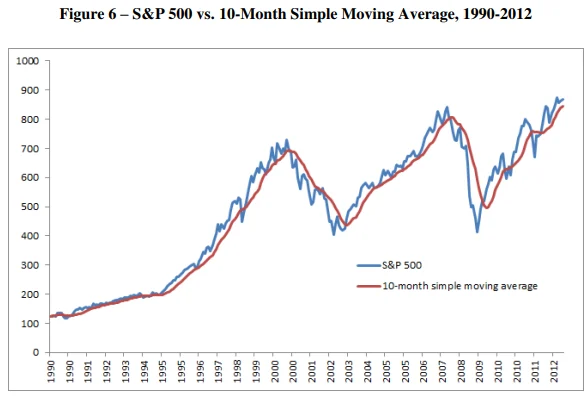
As retail investors began exploring quantitative tactics, Meb Faber published A Quantitative Approach to Tactical Asset Allocation in the spring of 2007—precisely five months before the peak of the market preceding the Great Financial Crisis (GFC). Faber’s research tested a deceptively simple rule: stay invested in an asset when its price sits above its 10-month moving average, and shift entirely to cash when it drops below. The timing of this paper provided an immediate, real-world stress test for trend-following during one of the worst economic downturns in modern history.
4. A Century of Evidence: AQR Capital Management
Looking backward to look forward, AQR published A Century of Evidence on Trend-Following Investing, utilizing historical data spanning all the way back to 1880 across stocks, bonds, commodities, and currencies. By analyzing more than 100 years of data, the researchers sought to prove that trend-following is not a recent byproduct of computer-driven algorithmic trading, but an enduring feature of global financial markets.
5. The Ultimate Validation: Fama and French (2006)
Perhaps the most reluctant acknowledgment of momentum came from Eugene Fama and Kenneth French—the literal godfathers of the Efficient Market Hypothesis. In their 2006 paper Dissecting Anomalies, the duo stress-tested various factor strategies across firms of all sizes. They formally conceded that "the premier anomaly is momentum," noting that it successfully satisfies the criteria of being present across all size groups with systematically varying returns.
Supporting Data: What the Numbers Tell Us
For the analytical investor, empirical backing is non-negotiable. The data supporting trend-following and momentum falls into two distinct categories: macro trend signals and relative momentum rankings.
Trend-Following: The Power of Moving Averages
Trend-following evaluates the absolute direction of an asset relative to its own historical price action. If the trend is up, you stay invested; if the trend turns down, you move to safety.
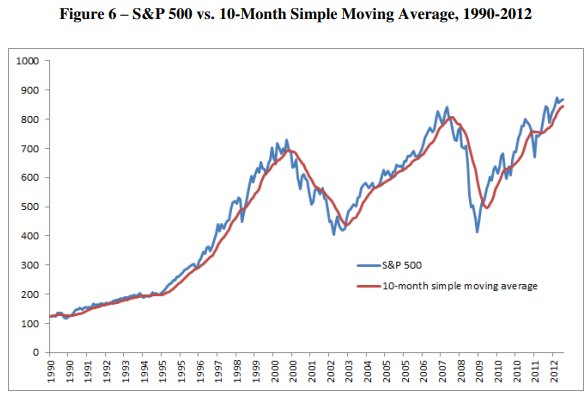
In Meb Faber’s historical backtests—extended across stocks, bonds, real estate, and commodities since the early 1900s—tactical trend strategies delivered annualized returns comparable to a standard buy-and-hold approach, but with a monumental difference: dramatic reductions in maximum drawdowns.
Similarly, quantitative researcher Wes Gray, in his paper Avoiding the Big Drawdowns with Trend-Following Strategies, tested a blend of a 12-month absolute momentum rule and a moving average rule across U.S. and foreign equities, REITs, bonds, and commodities. The data revealed that blending these signals maintained comparable long-term returns while significantly compressing volatility and softening the blow of severe bear markets.
Relative Momentum: The 3-to-12 Month Sweet Spot
Momentum, by contrast, is a relative metric. Investors rank a basket of assets based on their trailing performance over a 3-to-12-month lookback window, purchasing the top performers under the assumption that strong recent performance persists in the near term.
While individual stocks can experience sudden, violent mean-reversion, a diversified basket of momentum-driven equities has repeatedly proven its efficacy over long investment horizons. As Fama and French noted, momentum is unique among market anomalies because its return profile scales reliably from the lowest-performing deciles to the highest-performing deciles across firms of all market capitalizations.
Behavioral Implications: Why Do These Strategies Work?
If markets are theoretically efficient, why do trend-following and momentum persist? The answer lies not in math, but in psychology.
Wes Gray highlights the concept of dynamic risk aversion. Human beings do not operate as emotionless optimization machines. Instead, our risk tolerance is fluid, shifting dramatically based on our recent lived experiences.
- During a raging bull market, FOMO (fear of missing out) sets in, and retail investors chase rising prices—fueling the herding behavior that powers momentum.
- Conversely, during a brutal market crash, panic and loss aversion take over, leading investors to capitulate at the worst possible moment.
Trend-following systems serve as a behavioral release valve. By establishing a mechanical, rules-based boundary (such as a 10-month moving average), an investor removes discretionary decision-making from the equation. Even if a trend-following signal occasionally triggers a false positive or a whipsaw, having a systematic exit strategy can mean the difference between surviving a generational market crash and fleeing the market in absolute terror.
Official Perspectives and Portfolio Integration: Do You Need It?
Despite the robust data, a critical financial planning question remains: Just because a strategy works academically, does it belong in your personal portfolio?
The S&P 500 as an Accidental Momentum Strategy
Interestingly, passive indexers are already closer to momentum investors than they might care to admit. Market-cap-weighted indexes like the S&P 500 naturally let winning companies run while trimming or dropping declining companies. As mega-cap technology stocks ballooned in market cap over the past decade, the S&P 500 effectively functioned as the world’s largest momentum strategy disguised as passive beta.
The Case for Multi-Dimensional Diversification
For investors looking to build a truly bulletproof portfolio capable of withstanding shifting macroeconomic regimes—including prolonged inflationary cycles or stagflation—diversification must extend beyond simple geographic or asset-class boundaries. Incorporating trend-following or momentum overlays can introduce non-correlated return streams, protecting capital when traditional buy-and-hold portfolios experience prolonged stagnation.
Final Takeaway for Retail Investors
Ultimately, investing is intensely personal. Adding systematic trend-following or momentum strategies to a portfolio can feel like overkill to purists who prefer a pure, low-cost Boglehead approach.
The golden rule of asset allocation remains unchanged: Never invest in something you do not fundamentally understand or genuinely believe in. Whether you choose to stick strictly to low-cost index funds or utilize trend signals as an insurance policy against catastrophic drawdowns, the key is choosing a strategy you can stick with through thick and thin.