A Hard-Won Reprieve: North Texas Firefighters Battle the Historic Ross Fire Amid Changing Weather
By Staff Reporters
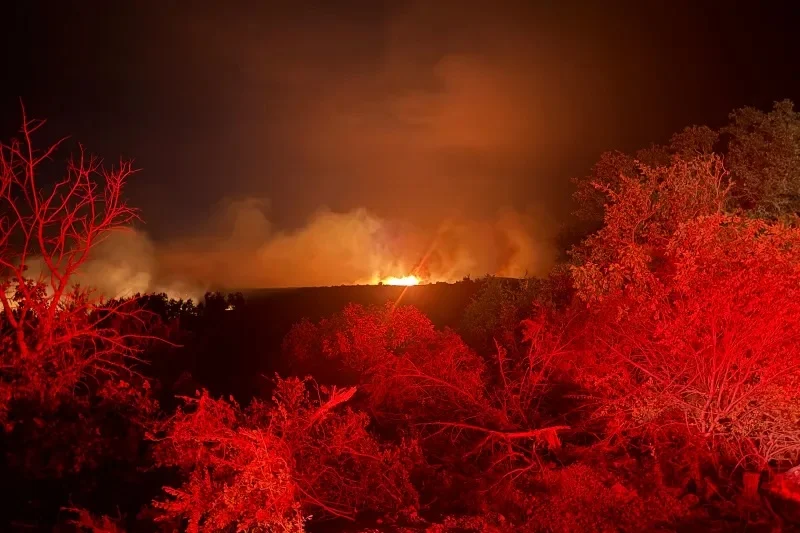
For two grueling weeks, the horizon in Palo Pinto and Jack counties has been defined by a terrifying, shifting wall of orange. The Ross Fire, now etched into the record books as one of the largest wildfires in North Texas history, has demanded a Herculean effort from state and local emergency responders. As of Thursday, however, the parched landscape received a vital, if fleeting, infusion of moisture.
Rain showers and scattered thunderstorms moved across the burn zone, offering a welcome—though tentative—reprieve to the exhausted crews who have been locked in a relentless struggle against the flames. While the precipitation was brief, its impact on the scorched earth could prove pivotal in accelerating containment efforts for the massive blaze, which has already consumed 90,400 acres.
The Current State of the Inferno
As of September 10, the Texas A&M Forest Service reported that the Ross Fire was approximately 76% contained. While this represents significant progress from the early days of the disaster, the situation remains highly volatile. The sheer scale of the fire—stretching across thousands of acres of rugged, inaccessible ranchland—means that the blaze is not a singular, uniform entity, but a collection of hotspots, smoldering debris, and pockets of unburned fuel.
"The fire is estimated at 90,000 acres, so there are going to be portions that may see rain, portions that may not see rain," noted Laura Stevens, a public information officer with the Texas A&M Forest Service. "It is an ongoing operation, very dynamic, very changing as the weather comes in."
Firefighters on the ground continue to face grueling conditions. In some areas, the heat remains so intense that direct manual suppression is impossible. To combat this, aerial support teams have been deployed, with helicopters conducting precise water drops on burning trees and logs. Despite these efforts, the "reburn potential"—the risk that embers from scorched timber could reignite—remains a primary concern for the Forest Service, particularly when coupled with strong, gusty southeasterly winds that can quickly turn a smoldering log into a new front.
A Chronology of a Catastrophe
The Ross Fire began on August 24, igniting in the dry, brittle ranchland near Palo Pinto. The conditions were primed for disaster: August had been the driest month on record for the Dallas-Fort Worth region, and the lack of rain, combined with extreme heat, turned the landscape into a tinderbox.
Within hours of ignition, the fire demonstrated what officials described as "extraordinary speed." By August 25, the fire had effectively doubled in size to 50,000 acres. The following day, as the blaze moved with terrifying momentum, estimates climbed past 80,000 acres.
For the remainder of August and early September, the fire dominated the North Texas landscape. The response was hampered by the terrain—steep, rocky, and often inaccessible to traditional fire trucks. Firefighters reported "extreme fire behavior," including crown fires where flames jumped from the tops of trees to others, fueled by high winds.
The tide began to turn slightly last week when the remnants of Tropical Storm Edouard moved through the region. The moisture and increased humidity associated with the storm helped crews raise the containment level from 38% to 57%, providing the first real glimmer of hope since the fire’s inception.
Supporting Data and Environmental Context
The historical significance of the Ross Fire is underscored by the environmental conditions of the region. The Dallas-Fort Worth area had gone more than 55 days without measurable rainfall, marking the seventh-longest dry spell on record. This drought, combined with record-breaking temperatures hovering near 100 degrees, created a high-stakes environment for wildfire development.
Currently, the Ross Fire ranks as the second-largest wildfire in the area’s history, surpassed only by the Possum Kingdom Complex Fire of April 2011, which razed 126,734 acres.
The human and infrastructure toll has been significant. Initial assessments by the Forest Service indicate that at least 157 structures have been destroyed, 18 of which were occupied homes. Among the losses is the historic Worth Ranch, an 800-acre Scouting America camp situated along the Brazos River. While the exact extent of the damage to the camp is still being assessed, the loss of such a landmark has been a poignant blow to the local community.
Regarding personnel safety, the intensity of the fight has taken a toll on the crews. Two firefighters have sustained injuries: one involving a minor hand injury during a traffic collision and another a minor eye injury treated on-site.
Official Responses and Strategic Priorities
The command structure responding to the Ross Fire is a complex coalition involving the Texas A&M Forest Service, local rural volunteer fire departments, and municipal departments from across the Dallas-Fort Worth metroplex.
Governor Greg Abbott has been a visible presence, emphasizing both state support and public safety. In a late-August announcement, Abbott confirmed that the Federal Emergency Management Agency (FEMA) had approved a Fire Management Assistance Grant (FMAG), which provides vital federal funding to help cover the costs of emergency protective measures and firefighting efforts.
During a press conference on September 3, Texas Division of Emergency Management Chief Nim Kidd projected that it could take up to two more weeks to fully extinguish the fire. Meanwhile, Governor Abbott has urged residents to prioritize their safety over their possessions.
"To all families out there affected or maybe not yet affected, our core message remains: protect your life," Abbott stated. "Don’t drive into the fire. Don’t drive near it. I know you may be wanting to get back to your home right now, but that could be very dangerous."
While evacuation orders for Palo Pinto and Jack counties have been lifted, officials remain cautious. Residents are advised to keep "go-bags" ready and to stay informed through local emergency channels, as changing wind conditions could necessitate immediate action.
Implications: A New Normal for North Texas
The origin of the Ross Fire has been traced by investigators to a road, likely sparked by a vehicle or equipment. While the specific source remains unidentified, the event serves as a stark reminder of how quickly human activity can trigger a catastrophe in drought-stricken conditions.
Beyond the immediate crisis, the Ross Fire has exposed the vulnerabilities of the North Texas landscape. With nearly 85 active fires recently reported across the state, the region is grappling with the reality that wildfires are no longer just a concern for the arid West. The smoke from the Ross Fire, which blanketed parts of the metroplex in a hazy, orange hue, served as a tangible reminder to urban residents of the devastation occurring in their own backyard.
Environmental regulators have warned that the air quality impacts, while transient, pose risks to children, the elderly, and individuals with respiratory conditions. Residents in affected areas were advised to stay indoors until the smoke dissipated.
As the state moves forward, the focus remains on stabilization. With the National Weather Service predicting scattered storms through the weekend, there is cautious optimism that the weather will continue to aid in the containment effort. However, the legacy of the Ross Fire will be felt for years to come—in the burned ranchlands, the destroyed homes, and the ongoing dialogue about fire preparedness in a warming, drying climate.
For now, the thousands of acres of charred landscape serve as a somber monument to the battle, a reminder of the fragility of the North Texas ecosystem, and a testament to the bravery of those who stood between the fire and the people it threatened.