Reconciling Market Parables: The Unseen Link Between "Worst Timers" and "Best Days"
Posted: July 16, 2026, by Ben Carlson
A fundamental tension in investment wisdom often leaves even seasoned observers pondering: How can the seemingly disastrous strategy of "Bob, the World’s Worst Market Timer" yield success, while the simple act of "missing the ten best days" in the market can utterly devastate returns? This intriguing paradox, recently brought to the forefront by a perceptive reader’s inquiry to financial expert Ben Carlson, delves deep into the mechanics of market volatility, human psychology, and the undeniable power of long-term commitment.
The reader’s question, posed to Carlson of A Wealth of Common Sense, highlighted the apparent contradiction: Bob, a hypothetical investor who consistently buys at market peaks, somehow emerges victorious due to compounding and an unwavering refusal to sell. Yet, the widely cited statistic, often championed by figures like Tom Lee, warns that even a slight absence from the market during its most opportune moments can wipe out decades of growth. The core of the dilemma is whether Bob’s unlikely triumph is entirely predicated on his accidental capture of these crucial "best days," which frequently erupt amidst the very crashes he bought into. The implications for an investor who succumbs to panic and misses these bounce-back periods are profound, warranting a closer examination of these two cornerstone investment parables.
Main Facts: The Duality of Market Experience
At the heart of modern investment discourse lie two powerful, yet seemingly conflicting, narratives that shape investor behavior and expectations. On one side, we have the reassuring tale of "Bob, the World’s Worst Market Timer." This parable, popularized by Ben Carlson, illustrates the extraordinary resilience of a disciplined, long-term investment approach, even when plagued by consistently terrible entry points. Bob invests a fixed sum annually, but with an uncanny ability to always choose the absolute peak of the market cycle. Despite this perpetually poor timing, his unwavering commitment to staying invested and allowing compounding to work its magic ultimately leads to significant wealth accumulation over decades. The story is a powerful testament to the adage "time in the market beats timing the market" and underscores the importance of never selling, regardless of short-term volatility.
Conversely, the financial world is frequently reminded of the devastating impact of "missing the best days in the market." This stark statistic, often attributed to analysis by firms like J.P. Morgan and frequently cited by market strategists, demonstrates that a mere handful of exceptionally strong trading days can account for a disproportionately large share of the market’s total returns over a decade or more. The implication is clear: attempting to time the market by stepping out during perceived downturns carries an enormous risk of missing these critical rebound days, thereby severely compromising or even obliterating long-term portfolio growth. This concept serves as a potent deterrent against emotional selling and encourages a "buy and hold" strategy.
The reader’s insightful query to Ben Carlson sought to reconcile these two seemingly disparate truths. If Bob’s success relies on never selling, does that inherently mean he benefits from capturing those crucial "best days" that often follow market troughs? And, what would be the true cost for a "Panic Bob"—an investor who, like the original Bob, buys at peaks but then capitulates and sells during the subsequent downturns, thereby missing the inevitable market recovery? Understanding the intersection of these two concepts is paramount for any investor seeking to navigate the unpredictable currents of financial markets with a clear strategy.
Chronology: Tracing the Origins of Investment Principles
The intellectual journey to understand this paradox begins with the separate development and popularization of each concept.
The Genesis of "Bob, the World’s Worst Market Timer"
Ben Carlson’s "Bob" narrative emerged from a desire to vividly illustrate the sheer power of long-term investing and dollar-cost averaging, even under the most disadvantageous circumstances. First published around 2020, the story meticulously tracks Bob’s investment journey, showing how consistent investment, irrespective of market levels, coupled with the magic of compounding, ultimately triumphs over poor timing. Carlson’s work often emphasizes behavioral finance, and Bob’s story is a prime example of how discipline and patience can overcome even fundamental investment errors. The enduring appeal of Bob’s story lies in its counter-intuitive conclusion: that one can be "wrong" about market timing every single time and still end up "right" in terms of wealth accumulation, provided they stay the course. The underlying principle is that equities, over sufficiently long periods, have an upward bias, and even significant drawdowns are eventually overcome.
The Prominence of "Missing the Best Days"
The statistic regarding the impact of missing the market’s best days has been a staple of investment education for decades, gaining particular prominence in the materials produced by major financial institutions like J.P. Morgan Asset Management. Their annual "Guide to the Markets" often features compelling charts illustrating this phenomenon, emphasizing the perils of market timing. The data typically spans several decades, meticulously calculating the difference in returns between an investor who remains fully invested and one who misses a specified number of the market’s top-performing days.
This principle is rooted in the inherent lumpiness of market returns. Significant gains often don’t occur in a smooth, predictable fashion but rather in sharp, concentrated bursts. These bursts are frequently observed during periods of high volatility, particularly following steep declines, as markets attempt to price in new information or rebound from oversold conditions. The statistic serves as a powerful argument against trying to "sit out" a downturn, as the subsequent recovery days are notoriously difficult to predict and, if missed, can severely hamper an investor’s overall portfolio performance. Strategists like Tom Lee frequently highlight this data to advocate for steadfast, long-term market participation.
The Reader’s Intellectual Challenge
The reader’s question represents a critical juncture where these two powerful narratives collide. It challenges the passive success of Bob by asking if his victory is merely an accidental byproduct of another well-known market truth. By forcing a contemplation of a "Panic Bob" scenario, the reader compels a deeper analysis into the precise mechanisms that allow long-term investing to succeed, especially during turbulent times. It asks: Is sheer time in the market sufficient, or is it specifically the unintentional capture of rebound days that truly underpins success when starting from a position of consistent poor timing? This intellectual challenge is crucial for understanding the nuances of market resilience and investor behavior.
Supporting Data: The Volatility Nexus
To truly understand how Bob’s success intertwines with the danger of missing the best days, we must delve into the data that illuminates market behavior, particularly during periods of heightened volatility. Ben Carlson’s response points directly to the critical observation that the best and worst days in the market are not randomly distributed but tend to cluster together.
The Compelling Evidence from J.P. Morgan
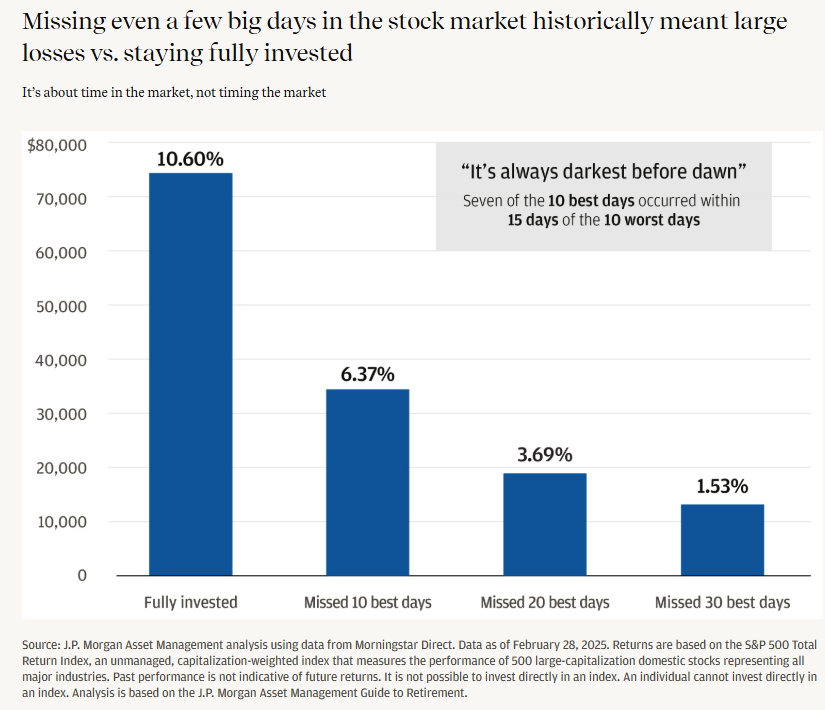
J.P. Morgan’s analysis provides stark figures on the cost of market timing. Their data, which often covers decades of S&P 500 performance, consistently shows:
- Missing just the best 10 days over a given period (e.g., 20 years) can reduce an investor’s annualized return by as much as 40%. For an investor expecting, say, an 8% annual return, this could mean realizing only 4.8% – a massive hit to long-term wealth accumulation.
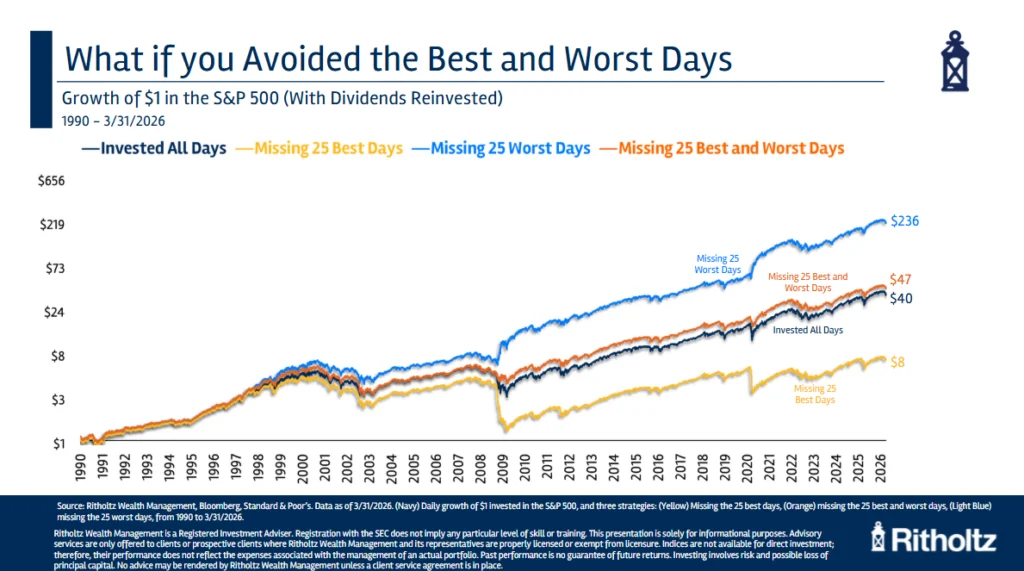
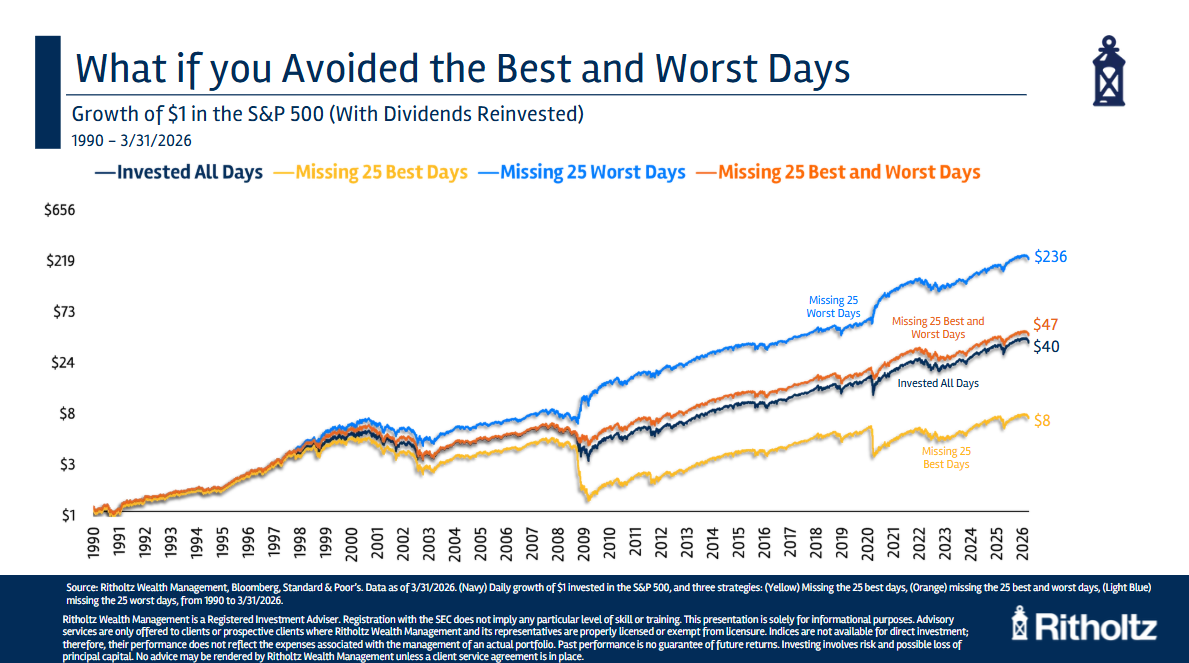
- The impact escalates dramatically. Missing the best 20 or 30 days can reduce returns to a mere fraction of the fully invested average, sometimes even turning positive returns into negative ones. For instance, if a fully invested portfolio grew $1 to $40 since 1990, missing just the 25 best days would have seen that $1 grow to a paltry $8.
This data powerfully illustrates why passive, long-term investing is so often advocated. The market’s most significant upward movements are often unpredictable and concentrated, making attempts to duck out of volatility a high-stakes gamble.
The Clustering Phenomenon: Exhibit A’s Insight
The key to reconciling Bob’s success with the "missing best days" warning lies in the phenomenon of return clustering. A chart from Exhibit A, referenced by Carlson, visually demonstrates that the market’s most extreme positive and negative trading days are not evenly spread but rather concentrated during periods of intense market stress.
Examining historical data since 1990, these clusters are strikingly evident around major market dislocations:
- The Dot-com Bust (early 2000s): Characterized by rapid boom and bust in tech stocks, leading to extreme daily swings.
- The 2008 Global Financial Crisis (GFC): A period of unprecedented financial instability, marked by massive daily losses followed by equally dramatic relief rallies.
- The COVID-19 Crash (2020): A swift, severe, and short-lived downturn triggered by the pandemic, followed by a remarkably quick rebound, both punctuated by extreme daily volatility.
- The 2022 Inflation Bear Market: A period of sustained downward pressure due to rising inflation and interest rates, interspersed with significant daily bounces.
In all these instances, days of precipitous declines were often immediately followed by days of strong rebounds, and vice-versa. This "volatility begets volatility" dynamic is crucial.
Why Do Best and Worst Days Cluster?
Several interconnected factors contribute to this clustering:
- Volatility Begets Volatility: When markets become uncertain, investor emotions amplify. Significant losses trigger fear and panic, leading to more erratic trading behavior. This heightened emotional state means that any piece of news, whether good or bad, can trigger an outsized market reaction, perpetuating a cycle of large up and down swings.
- Panic Works in Both Directions: Market movements are driven by both emotional and structural factors.
- Selling Cascades: Initial downturns can be exacerbated by forced selling (e.g., margin calls), profit-taking, and widespread fear, leading to rapid declines.
- Rebound Mechanisms: Conversely, deep declines can trigger short covering (investors buying back borrowed shares to close short positions), bargain hunting by long-term investors, and relief rallies often fueled by policy responses (e.g., central bank interventions, government stimulus) or simply a reversion to the mean from oversold conditions. This creates powerful upward spikes.
- Herding is Heightened: As French psychologist Gustave Le Bon observed in The Crowd: A Study of the Popular Mind (1895), individuals in a crowd exhibit a "collective mind," acting differently than they would in isolation. During market crises, the desire to follow the crowd—either to sell when everyone else is selling or to buy when a rebound seems to be starting—becomes incredibly strong. This herd mentality amplifies both downward and upward movements, compressing extreme returns into short periods. It feels safer to participate in collective action, even if irrational, than to stand alone.
This clustering phenomenon is precisely why market timing is so notoriously difficult, especially in turbulent environments. An investor attempting to "wait out" a downturn is highly likely to miss the very rebound days that are most critical for long-term returns, as these often occur before the market has fully recovered or stabilized.
The Catastrophe of "Panic Bob"
Now, consider the reader’s hypothetical "Panic Bob"—an investor who, like the original Bob, consistently buys at market peaks but then succumbs to fear, panic-sells at the bottom of the subsequent crashes, and misses those critical bounce-back days. The math for Panic Bob would be catastrophic.
If the original Bob’s success stemmed from simply staying invested through all market conditions, including the worst and best days, Panic Bob would systematically excise the most potent drivers of long-term growth. By selling at the trough, Panic Bob locks in losses. By missing the subsequent "best days" (which, as we’ve established, often occur immediately after the worst days), Panic Bob forfeits the very gains that would have begun to repair his portfolio and set it on a path to recovery.
Using the J.P. Morgan data as a proxy: if missing just the 25 best days turns a $40 gain into an $8 gain over decades, a Panic Bob who repeatedly sells at lows and misses these rebounds would likely see his capital significantly eroded, potentially never recovering his initial investments. His portfolio would not only suffer from terrible entry points but also from missing the crucial recovery periods that are essential for long-term compounding. This scenario would validate the "missing the best days" statistic in its most brutal form, demonstrating that selling out of fear is often a double-edged sword: you crystallize losses and prevent future gains.
Official Responses: Carlson’s Analysis and The Compound’s Insights
Ben Carlson’s direct response to the reader’s insightful question unequivocally clarifies the relationship between these two market truisms.
Carlson’s Core Argument: Time Horizon is King
Carlson states plainly: "No, Bob’s only saving grace was a long time horizon." This is the crux of his argument. The "magic" in Bob’s seemingly terrible market timing strategy isn’t about some hidden ability to selectively capture the best days while avoiding the worst. Instead, it’s the inherent nature of a long-term investment horizon that forces an investor to endure all market conditions.
Because Bob never sells, he is, by definition, invested through both the most brutal downturns (often immediately after his ill-timed purchases) and the subsequent powerful rebounds. The clustering of best and worst days means that by staying invested through the bad, Bob automatically positions himself to capture the good. He doesn’t choose to capture the best days; his passive, unwavering commitment guarantees his presence during them.
Carlson emphasizes that the best and worst days typically occur after the peaks—the very points where Bob makes his investments. This means Bob is directly exposed to the market’s initial descent and its subsequent, often volatile, recovery. His success isn’t about astute timing, but about avoiding the fatal flaw of emotional capitulation.
The Role of Behavioral Economics
Carlson implicitly touches upon the behavioral aspects that make market timing so challenging. The natural human inclination during a downturn is to panic, to sell, and to "cut losses." This is exacerbated by the herding instinct described by Le Bon, where individuals feel safer acting collectively. However, it is precisely this emotional response—selling during peak fear—that causes investors to miss the critical rebound days.
Bob, by simply not selling, circumvents this behavioral trap. His strategy, though appearing irrational at the outset due to poor timing, proves superior because it negates the most damaging human impulse in investing: emotional reaction to volatility.
Insights from "Ask the Compound"
Carlson further elaborated on this topic in an episode of "Ask the Compound," a platform where he and his colleagues discuss various financial questions. The discussion, featuring Taylor Hollis, likely delved into practical implications beyond just this specific paradox. While not detailed in the provided text, such discussions typically reinforce themes of:
- Estate Planning and Financial Success: Highlighting how long-term thinking, similar to Bob’s strategy, is crucial for generational wealth building.
- Debt Management: Emphasizing disciplined approaches to financial health, mirroring the discipline required for Bob’s success.
- Advisors and Financial Education: Reinforcing the value of professional guidance and continuous learning to avoid common behavioral pitfalls.
The overarching message from Carlson and his team remains consistent: while market mechanics can be complex, successful investing often boils down to simple, disciplined, and long-term adherence to a well-defined strategy, rather than attempting to outsmart the market’s unpredictable short-term movements.
Implications: A Unified Theory of Long-Term Investing
The reconciliation of "Bob, the World’s Worst Market Timer" and the "missing the best days" statistic offers profound implications for investment philosophy and practical advice. It reveals a unified theory of long-term investing that underscores discipline, patience, and the futility of emotional market timing.
The Primacy of Time in the Market
The most significant implication is the reinforcement of the adage that time in the market unequivocally beats timing the market. Bob’s story, far from being a whimsical anecdote, becomes a powerful empirical demonstration of this truth. His consistent, albeit poorly timed, investments coupled with an ironclad resolve to never sell, prove that even initial disadvantage can be overcome by the twin forces of compounding and sustained market participation. This directly addresses the reader’s question: Bob’s ultimate success is because his strategy inherently forces him to be present for the critical rebound days that follow downturns. He doesn’t accidentally capture them; his steadfastness ensures he does.
The Peril of Market Timing
Conversely, the catastrophic hypothetical outcome for "Panic Bob" serves as a potent warning against attempting to time the market. The data on missing the best days is not merely an interesting statistic; it’s a stark illustration of the financial damage caused by emotional selling and subsequent re-entry attempts. Since the best and worst days cluster, exiting the market during a downturn (often driven by fear) carries an extremely high probability of missing the very recovery that makes long-term investing profitable. This reinforces the idea that an investor needs to be wrong only a few times in market timing to significantly impair their returns, potentially for decades.
Behavioral Finance at Play
This discussion highlights the critical role of behavioral finance in investment success. Human emotions—fear, greed, herd mentality, loss aversion—are powerful forces that often lead investors astray. The "Panic Bob" scenario is a perfect storm of these cognitive biases, where the desire to avoid further pain (loss aversion) leads to a decision that ultimately inflicts greater long-term damage. The "original Bob," by contrast, embodies emotional discipline, demonstrating that overcoming these innate human tendencies is paramount for achieving financial goals.
Practical Advice for Investors
- Embrace Long-Term Commitment: Understand that market volatility is a feature, not a bug. Adopt a mindset that prioritizes decades over months or years.
- Automate and Diversify: Implement a consistent investment plan (e.g., dollar-cost averaging) that removes emotion from the decision-making process. Diversify across asset classes to mitigate risk, knowing that different parts of the market will perform well at different times.
- Resist Emotional Decisions: Develop strategies to manage emotional responses to market fluctuations. This could include having a written investment plan, avoiding constant monitoring of your portfolio, or seeking advice from a trusted financial professional.
- Understand Your Risk Tolerance: A clear understanding of your comfort level with risk will help you build a portfolio that you can stick with during both bull and bear markets, preventing panic selling.
- Focus on What You Can Control: Rather than attempting the impossible task of market timing, concentrate on factors within your control: saving rate, asset allocation, diversification, and minimizing fees and taxes.
In conclusion, the intertwining lessons from "Bob, the World’s Worst Market Timer" and the "missing the best days" statistic converge on a singular, powerful truth: enduring investment success in volatile markets is not achieved through perfect foresight or clever timing. It is forged through unwavering discipline, a commitment to staying invested over the long haul, and the quiet resilience to weather the inevitable storms, thereby ensuring presence for the equally inevitable, and often critical, periods of recovery. For the astute investor, this synthesis offers a robust framework for navigating the complexities of the financial world with confidence and clarity.